
Leap Year babies are defined by their birthdays in a way that trumps even astrology. There is a family in Utah who have three leap year Feb 29th-born children. They do have 7 kids in all and the second was induced, so I tend to think they might have worked out how to avoid it if that had wanted to. The French for Leap Year is bissextile which has nothing to do with gender, it is all due to the Romans. They referred to February 23 as the 6th day before the beginning of March, and the extra day inserted on February 24 was called the “second sixth” day, or “bissextile day” in a “bissextile year”. It does not roll off the tongue like Leap Year so we can be forgiven for having forgotten about its origins.
In France, they publish a newspaper every 4 years on the 29th called ‘La Bougie du Sapeur’, it’s a satirical broadsheet that has been published since 1980, so this year was edition 12. I tried to buy one on the 29th, but our local newspaper stand was closed because it was school holidays and ski-week. If you want an illustration of how serious the French take their vacations there it is, the newspaper stand closes, so the guy can have his holiday too.

Who does not get the 29th off is St Auguste. Yes, ‘le jour bissextile’ has a saint and like every other day is a Saint’s Day, so even if you are fated to be born on the 29th you still have your own patron saint; who says the Catholic Church is uncaring for its flock? St Auguste was a priest who was part of the mission to China in the 19th Century who suffered a horrible death in Guangxi province on February 29th, 1856. “He was locked into a small iron cage, which was hung at the gate of the jail. The planks he stood on were gradually removed, placing a strain in the muscles of the neck, and leading to a slow and painful death from suffocation. He had already died when he was decapitated. His head was hung from a tree by his hair. Children were said to have thrown stones at the head until Chapdelaine’s head fell to the ground and was devoured by street dogs and hogs.” The French responded by joining the British in what is unflatteringly called the Second Opium War, as in we and the French, with help from the US, went to war on China to force the Emperor and his government to let us sell opium to the people of China. We used real gun boats in our diplomacy and were successful in our aims, we also took Kowloon and added it to our Hong Kong territories and also insisted upon the legal right to proselytize Christianity, negotiated in the name of Auguste Chapeldain, who had been ‘martyred’ in doing just that. China today looks back on this period with great disdain if not shame, and Xi often mentions the Western efforts to get involved between them and Taiwan as being similarly colonial.
In Guangxi today you can enjoy a life-size diorama showing Saint Auguste kneeling before the magistrate who sentenced him to death. A six-metre bronze mural shows the cage in which he suffocated to death. A poetry contest gives prize money to those who praise “iron-willed” magistrate Zhang. So definitely not a popular figure in China is our Saint Auguste.
Lyon is back to normal today, the kids are in school and Reymond the baker is back in action. While he was off skiing, we were unfaithful in our bread breaking and went to Mado on Rue de la Thibuadiere. Mado made it into the latest edition of the foodie bible, the annual magazine “Fooding”. They do a fabulous Panettone at Christmas and their breads are hearty grained, organic beauties. However, it is their baked goods that have an opium-like hold on our taste buds. Their current offerings include a small brioche stuffed with apple sauce, a pastry-like crusted cake with preserved plums that is probably Italian in origin too called a Pasticcioto, scones, the most glorious lemon flavored brioche bun that has an almost hot-cross-bun like top crust, and a large what I can only describe badly as a large Jammy Dodger with two heart shape openings for the jam which is called Une Spectacles. Leap Year’s Day breakfast comprised of a selection of these, and we were still suffering a sugar coma about 2 hours later.
We have been watching ‘Bear’, the TV show. For those who have not yet had the pleasure, it starts unsettlingly with various Chicagoans shouting at each other in the shitty kitchen of a sandwich shop, while loud 1980s hair metal plays at a volume only just below that of the hammering dialog. It also features as a leading character, Ritchie, one of the shoutiest, and played by the actor who first came to attention as Desi, part of the Desi and Marnie sickly sweet folk duo in Lena Dunham’s ‘Girls’, as played by Ebon Moss-Bachrach. I almost stopped watching the show because Ritchie was so crushingly annoying. However, with affirmation from Holly that it was worth the perseverance I did continue to watch it, and grew to enjoy its unadulterated food porn, its exterior shots which are a love-letter to Chicago and its odd soundscape of a mix of great and grating 80s and 90s songs. Ritchie’s character arc does actually move towards a positive epiphany, and even I started to root for him at the end of the second season. The tension and pressure in delivering such high-end serious cuisine, as portrayed in the show, strikes a balance that just about tilts towards earnest craft and excellence and away from pretentious tosh, but only just.
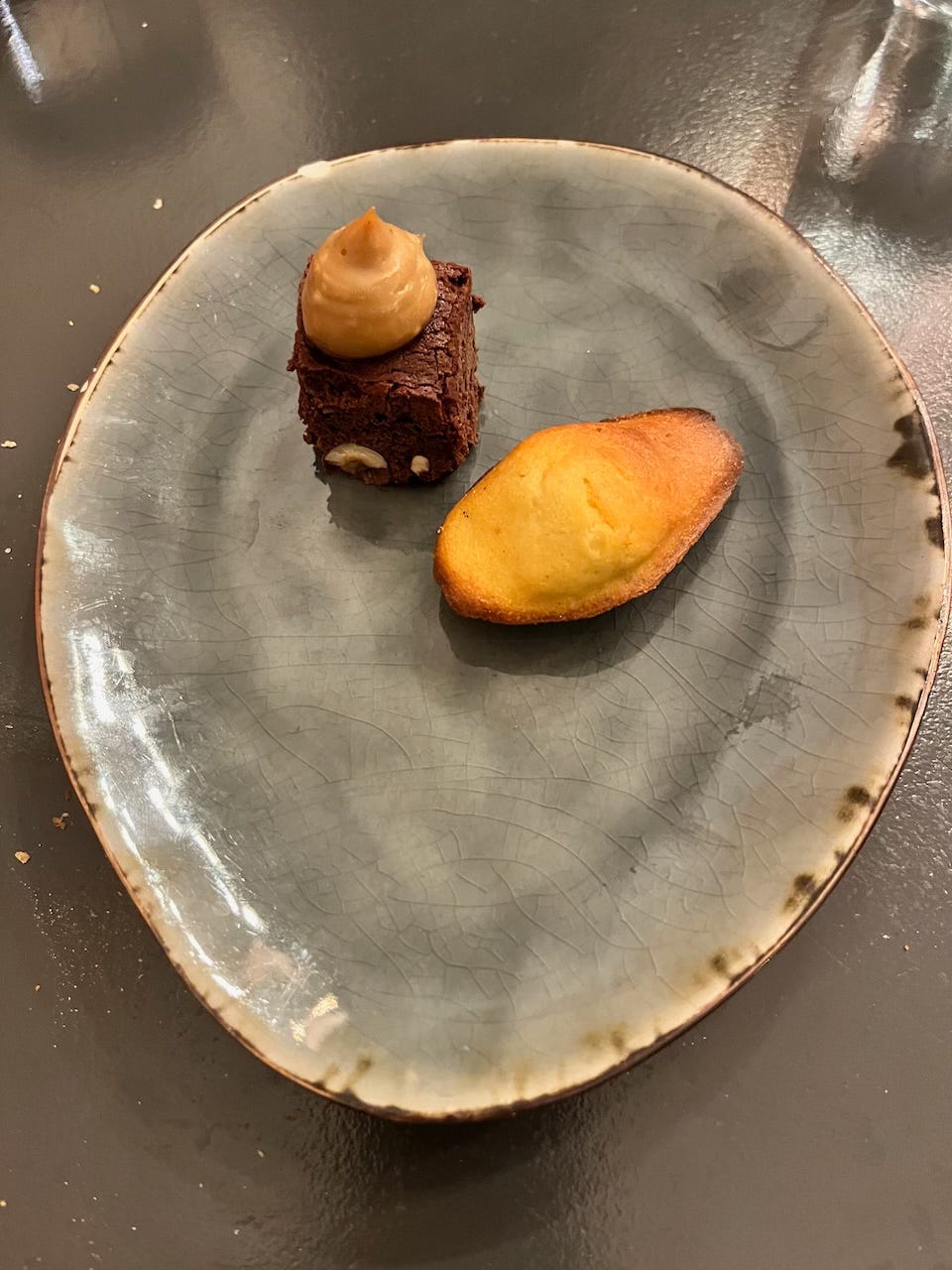
A million miles away from the restaurant experience at the 3-star place that Ritchie learns to polish forks for 3 days is Bistro B on Rue Dugesclun. A small front room downstairs with yet another Canut-style mezzanine above, holding a combined total of 30 covers decorated with a natural-wood pretend garden fence along the walls. The host/ sommelier/ cocktail maker/ waiter/ table-busser greets you in a long server’s apron with almost too intricate an arrangement of straps on the back. It is relaxed, as is he. The menu is accessed through a QR card, we get waters and a ‘pot’ of Chardonay from the Rhone Valley. They just received their Michelin Guide entry under Bib Gourmand, the great food for under €40 rating, but the food is as serious as it is affordable. I had the Duck main course, which was two ruddy steaks cut across the breast on a bed of celery purée and some assorted small select veggies and bloody delightful: “Magret de canard au vinaigre de poire, sauce gastrique, poire rôtie, pommes grenailles et mousseline de céleri”. Everything was well executed, service was good, amazing really, seeing it was one guy and a small kitchen. Two hours flew by, concluded with perfect little brownies and memorable madeleines with the coffee. 3 courses and wine for just over a hundred Euros, and we meandered our way home, happy bunnies.

 Anecdotes and Antidotes in Burgundy