April the first passed with several striving consumer brands demonstrating their hip edginess by self-knowingly winking at the April Fool’s tradition with hot dog flavor soda drinks, stoner-speak decoding apps and Korean BBQ scented deodorant sticks. It does not really translate in France, as their tradition for April 1st is a unique and esoteric take on pranking someone by attaching to their back a paper cut-out of a fish. So the worst that can happen to you is that you are the Poisson d’Avril for a period of time until you work out why everyone is sniggering and yes, it’s you, you have a paper fish stuck to you!
The origin of this odd little tradition is that until the 16th century the new year was celebrated at different times, in different regions of France; the first day of spring in some places, Easter in other, 1st of April in others. Charles the IX decided to standardize the calendar, and the new year officially started in 1564 on January 1st. The word didn’t get distributed that well in pre-industrial days, but when the King’s Messengers finally spread the word, there were still some folks celebrating the turn of the year in April and giving the traditional gifts of fish – partially tied to the ending of Lent. The sophisticated and well-informed took the piss out of the rural rubes by giving them pretend fish gifts. So if you end up the butt of the office joke and everyone is sniggering behind your back as you discover a paper fish sellotaped to your designer hoodie, then blame King Charles.
What the French do take seriously is the overall quality of life, more as something to debate about rather than boast about. As much as arriviste foreigners we look at France and revel in its positive contrast with the tattered putrefying carcass of our homeland that once was England, or the political dumpster fire of a gerontocracy in thrall of big business that the US has sunk to, the French always find something to complain about. This week, the French woman’s magazine ‘Femme Actuelle’ published its list of top 50 places to live in France as a woman. They used data from the Ministries of the Interior and Health but also from numerous agencies known intimately to the French but who remain to me just one of many confusing collections of initials, including INSEE and CAF. They evaluated the quality of life for women through the comparisons of factors such as health, access to housing, public transport, security, juvenile delinquency and even pollution. For each, they gathered the most relevant indicators, but Femme Actuelle admitted that this was not always easy. The data had to be available, reliable and comparable for all the competing cities. As an example, they could find no reliable publicly available measures of the share of green spaces or pedestrian zones available in a municipality, although, under certain conditions, women favor them. They finally selected twenty-one indicators, to which a weighting coefficient was applied, according to the importance the magazine attached to them, focused around 4 key axis to derive the final ranking: the provision of specific care, security, the living environment and the action of the municipal authorities. Lyon was happy to receive the fourth place in the ranking behind Strasbourg, Rennes and Bordeaux. Paris was 7th and in last place Perpignan, just behind monied Antibes in 49th. Lyon takes the green space and pedestrianization super seriously, so might probably have scored higher if that was one of the measurable common factors.
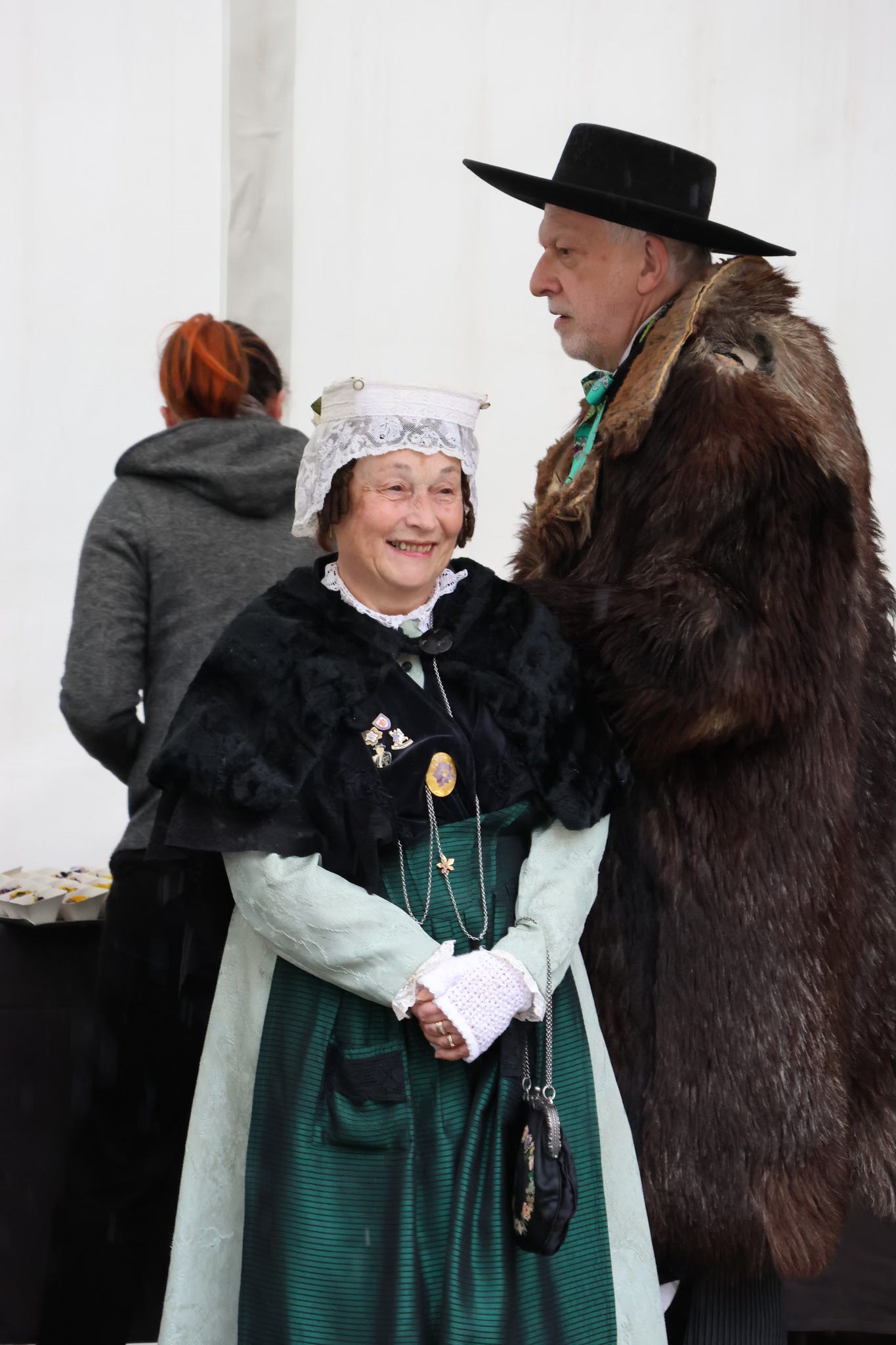
The French also take cheese seriously. As part of Charolles’ inaugural Gourmet Festival, “Les Rendez-vous Gourmands” there was an event hosted by our local L’atelier des fromages, the cheese workshop, which being out of Lyon for the week we took advantage of. This was in contrast to Maître Doucet, who hosted 3 four-handed dinners at his Michelin starred Maison Doucet, each one featuring a guest pair of hands from another 1 or 2-star chef. Those little beanfeasts were €250 a head, each one; so I would be intrigued to find out how many locals ponied up for more than one of these. Doucet is a relentless self-promoter, appearing on the French equivalent of Good Morning America, cooking Charolais beef during the recent Agricultural Foire in Paris. That was the one that Macron spent an unprecedented 14 hours at, to prove his ‘man of the people’ standing. I am sure Doucet has a well-heeled fan base who made the journey up from Lyon or down from Paris for the rendez-vous. He was there as the event was kicked off on the Wednesday morning, which coincided with the weekly market, so the town was bustling, even in the incessant rain. They had drinks and folk music and the local folk culture society, Les Gâs du Tsarollais turned out in their peasant costumes of yore, which for some reason seem to include fur coats.
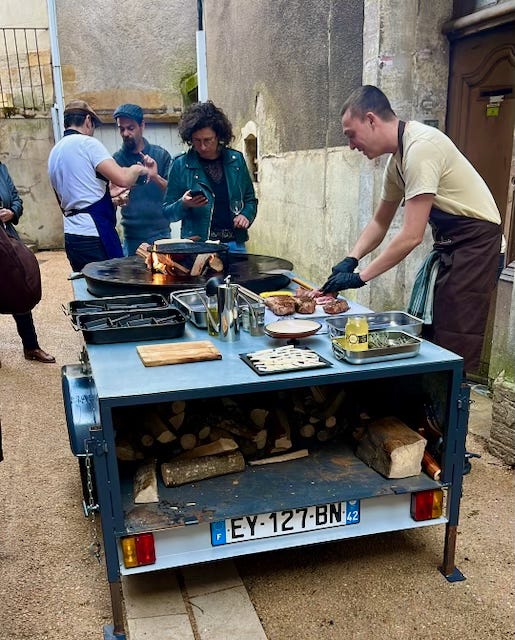
He is a good chap, our cheese guy, literally as his name is Bonhomme. He provided an “Atelier Brasero Autour Du Fromage” of 5 courses with drinks included for €30 a head. The rain and wind fortuitously decided to bugger off that Thursday morning, and so we had a warm spring evening around the Brasero, tucked away in the alley between the cheese shop and Place Baudinot. The Brasero for the unitiated, (myself included before the evening) is a large circular wood-fired grill with cast iron cooking surfaces above and surrounding the vented fire box.
We were welcomed to start the evening with a selection of cheese appetizers with a local Blonde beer. Each of the cheeses was given a formal introduction by Pierre Bonhomme, all examples were Fromage Fermier, which is a subtle but critical distinction. This means it is made on a farm and not in a large dairy, it brings a link directly from the animals raised to provide the milk, the land they graze on and the hands that work the cheese. We had a winter’s milk Beaufort, a fruity Comté (16 month old), a local Charolles AOP goat cheese and a mild sheep’s milk blue cheese.
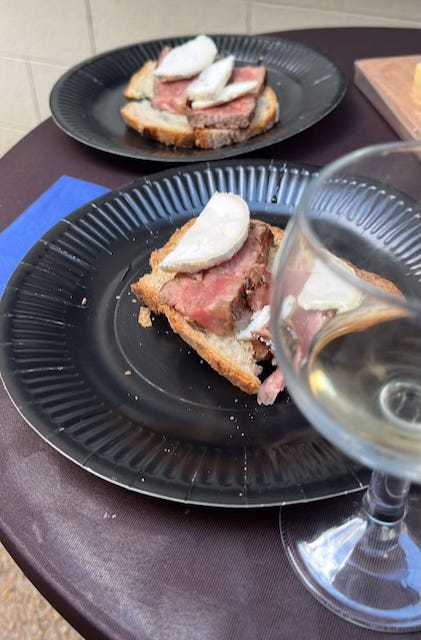
The Brasero kicked into action and we had local beef grilled then bathed in an oil-based dressing of garlic, wild thyme and local honey. It was served with a slice of another Charolles goat-cheese and drizzled with honey and served with a White organic St Veran, which is the closest quality white wine to us. Pierre explained that Charolles as a AOP, appelation d’origine protégée, has one of the highest proportion of fermier producers, with each hustling to make the little towers of cheese, supposedly inspired by the Tour De Charles le Temeraire; it takes 3 liters of milk to make 1 Kg of cheese.
This was followed by a take on the traditional raclette, with a chilli infused raclette cheese, heated to bubbling hot served on bread with generous options of charcuterie to accompany it. This was served with a Fleurie.

For the traditional cheese course, we then had two contrasting but stand-out strong cheeses. There was a lively discussion about which are the ‘strongest’ tasting cheeses and Montgomery Cheddar, which he sells, got an honorable mention alongside Maroilles and Munster. He served Epoisses, which was made originally by a religious order but has been made in Burgundy for over 500 years, its orange rind a result of the regular brushing with Marc de Bourgogne, an eau de vie. There remains only one fermier producer still producing it today. This was accompanied by another strongly flavored rich cow’s milk cheese, Chaource, from 2 hours north-east of us on the way to Champagne. This was another farmer produced and refined cheese, Fermier AOP. We washed this glorious pairing down with Hautes Cotes De Beaune and had a serving of whole grain Dijon mustard on the side.
On the subject of strong cheese, we then had a tasting of Pierre’s ‘Fromage Fort’. This is a typical poor man’s food that takes leftovers and recreates something new. Generally it’s the odd pieces and leftovers of cheese that remain, shredded finely and mixed with cream or yoghurt, some alcohol (white wine or marc) and some also mix in leek or other vegetable stock. The beaten, smoothed version of a cream cheese is then eaten on toast. It’s an acquired taste and depends ultimately on the recipe as it is very sharp, pungent and acidic. Pierre makes one with only goats milk cheese or only cows milk cheese, never with sheep and never with blue cheese. If you like those acidic Danish blue cheeses, you will like Fromage Fort. I think you could also use it to revive olden wooden furniture or polish tarnished jewelry, not a great fan; although Dan, who was with me, loved it.
We finished the cheese exploration with Salers on whisky-flamed toast and the same Irish single malt whisky on the side. By this time most of the social awkwardness in throwing 16 people together had melted around the now-cooling brasero, so we had a rambling discussion on salted butter, whisky and whiskey, Brexit and walked away full, satisfied and happy into the dark evening streets, no fish stuck on our backs.

 Anecdotes and Antidotes in Burgundy