
Salmon is great to eat, but less impressive as a color for pants. You can farm salmon in large lakes, lochs and open sea-pens, so from the perspective of sustainability you would think it would get a hefty thumbs up. Especially as we are supposed to eat oily fish, reduce meat consumption and support a sustainable protein source with no methane emissions. In the US, partly thanks to the ubiquity of farmed salmon in sushi, the annual consumption per head is over 3 pounds of salmon. That sounds a tiny amount from a European perspective, but you have to remember vast swathes of the US eat zero fish, ever. European per capita consumption of just farmed fish production was 6.7 kilos in 2021, the last year data was available. Farmed salmon divides opinion sharply, in fact in some quarters it is demonized. When I lived in California I could choose to only eat wild salmon and its depth of flavor and color is like night and day, but in France we get one choice of Salmon, farmed. There are by contrast a plethora of options of other fish even in supermarkets and my fish guy on the market (a long-suffering PSG fan), has 2-3 whole different types of fish, 6-8 filleted fish plus shellfish of various hue, seafood preparations like quenelles, fish moussaka and preserved fish like herrings, smoked salmon and kippers. But salmon he does not sell, as he cannot compete with supermarkets and their farmed Norwegian salmon. The concern with the farmed salmon, particularly that emanating from Norway, Scotland and Chile, is that it’s raised in poor conditions of health and hygiene for the fish. The fish meal used to feed them together with insufficient water filtration means that the farms cause real destruction around them and have effectively killed off the wild varieties of salmon that gave the original reputation to those fish origins. There are efforts to identify those sources that do play by the rules, but it’s not always that easy on markets or where wet fish is sold to identify whether you are buying good or evil salmon. Being marked as Organic is also a false friend, as that can refer to the food on which they are raised rather than the overall farming regime.
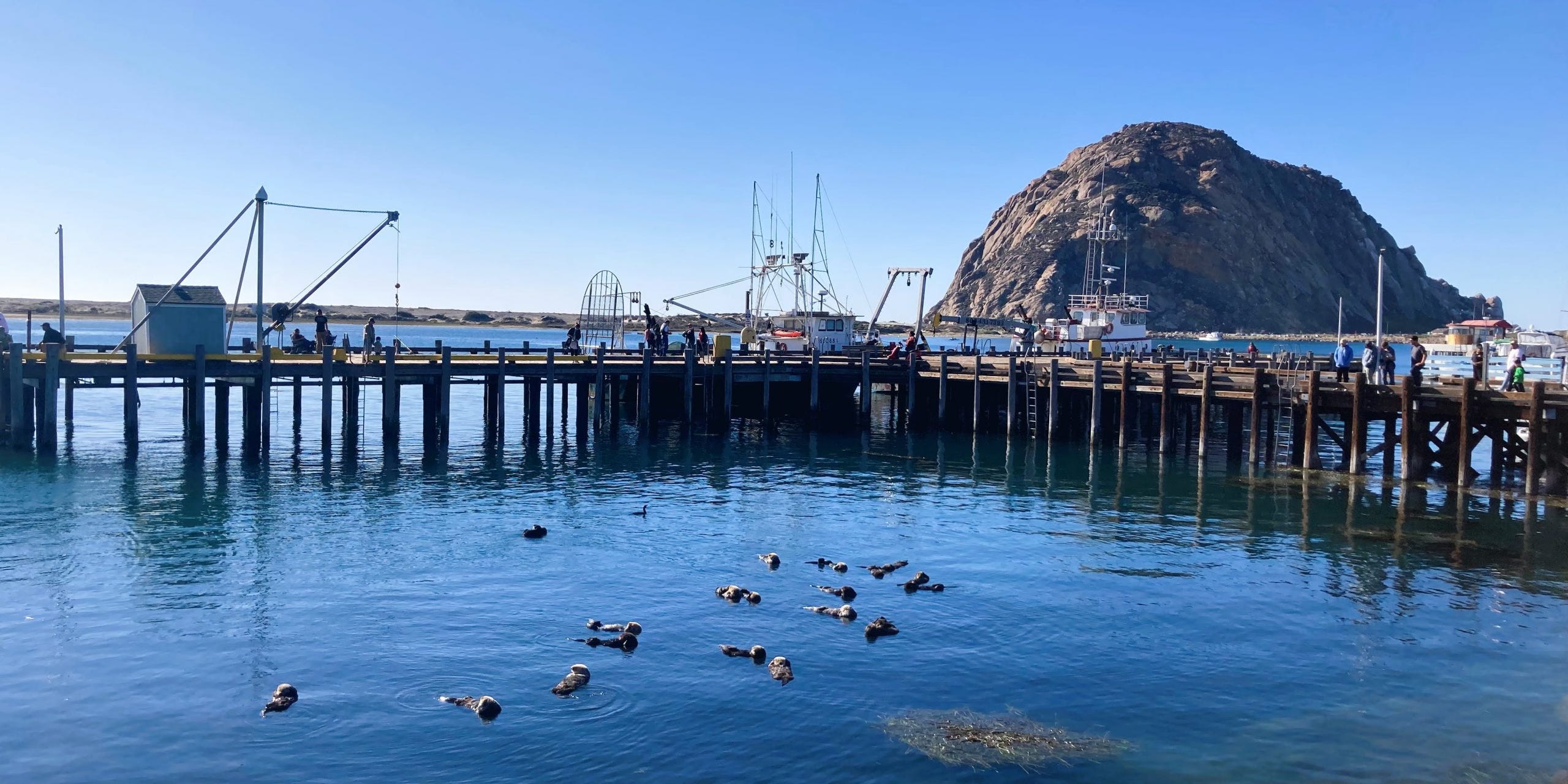
I once went wild salmon fishing off Morro Bay on the Central Coast of California. A friend won a prize at a private school fund-raiser that his kid went to. Another parent was a salmon fisherman, so he, and a plus one, got to go out on his commercial fishing boat. I was roped into being the plus one and at 6.00 am one Saturday morning was picked up to go and fish. My friend forced down me some disgusting anti-seasickness med with coffee, despite my protestations that as a semi-experienced sailor, it didn’t bother me. Off we sailed on a small fishing boat on a pretty flat, sunny morning sea while the Dramamine fucked with me. I felt like death for the first 45 minutes as we headed out to sea, finally the mate cooked us a fried breakfast – part of the prize thank god – and finally the nausea disappeared. We were using sonar to find the shoal of King Salmon the captain was in search of. This was definitely not Ahab and the beast, this was technology provided mastery of our domain. The visual clues were dolphins and seabirds, the dolphins smash into the shoal, which for safety swim in giant spherical shapes. The dolphin impact stuns and breaks off the salmon swimming on the perimeter of the ball, and they float up, stunned, to be gobbled up by the dolphins or the diving seabirds. The ball shape shows up clearly on the sonar, and we let out the fishing lines. Again, no romance here, just large hooks with shiny reflective aluminum lures on lines 800 yards long get trailed off the back of the boat as we slowly drift over the battered ball below us. We haul the lines back in and every 6-8 feet there is a large king salmon flailing on a hook, some of these are immense, the size of small sheep, 30-40 pounds in weight. Friend and I help with the hauling-in of the lines but the Mate and the skipper do the execution work, the gift to the school ensures we don’t have to bludgeon our way to our prize. An hour or so later we putt-putted back into Morro Bay, the catch nicely snuggled in the chiller hold covered in ice. We were each given one cleaned King Salmon as our bounty-come souvenir of our morning’s adventure on the high sea.
I am, as the regular reader will have spotted, quite fascinated by the daily saint’s days that the baker’s shop writes on the chalk board each day. So last Tuesday the 9th of April was in honor of St Gaultier. He should be the patron saint of reluctant labors, like my salmon fishing, and is in fact I was delighted to discover invoked in case of work related stress. He is also patron saint of Vintners, which is a good cause. St Gaultier was a professor of philosophy and rhetoric which was so exciting he became a Benedictine monk near Meaux, of mustard fame. He was appointed by the king, Philip 1st, abbot of a new foundation at Pontoise. The discipline at this new Abbey was lax, and he ran away several times to avoid the responsibility of making it less lax. He gave up completely and went to Cluny, which is actually not far from us at Charolles and was at the time the biggest and richest abbey in Eastern France. They sent him back to Pontoise. He tried to escape to Tourraine and hid himself on an island in the Loire, before yet again being led back to the abbey. He also escaped to an oratory near Tours before being recognized by a fellow pilgrim, who grassed him up.
After being forced to return yet again to Pontoise, this time he decided to go to Rome to appeal directly to Pope Gregory and gave him his written resignation. Gregory instead ordered him to resume his responsibilities as abbot and never leave again. Accepting his fate, he campaigned against the abuses and corruptions of his fellow Benedictines, and was beaten and imprisoned for his troubles, which may have been why he was not so keen on the job in the first place. He resumed his work after being released and died in 1099.
St Gaultier or St Walter as he is known in English, was buried in the abbey at Pontoise, the place he had strived so hard to avoid. He was canonized by Hugh, Archbishop of Rouen in 1153, and was the last saint in Western Europe to have been canonized by an authority other than the pope. He did finally escape Pontoise, as they managed to lose his body during the Revolution.
I have escaped the city life of Lyon this week by taking a late break to ski with Dan in the Val D’Iseres, staying with a friend in Tignes 1800. It’s typical spring skiing so today we had sun, sleet, snow and rain. It is by coincidence the last week of the Easter school break for Paris so the resorts, although not full as it is late, are awash in Parisians. Some are gloriously old school in terms of spring skiing means one thing and one thing only, working on your tan. There are great examples of people at each bar and restaurant with pine yellow tans, working hard to get them to the full dark oak tan that some of the older French ski-instructors sport. It was a sunny day yesterday and there were folks laying out in deck chairs at 10.30 in the morning at 2500 meters above sea level. If I hadn’t watched him play badly against Villa later that day, I would not have been surprised to spot Ben White of Arsenal fame laying out there too. He is a young man who seems to have taken upon himself the curation of a serious tan all winter and with his odd goatee, looks more and more like a pantomime Captain Hook, grease paint and all.
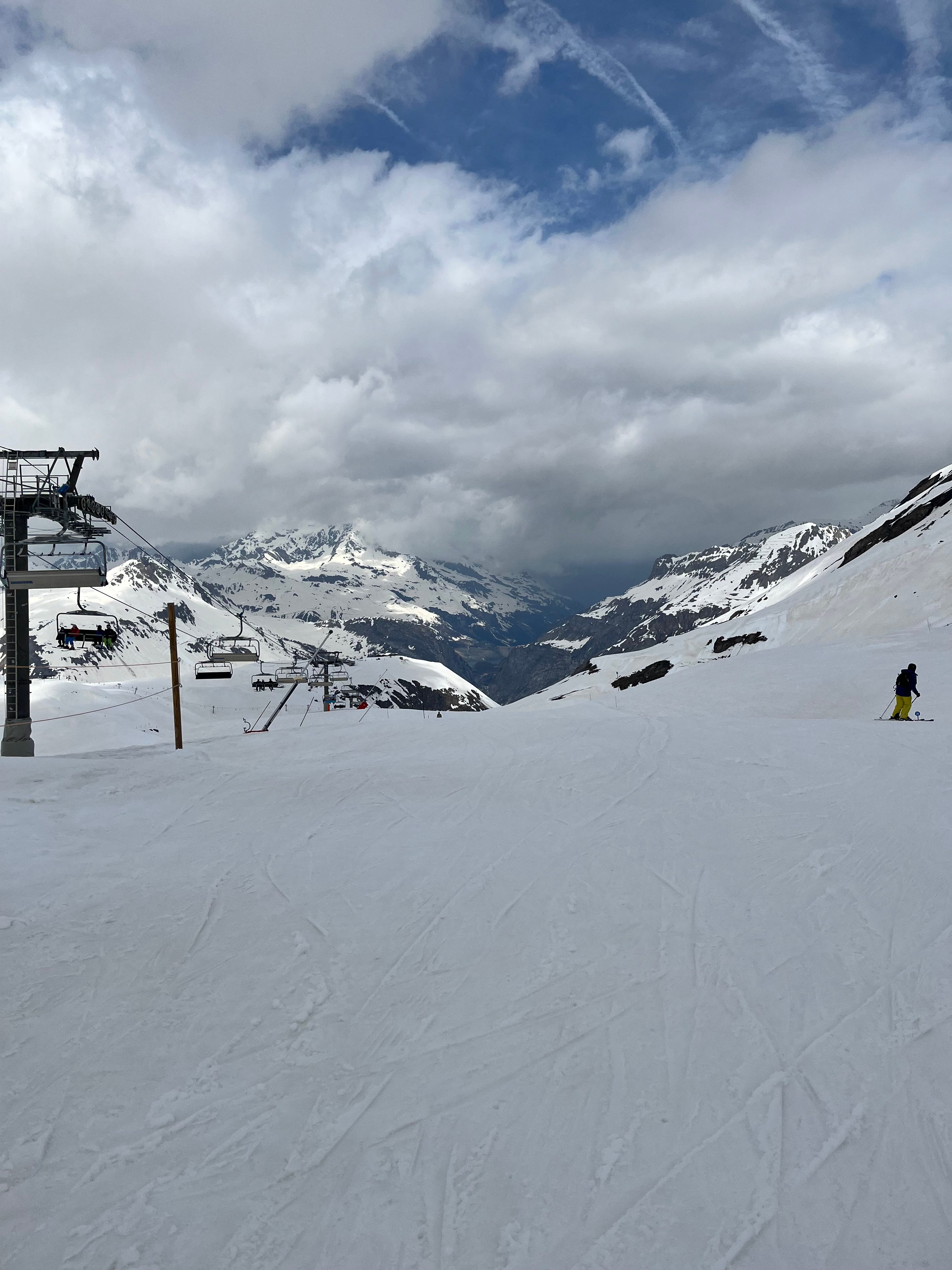
We are this week in the former land of Savoy, Italy is just over the mountain to our East, and so much cheese, ham and pasta is consumed. They have basically exhausted any way of cooking cheese, ham and potatoes and all combinations are sold for lunch and dinner. Tartiflette, raclette, baked whole Mont D’or and Rebluchon. Pasta with cheese, pasta with ham and cheese, pasta with cheese, ham and potatoes dominate the menus. The good news is that the local wines from Savoie are good accompaniments and great value, we had a Chignin Bergeron last night which was a bright pretty white without being floral. If you are spring skiing, you oscillate between being cold, wind swept and needing staunch hearty food and being hot and sun burned and wanting salads and bottles of rosé at lunch. Happily, the quality of food at French ski resorts puts to shame the rarefied efforts, at what is basically fast food, that masquerades as $45 lunches at any US ski resort. We are surrounded by valleys that in summer provide pasture for cows that deliver the milk for the Beaufort, the Abondance, the Raclette and the various Tomme de Savoies that enrich the local dishes. The other local drink owes much to St Gaultier’s fellow Benedictines, Chartreuse. In both Green and Yellow forms, the bottles are behind every bar, in every restaurant, in every shop. Here in the Alps they also have local Jenepé liqueurs which compete taste wise with Chartreuse and both the original and the local versions turn up in ice-cream and deserts. Lyon celebrates its affinity to Chartreuse like San Francisco does to Fernet, but for some reason our local wine shop on Felix Faure cannot seem to secure regular supplies. I am going to have a Chartreuse with a coffee one morning this week, just because it seems to be the done thing, and maybe I bring a bottle home.

 Anecdotes and Antidotes in Burgundy