Gones for good: Episode 11 Disquaires, drugs and discoveries

Lyon made an unscheduled and unflattering appearance on France 2 a few weeks ago. France 2’s news programming is the most watched, like BBC’s or NBC’s nightly news, it is more generally watched than other populist or entertainment-focused options. They have a serious approach to the news, slightly undercut by the female news anchors still tottering around in 5-inch heels; they may be occasionally allowed to be in jeans to show they are not overly buttoned up, but the jeans are ferociously tailored, and the heels are sharp. The men always and without exception appear in blue suits, white shirts and often with blue ties. The royal blue suit, a fashion item not seen in the anglophone world since the 80’s, regularly makes an appearance. Lyon’s appearance was on a 45-minute special ‘exposé’ featuring an undercover examination of the urban drug trafficking in one of Lyon’s suburbs, the Tonkin public housing complex in Villeurbanne. The hidden cameras were concealed among the efforts of a group of citizens who formed a collective effort called Tonkin-Paix-able, looking to ensure a peaceful Tonkin. The group rock up regularly in the middle of the major drug exchange with white t-shirts, rubber gloves and trash bags and ostensibly remove the detritus of the marketplace, ironically less used needles and more fast food packaging and beer cans thrown down by the dealers as they sit, hoodied and bored, on make-shift cardboard seats on the steps of the large public building opposite the tram stop. The collective tries to engage with the dealers to keep things as civilized as possible for the neighbourhood.

The story is common across France, not just the large banlieues that ring the major cities. Banlieue means suburb in a strictly etymological sense, but in France it is more synonymous with what Americans refer to as ‘the projects’. Public housing is a key part of the French social contract. The majority of French people rent rather than own houses and long term rental contracts, ample legal protections for tenants and local government rent controls mean it’s a simple long term choice for many working class people in the large towns and cities. Much of the rental housing is state owned, usually by the local council, some are private or charity but most is truly public housing. Through a natural process of selection recent immigrants get concentrated into the less well positioned cités, as in the movie images of ‘les banlieues’ in Marseilles or the Paris suburbs, isolated for many years without access to good public transport. In these areas, poverty and lack of opportunity follow declining standards in the schools and those who can do, move away, further concentrating the young poorly educated boys, not really men, into a process of boredom and finally relief through working for drug trading gangs. Selling ‘stups’ as in ‘stupifiants’, is a way and for many the only way for kids to make a living, other than riding scooters and bikes delivering food to the richer areas. The biggest trade is in weed or hash, with coke and crack some way behind. It’s a cash business and profits flow upwards, so at the sharp end the kids are not covered in gold chains, nor driving Mercedes SUVs in some wannabe rap video lifestyle. They all wear the same drab outfit, black Adidas jog pants, black Nike ‘baskets’, black zip hoodie, black baseball-cap and the one sign of affected affluence, a faux Gucci man-bag strapped across the chest.

France still gets shocked when the turf wars escalate into deadly violence, and even a single death will usually make the nightly news. Macron, in one of his studied efforts to deprive the far right of its rallying points, recently dropped into one of the major banlieues of Marseilles, La Castellane. On camera, he told residents that his newly announced campaign will “try to destroy the networks and the traffickers.” Macron said 82 people have already been detained, with 60 of them remanded in custody for further questioning. “Drug trafficking is a growing scourge” and “the situation is very difficult” in Marseille and other cities, he said, adding France was in the throes of a “battle” against the dealers. One of the ‘difficulties’ is that if the dealers are under 16, and most are, they cannot usually be arrested. The other glaring problem is the obvious demand for weed and an almost blind denial of the simplest thing to do would be to regulate the sale and take the clandestine market public. The wine lobby is dead set against legalizing weed as it watches Gen Z drink more IPA than vin de table. The French are happy to regulate the crap out of tobacco and vapes, but not marijuana. Go in a tabac today, and you are confronted by pack after pack of cigarettes with no visible branding and statutory stipulated 2.3rds of the packaging displaying pictures of cancers and post-mortem lungs. There was a story this week, continuing the theme of the “national effort” to save the tabacs. With some 23,300 shops across France, 41 percent of which are located in towns with fewer than 3,500 inhabitants, tabacs are an important part of French life, even for non-smokers. We regularly get parcels delivered to our local tabac as it’s often the free or cheaper option. This week’s new effort was paying the expanding no-touch automatic freeway toll charging. Last Fall, it was them selling ammunition for hunters. Why not allow them to sell weed? Solve all the small town angst and big city crime in one joint.

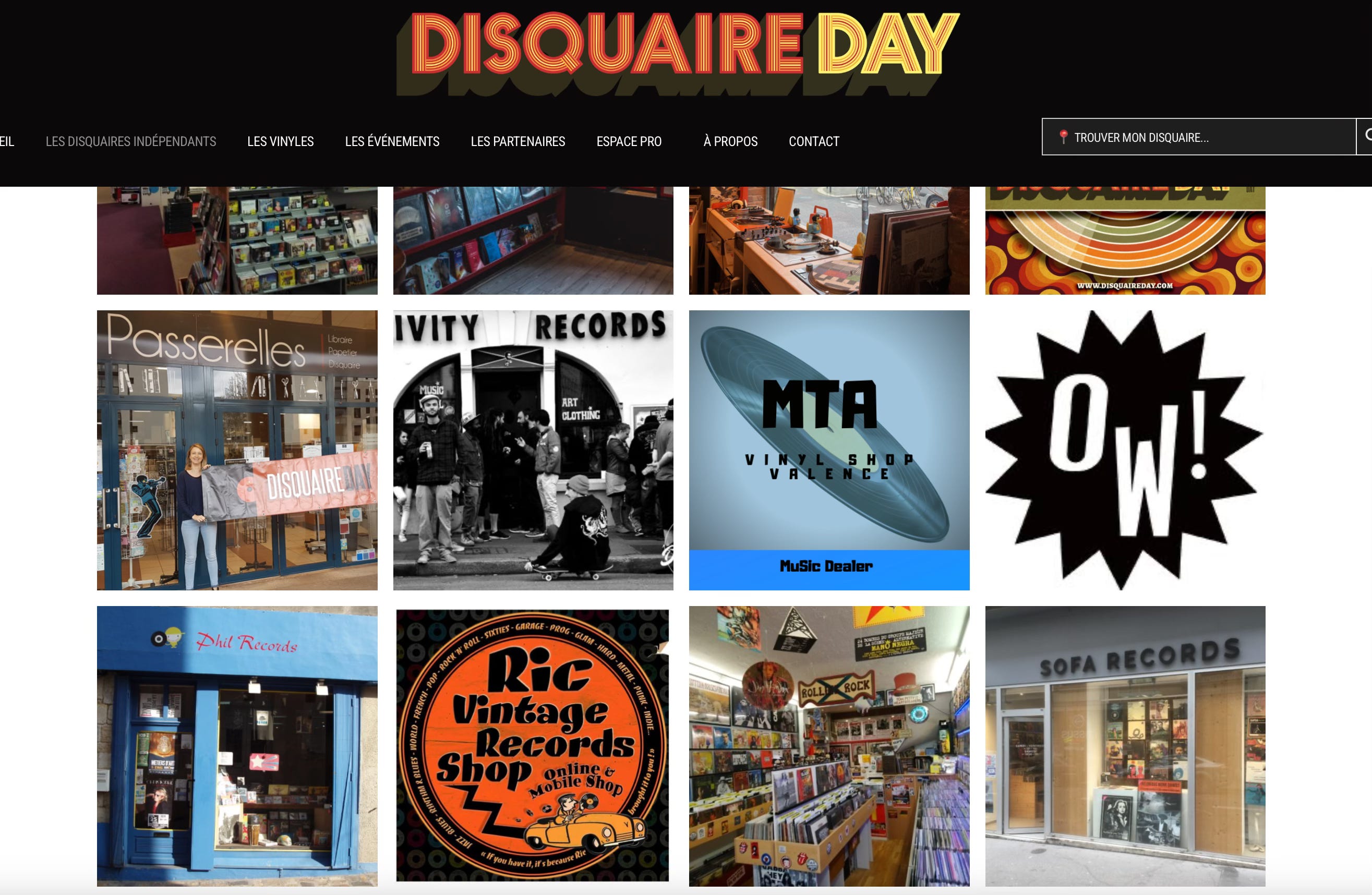
Saturday was the saint’s day of independent record stores, Disquaire Day or Record Store Day. Fuelled by special one off releases or collector’s items in the making, April 20th is a celebration of small and large record shops and Lyon is blessed with lots of them, most within walking distance spread around the narrow streets at the foot of les Pentes de Croix Rousse, a short walk from the Hotel De Ville. We made our way through the weekly pro-Palestine rally and the now regularly red stained fountains symbolizing the daily death in Gaza to my favorite, Sofa Records. They have an insane collection of West African and Hi-Life music and always something intriguing playing. They have good rock and pop stocks as well, and the shelves are well organized and easy to browse. Maybe it is completely unlikely that I would find a real gem of a discovery as those are now only found in charity shops, but it’s still a pleasurable way to while away some time. There was an interesting article in last Friday’s Grauniad about record collecting, ahead of RSD. In the UK even the charity shops have worked out that a quick look on Discogs will turn a €4 bargain into a €25 special display.
I didn’t need a Rumours picture disk or a “réédition splatter” of Sabbath’s ‘Paranoid’, so my shopping was less focused on the ‘special RSD releases’. I found the following treats: 

“Lets Make Up and Be Friends” – The Bonzo Dog Band’s last album before Stanshall’s death (but featuring the first appearance of Sir Henry Rawlinson).

“TANGK” – Idles – independent record store version, new album from the best men in dresses.

“Desolation Boulevard” – The Sweet. The vainglorious effort by the Ballroom Blitzers to shake off their Glam-Pop reputation with a hard rock record.

“Flock” – Jane Weaver – a bargain pink vinyl version of her 2021 album which features vibes and who can resist a good vibraphone sound.

“Actual Life” – fred again – The first of the ‘Life’ trilogy, silver vinyl.

“Pretty Hate Machine” – Nine Inch Nails. A gift for Rachel, who is currently inspired by Reznor and tough to find on vinyl.

“Live Montreal 1971” – Frank Zappa. A semi-official bootleg from a radio broadcast. Its the ‘vaudeville’ band with Flo and Eddie on vocals, so all Fillmore 71 favorites plus one of the songs from the eponymous Phlorescent Leach and Eddie album from 72, which I have never seen on any official release.

If you would like to sample these treats, listen here.

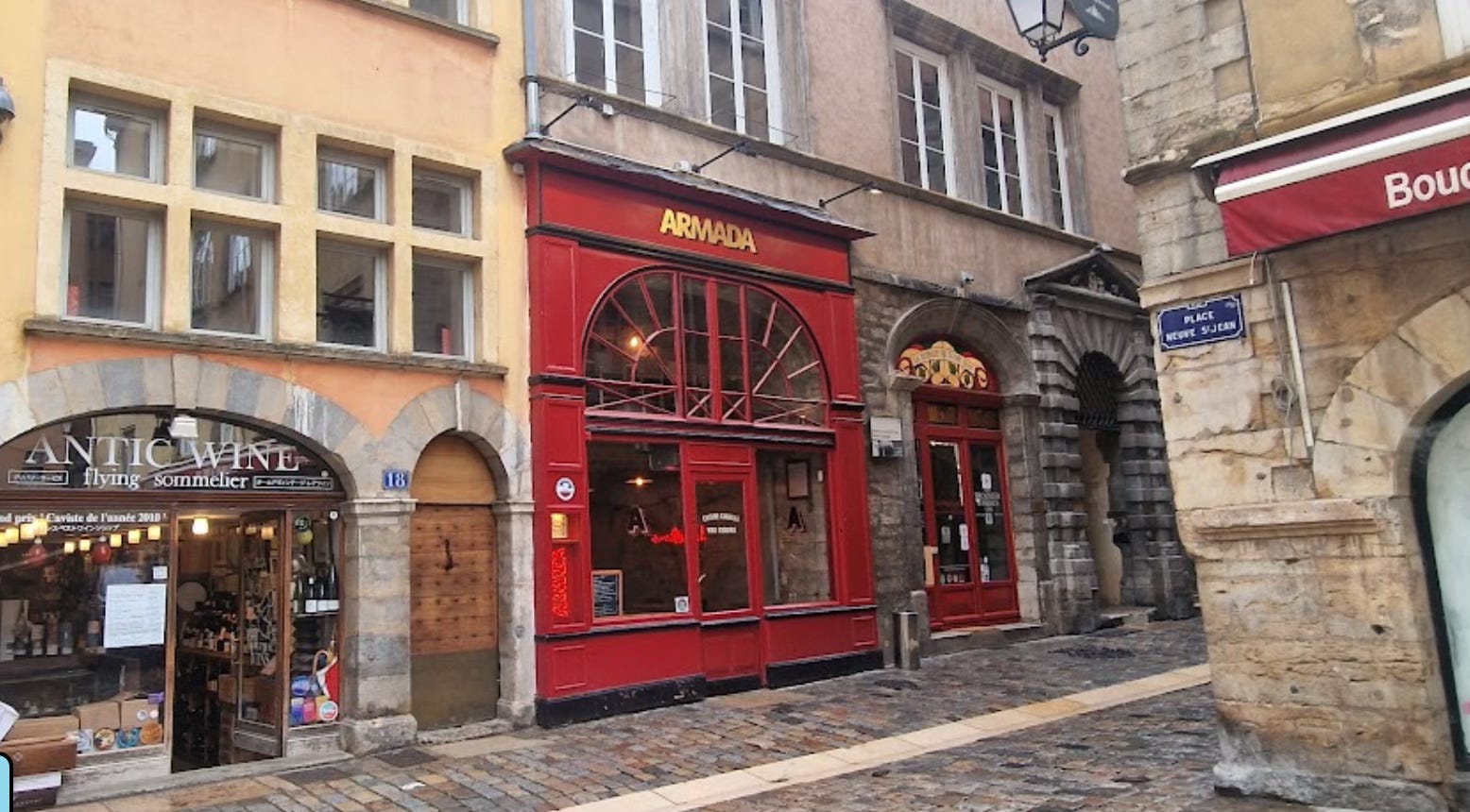
After a week in the mountains living on cheese and ham, it was good to get back to proper nosh. Friday night we went back to Armada on Rue de Boeuf in the old town. The first time we went there was by coincidence when they publicly made Le Fooding Guide, so it was interesting to see how they had adapted to their new fame in the intervening couple of months. They are still super friendly and faithful to the original vision of fun food. A modest space, sharing plates but not twee, tiny portions that you end up ordering 3–4 dishes a head. All very very good, the veggie driven starters were spring encapsulated, which was welcome after the winter of Tuesday and Wednesday in the shadow of Mont Blanc. Next door is Antic Wine, so they occasionally have specials from the neighboring cellar, and we had an amazing 2013 Montlouis followed by a 2011 St Amour. Some Loire whites are known to age and Chenin is a good grape to do that but a 13-year-old Cru Beaujolais is not common outside of Morgon, so we were blown away how good this was. The best dish of the evening was a lamb spring festival on a server, lamb from the Ardeche 3 ways, the fatty belly end grilled, the main rump chop served ruddy and the sweet breads done quickly on the griddle. All served over peas, pea pods and asparagus. The chef proudly delivered the two deserts and happy to chat about what made them special to him and ultimately to us. Among a ton of tourist traps, the modern Francis Drake would be happy to stumble into this Armada.
If you would prefer to receive this via Substack stroll over here: https://open.substack.com/pub/anecdotesandantidotes/p/gones-for-good-465?r=tnn6j&utm_campaign=post&utm_medium=web

Gones for Good: Episode 9 – Cheese coursing

April the first passed with several striving consumer brands demonstrating their hip edginess by self-knowingly winking at the April Fool’s tradition with hot dog flavor soda drinks, stoner-speak decoding apps and Korean BBQ scented deodorant sticks. It does not really translate in France, as their tradition for April 1st is a unique and esoteric take on pranking someone by attaching to their back a paper cut-out of a fish. So the worst that can happen to you is that you are the Poisson d’Avril for a period of time until you work out why everyone is sniggering and yes, it’s you, you have a paper fish stuck to you! 

The origin of this odd little tradition is that until the 16th century the new year was celebrated at different times, in different regions of France; the first day of spring in some places, Easter in other, 1st of April in others. Charles the IX decided to standardize the calendar, and the new year officially started in 1564 on January 1st. The word didn’t get distributed that well in pre-industrial days, but when the King’s Messengers finally spread the word, there were still some folks celebrating the turn of the year in April and giving the traditional gifts of fish – partially tied to the ending of Lent. The sophisticated and well-informed took the piss out of the rural rubes by giving them pretend fish gifts. So if you end up the butt of the office joke and everyone is sniggering behind your back as you discover a paper fish sellotaped to your designer hoodie, then blame King Charles.

What the French do take seriously is the overall quality of life, more as something to debate about rather than boast about. As much as arriviste foreigners we look at France and revel in its positive contrast with the tattered putrefying carcass of our homeland that once was England, or the political dumpster fire of a gerontocracy in thrall of big business that the US has sunk to, the French always find something to complain about. This week, the French woman’s magazine ‘Femme Actuelle’ published its list of top 50 places to live in France as a woman. They used data from the Ministries of the Interior and Health but also from numerous agencies known intimately to the French but who remain to me just one of many confusing collections of initials, including INSEE and CAF. They evaluated the quality of life for women through the comparisons of factors such as health, access to housing, public transport, security, juvenile delinquency and even pollution. For each, they gathered the most relevant indicators, but Femme Actuelle admitted that this was not always easy. The data had to be available, reliable and comparable for all the competing cities. As an example, they could find no reliable publicly available measures of the share of green spaces or pedestrian zones available in a municipality, although, under certain conditions, women favor them. They finally selected twenty-one indicators, to which a weighting coefficient was applied, according to the importance the magazine attached to them, focused around 4 key axis to derive the final ranking: the provision of specific care, security, the living environment and the action of the municipal authorities. Lyon was happy to receive the fourth place in the ranking behind Strasbourg, Rennes and Bordeaux. Paris was 7th and in last place Perpignan, just behind monied Antibes in 49th. Lyon takes the green space and pedestrianization super seriously, so might probably have scored higher if that was one of the measurable common factors.

The French also take cheese seriously. As part of Charolles’ inaugural Gourmet Festival, “Les Rendez-vous Gourmands” there was an event hosted by our local L’atelier des fromages, the cheese workshop, which being out of Lyon for the week we took advantage of. This was in contrast to Maître Doucet, who hosted 3 four-handed dinners at his Michelin starred Maison Doucet, each one featuring a guest pair of hands from another 1 or 2-star chef. Those little beanfeasts were €250 a head, each one; so I would be intrigued to find out how many locals ponied up for more than one of these. Doucet is a relentless self-promoter, appearing on the French equivalent of Good Morning America, cooking Charolais beef during the recent Agricultural Foire in Paris. That was the one that Macron spent an unprecedented 14 hours at, to prove his ‘man of the people’ standing. I am sure Doucet has a well-heeled fan base who made the journey up from Lyon or down from Paris for the rendez-vous. He was there as the event was kicked off on the Wednesday morning, which coincided with the weekly market, so the town was bustling, even in the incessant rain. They had drinks and folk music and the local folk culture society, Les Gâs du Tsarollais turned out in their peasant costumes of yore, which for some reason seem to include fur coats.

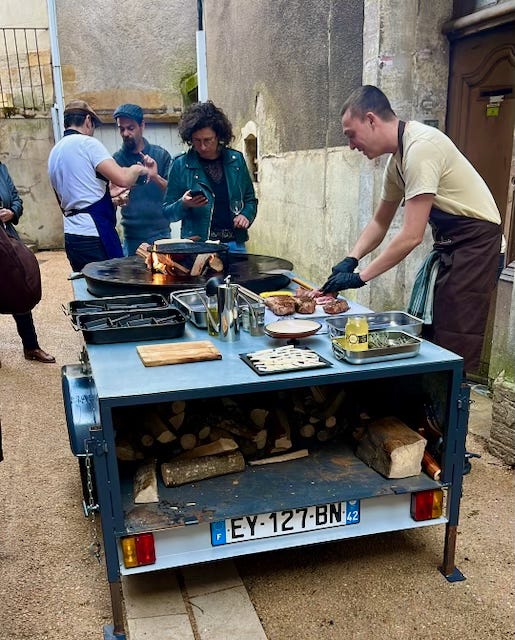
He is a good chap, our cheese guy, literally as his name is Bonhomme. He provided an “Atelier Brasero Autour Du Fromage” of 5 courses with drinks included for €30 a head. The rain and wind fortuitously decided to bugger off that Thursday morning, and so we had a warm spring evening around the Brasero, tucked away in the alley between the cheese shop and Place Baudinot. The Brasero for the unitiated, (myself included before the evening) is a large circular wood-fired grill with cast iron cooking surfaces above and surrounding the vented fire box.

We were welcomed to start the evening with a selection of cheese appetizers with a local Blonde beer. Each of the cheeses was given a formal introduction by Pierre Bonhomme, all examples were Fromage Fermier, which is a subtle but critical distinction. This means it is made on a farm and not in a large dairy, it brings a link directly from the animals raised to provide the milk, the land they graze on and the hands that work the cheese. We had a winter’s milk Beaufort, a fruity Comté (16 month old), a local Charolles AOP goat cheese and a mild sheep’s milk blue cheese.

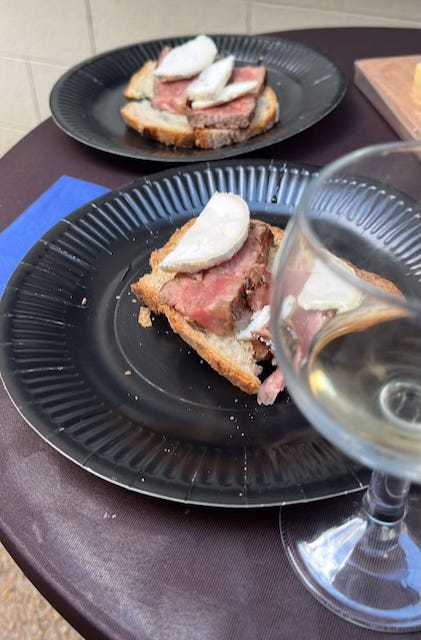
The Brasero kicked into action and we had local beef grilled then bathed in an oil-based dressing of garlic, wild thyme and local honey. It was served with a slice of another Charolles goat-cheese and drizzled with honey and served with a White organic St Veran, which is the closest quality white wine to us. Pierre explained that Charolles as a AOP, appelation d’origine protégée, has one of the highest proportion of fermier producers, with each hustling to make the little towers of cheese, supposedly inspired by the Tour De Charles le Temeraire; it takes 3 liters of milk to make 1 Kg of cheese.

This was followed by a take on the traditional raclette, with a chilli infused raclette cheese, heated to bubbling hot served on bread with generous options of charcuterie to accompany it. This was served with a Fleurie.

For the traditional cheese course, we then had two contrasting but stand-out strong cheeses. There was a lively discussion about which are the ‘strongest’ tasting cheeses and Montgomery Cheddar, which he sells, got an honorable mention alongside Maroilles and Munster. He served Epoisses, which was made originally by a religious order but has been made in Burgundy for over 500 years, its orange rind a result of the regular brushing with Marc de Bourgogne, an eau de vie. There remains only one fermier producer still producing it today. This was accompanied by another strongly flavored rich cow’s milk cheese, Chaource, from 2 hours north-east of us on the way to Champagne. This was another farmer produced and refined cheese, Fermier AOP. We washed this glorious pairing down with Hautes Cotes De Beaune and had a serving of whole grain Dijon mustard on the side. 

On the subject of strong cheese, we then had a tasting of Pierre’s ‘Fromage Fort’. This is a typical poor man’s food that takes leftovers and recreates something new. Generally it’s the odd pieces and leftovers of cheese that remain, shredded finely and mixed with cream or yoghurt, some alcohol (white wine or marc) and some also mix in leek or other vegetable stock. The beaten, smoothed version of a cream cheese is then eaten on toast. It’s an acquired taste and depends ultimately on the recipe as it is very sharp, pungent and acidic. Pierre makes one with only goats milk cheese or only cows milk cheese, never with sheep and never with blue cheese. If you like those acidic Danish blue cheeses, you will like Fromage Fort. I think you could also use it to revive olden wooden furniture or polish tarnished jewelry, not a great fan; although Dan, who was with me, loved it.

We finished the cheese exploration with Salers on whisky-flamed toast and the same Irish single malt whisky on the side. By this time most of the social awkwardness in throwing 16 people together had melted around the now-cooling brasero, so we had a rambling discussion on salted butter, whisky and whiskey, Brexit and walked away full, satisfied and happy into the dark evening streets, no fish stuck on our backs.

Gones for good: Episode 3- Farm to table

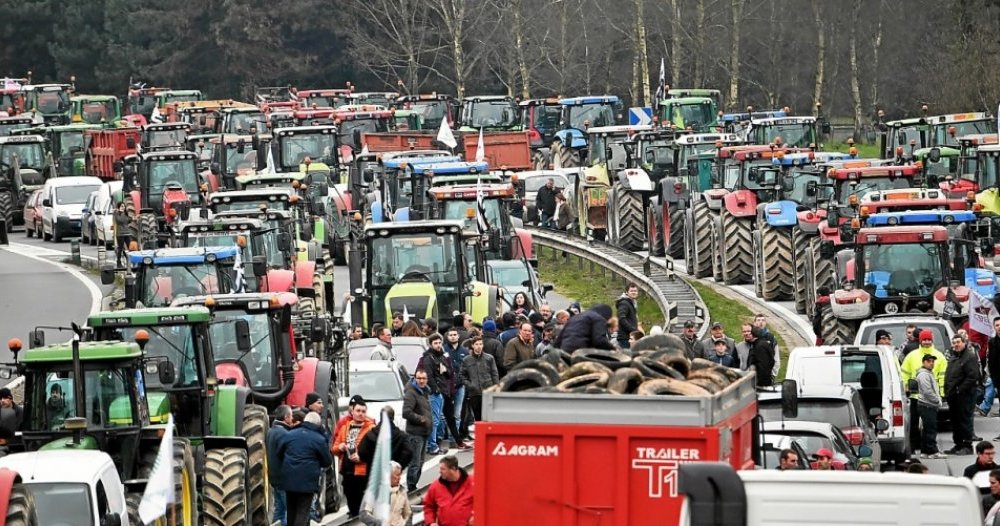
Spraying shit on the town hall has to be the best performative protest against bureaucratic bullshit ever conceived. The French farmers are in round 3 against the government of Gabriel Atal and the bright young thing PM is scrambling to defuse the situation ahead of Macron, never a popular figure in the countryside, making his cow-admiring, cheese tasting appearance at the annual Agricultural Salon in Paris this weekend. France loves a good protest and also love their farmers. The food and wine of France are at the heart of its self-image of being paradise on earth, the very essence of the good life. They parade their local produce as part of the ‘patrimoine’ and have been fierce in the protection of the various ‘pays’ and ‘produits’. There are 114 different protected types of agricultural produce under the AOP scheme in France, plus 363 registered protected wine designations. The obvious problem is that all of the protections mean nothing if the supermarkets are doing their best to drive price down and the incredible concentration of their purchasing power – the top 6 supermarkets are French owned and have revenues of €180 billion. Milk is bought at a marginal price that keeps farmer’s in penury and forced to use whatever production enhancers they can to keep alive, regardless of the long term damage to the cows. Several publicized suicides of farmers has reinforced the public support for the farmers and even with their protests blocking roads with what the Spanish are calling ‘tractorados’, as the protests spread to Spain, Czechia and Greece against what are seen as overly bureaucratic and complicated oversight and rules emanating from Brussels. 

What is putting a hair up the ass of the farmers is that these rules which are costly and frustrating do not apply elsewhere. So the target for their ire is the import of foods from outside of EU, milk from New Zealand seems a ridiculous example yet finds its way into European dairy products. French farmers did an inspired version of a trolley run this week by going into French major supermarkets, loading up in front of the cameras with products either masquerading as ‘French’ produce, or imported where the local version cannot be made for similar pricing; walking through the doors, without paying, and then donating it to the food banks that are a part of everyday life for many people in the rural farming dominant communities.

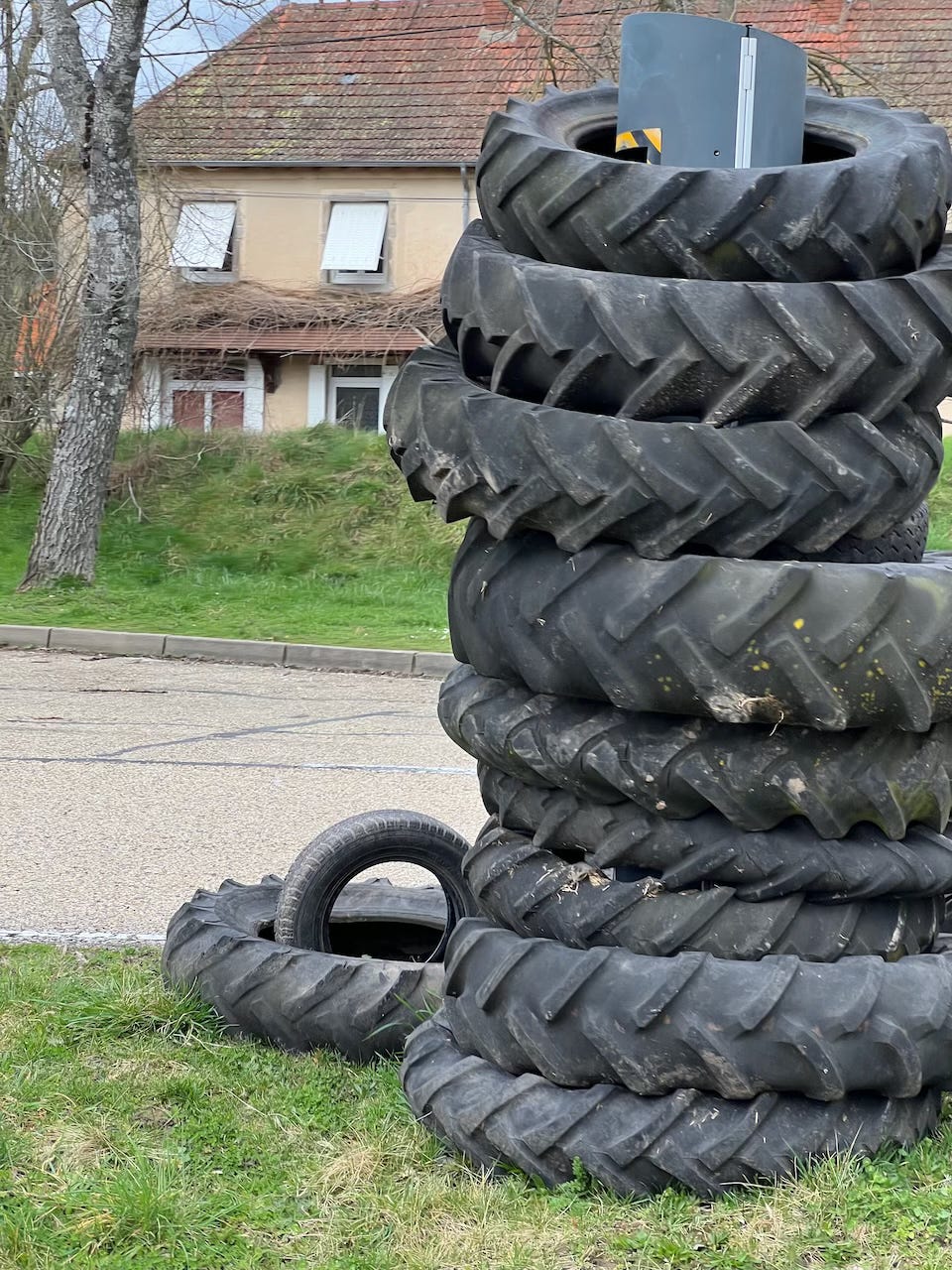
Attal and other officials were supposedly surprised by “the scale and fury of the protests” . I was impressed. We had tractors ambling along the major freeways in and out of Paris, Lyon, Bordeaux and most major cities, 3 abreast, at 5km an hour. Dumping of manure, hay bales and that staple of farm equipment, the old car tire, outside local offices of the government that are involved in any way with administering the EU’s farm policy. There is a speed camera on the way to Macon in a rural part of the department, and it often gets spray-painted but it got tired two weeks ago, and they have either not bothered to remove them or they keep them topped up. Surveys in France showed 90% plus support for the farmers, after all in principle they only want French produce as it’s the best and anything that threatens that gets an easy thumbs down.

Speed cameras looking tired

In a familiar routine now this has been going on now for 4 weeks, protests, disruption, and widespread support, Attal and other ministers urgently travel hither and nither meeting with the local Farmer’s Union guys. Every time one is interviewed on TV we get yet another example of regional dialects living on, I can barely understand them and I think the urbane Gabriel struggles too. Having survived his brush with the blue-overalled ‘Bobs’ with tractors and wellies, he dashes back to Paris and prepares another round of concessions. One early give was the repeal of the 16, yes 16, different regimes involved with preserving and controlling hedgerows. This week brought increased checks on food producers claiming their products are made in France and heightened legal action taken against those that did not conform. Attal promised there would be “product by product” checks on foods produced outside the EU containing pesticides banned across the continent to ensure they were stopped. Which is all well and good, but you cannot help but wonder why did it take 4 weeks of mass protest to get that to happen? The original protests were about the byzantine pension rules for Farmers and the pending removal of the agricultural fuel subsidiaries. Those got rolled back, but the issue is less about which little ‘give’ the government acquiesces to next but the ongoing fight underneath across the European Union.

We have an existential threat to European peace and harmony sitting in his bunker under Moscow at the end of a 30’ long table, probably at this very moment lecturing some poor lackey on the history of the Kievan Rus, or at least his own personal take on it. His Ukraine adventure cranked up energy prices to the point that inflation took off. Everyone got squeezed. Everyone was supposed to make sacrifices, but it seems the large corporations, especially the supermarkets, didn’t get that memo. While they record soaring profits, paying dividends and obscene bonuses to each other for ‘job well done’ the farmers and the ordinary person struggles with higher costs for fuel, food and rent. At the same time we have very lofty and admirable goals to right the years of ecological wrongs with rules to reduce loss of hedgerows, biodiversity, over dependence on monocultures and overuse of pesticides. However, no-one wants to price that in and so as the pithy adage goes, the shit flows downhill and the farmer is supposed to deal with the consequences, but the supermarkets can still make their profits and the ordinary person does not want to pay €0.20 more for a liter of milk or butter to keep the farmer from bankruptcy or in extremis, suicide. So yes, I guess I understand why they are spraying shit at government offices.

Lyon this week has been mild again and although the schools are off for ski week the only snow is at high elevations and the smaller, low level elevation places in the Jura and the Alps Maritime are fields of unwelcoming brown rather than glistening pristine white snow. It is the snow season so the restaurants and media are talking up the winter dishes like Choux Croute, Fondu, Tartiflette and other various holy alliances of cheese, pork and potatoes. 

Lenten Roses right on time

Saturday was St Modeste’s feast day but again no special dish in his honor. St Modeste is, it transpires, one of those fortunate chaps who was considered a generally good sort as Bishop of Trier and was rewarded with sainthood for being a best in class confessor. So he actually died in his bed in 489, no miracles, visions of the bleeding pumping heart or public beheading following several days torture for him. He got the honor as more of a local nomination process that people put forward their local martyrs and their very best confessors. After being canonized locally, all it took was some local big wig to persuade the Pope to support it, perhaps while on pilgrimage to Rome, or Avignon. Having a local saint was always good for tourism and trade with people coming to see whatever relics remained at the patron church, so the big-wig would return happy, some fiscal lubrication of the process may have been necessary, but it seemed to work for these what are called Pre-Congregational Saints. All good things come to an end, and Rome and the Pope stopped the local ‘Vote for your local Saint’ efforts in the 11th century. By that point I think they were afraid the title of Saint was being devalued as there were mushrooming cases of miracles, no shortage of martyrs and by that time there were confessors nearly everywhere. So St. Modeste is really an old style saint, and in full Lent no real feasting to be had anyway.

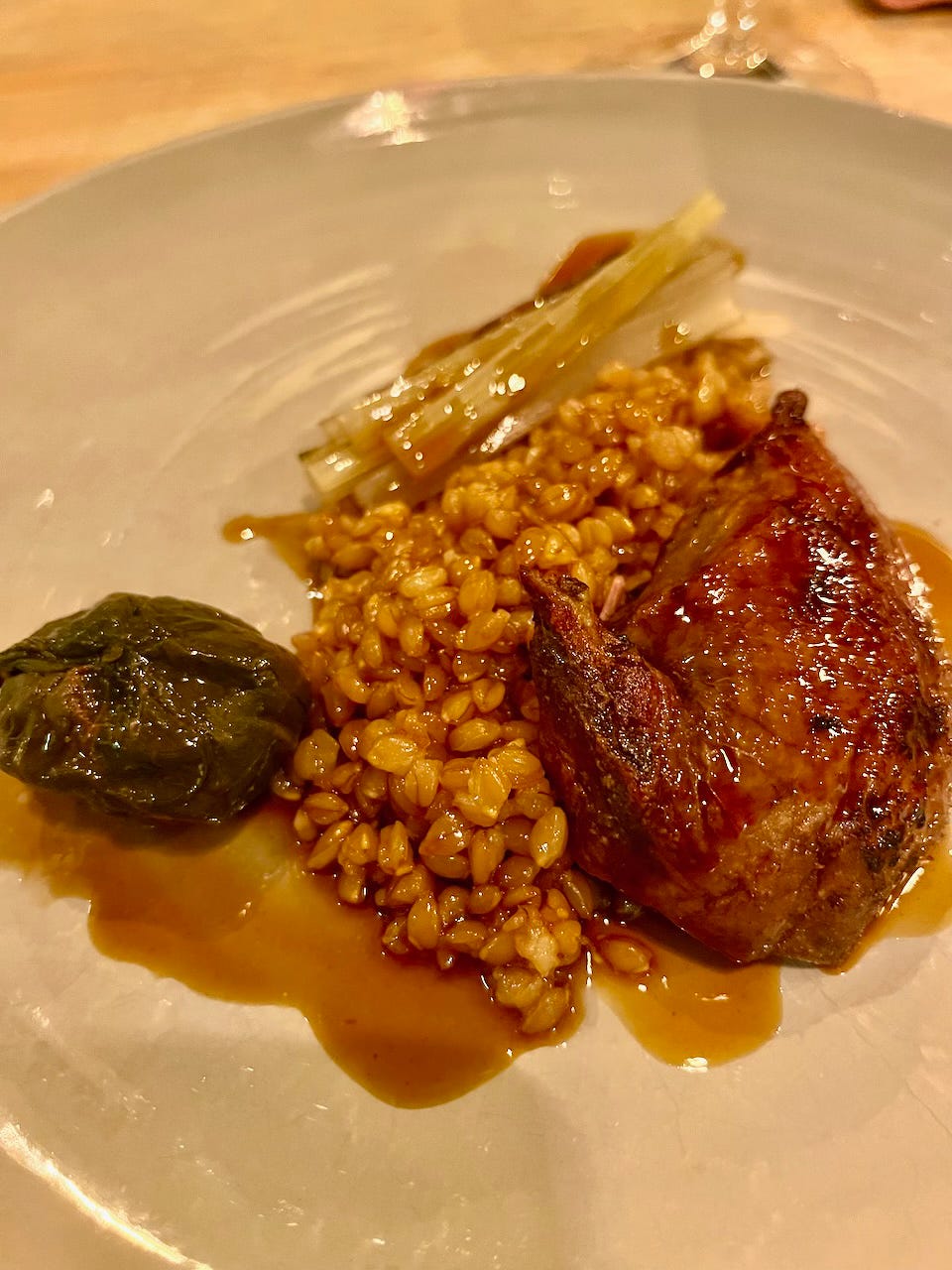
Friday night we went to “Le Cochon Qui Boit” tucked away in the narrow streets between the hillside below Croix-Rousse, ‘Les Pentes’ and the Saone. The Drinking Pig is a bright small space in a typical Lyonnais Canut-style building run by two guys who trained at Tetedoie, the expensive Mich one star up on the hill of Fourviere.  The food was very veggie led, a fabulous Jerusalem Artichoke bisque as an amuse-bouche signalled their intent. The wines are all natural as is the trend now. Natural wines all have labels that are bright-colored, and the names pun their way to taking what was traditionally very cheap wine from non-fashionable appellations into something cool and sells at 3 times the price of their traditional neighbors. The first white I tried was a Gros Plant Nantais which was crisp with a hint of the fruit from the Melon de Bourgogne grape it was partly blended from. More succesful than the Jura white that followed, a grassy yellow Chardonnay which only just made it on to the side of pleasurable. The Carignan from Languedoc was lighter than I expected but a great compliment to the Pigeonneau fermier de Bresse, petit épeautre et blettes. Filleted breast of roast pigeon, served with spelt, chard and a cabbage parcel stuffed with all the inside bits of the bird made into a deep red rich sausage. The dessert was insanely good. Describing it as butternut squash three ways does it a disservice, one caramelized round of roast squash sat in a nutty foam and was topped with a quenelle of butternut ice-cream wrapped in a stripe of chestnut puree. I always feel a bit uneasy taking pictures of plates as it is so clichéd, but here is the pigeon dish. In conclusion, this particular pig was well-fed and did his best to join in the drinking.

Gones for good

A Lyonnaise Life – Episode 1 February

There are several words that, if not unique to the city, they are redolent of and in their repetition evoque Lyon. Canut, canaille, coquins, bouchons and gones. Gones technically is local slang for young kids but is appropriated to represent those who think of themselves as truly Lyonnais, the children of the city. We have become the adopted children of this great city, we explore with a childlike curiosity. Since we found our little part of the 3rd near Place Bir Hakeim 18 months ago we have spent more and more time here, discovering our way around, venturing further and further and developing the useful mental maps of where we find the things we need.

As someone said to me this week, Lyon fundamentally is a city of nosh, ‘une ville de bouffe’. That manifests itself in various ways. There are more restaurants with Michelin stars here than in Paris, this is where people come from around the globe to learn to cook. From the pilgrim like Bill Buford, the serious foodies, to the many Japanese who come to worship at the altar of Bocuse. France is famously great for French food, and generally sucks at all other cuisines. Lyon is the exception. Many of the global visitors, having learned their part in the brigade at one of the many cooking schools, stay for a while and present their version of their culinary tradition for a French audience. So Lyon has a ton of good Japanese restaurants, Korean, Thai, West African and even Mexican (not Tex-Mex). They are forced to tailor their offering to the local tastes, especially at lunchtime, the hot spice is turned down to 2, a basket of sliced bagette is provided and there are 3 courses, the main course has a starch and a protein. 

The 3-course meal comes in around €20 as that is the average allowance that all workers get on their ‘carte resto’, the French equivalent of the old luncheon vouchers. It’s a great example of state intervention that works in France. The worker in a large company has a canteen where free or heavily subsidized food – again 3 courses and wine is available. When I visit a large client CMA-CGM in their gorgeous tower on the waterfront in Marseilles we go for lunch in their ‘canteen’; as much as it’s served buffet style the food is serious. For everyone else who does not have access to a company restaurant they receive a restaurant card, it looks like a standard credit card and functions like one for food and drink. Couple of rules: can only be used on a work day, no Sundays, no holidays; can be used anywhere you might buy lunch from supermarkets, snack bars, fast food or restaurants. Food or booze but up to a daily limit, Mme Britton’s card is €25 a day. Just think about that with an American legal mind set: a company provided card is used to buy alcohol?! The deal with the card is the employee pays a contribution, the restaurant gives a discount and the company pays the spread. The company gets a tax deduction, the employee gets a tax-free perk, the restaurant/retail business gets business for a discount; win:win:win.

It is winter in Lyon, or what passes in our post-truth days as winter, it’s mid-February and since the Fête de Chandeleur, February 2nd the temperature has been more spring like with warm showers and temperatures in 50’s and 60’s, 8-14 C. We missed the pancakes on Chandeluer and will do likewise tomorrow on Shrove Tuesday. Not that I have anything against them, we had an old recipe that was Rachel’s grandmother’s for Finnish Pancakes, which produced crêpes as close to what I remember as my Mum’s Pancake Day pancakes, but we cannot find it. I remember my Mum gamely running a Pancake Race with other mothers at my elementary school in Bradford on Avon, I am pretty sure that is a tradition that has been consigned to the Ladybird Book version of English History and not something you would catch a French housewife doing on Chandeleur.

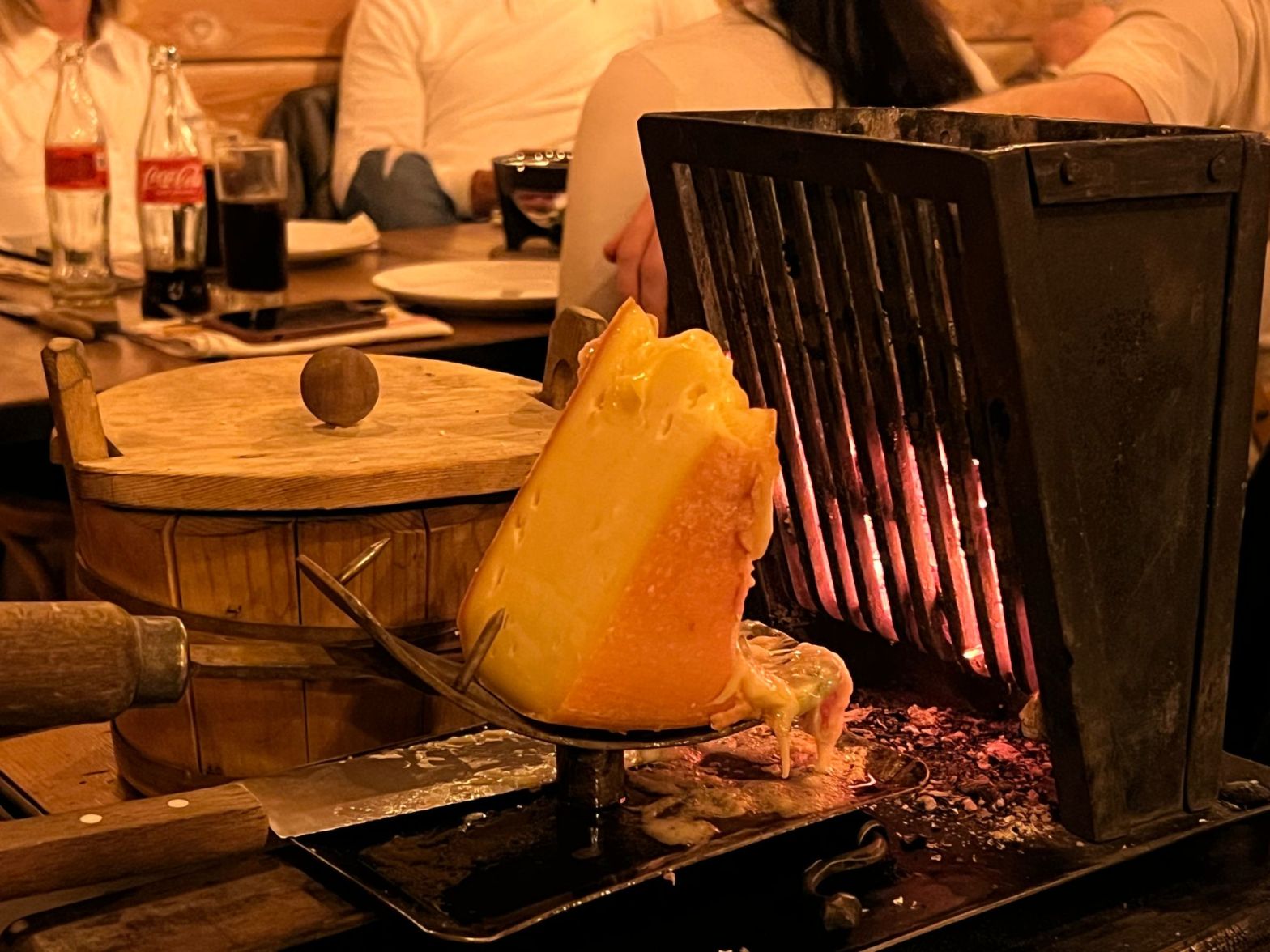
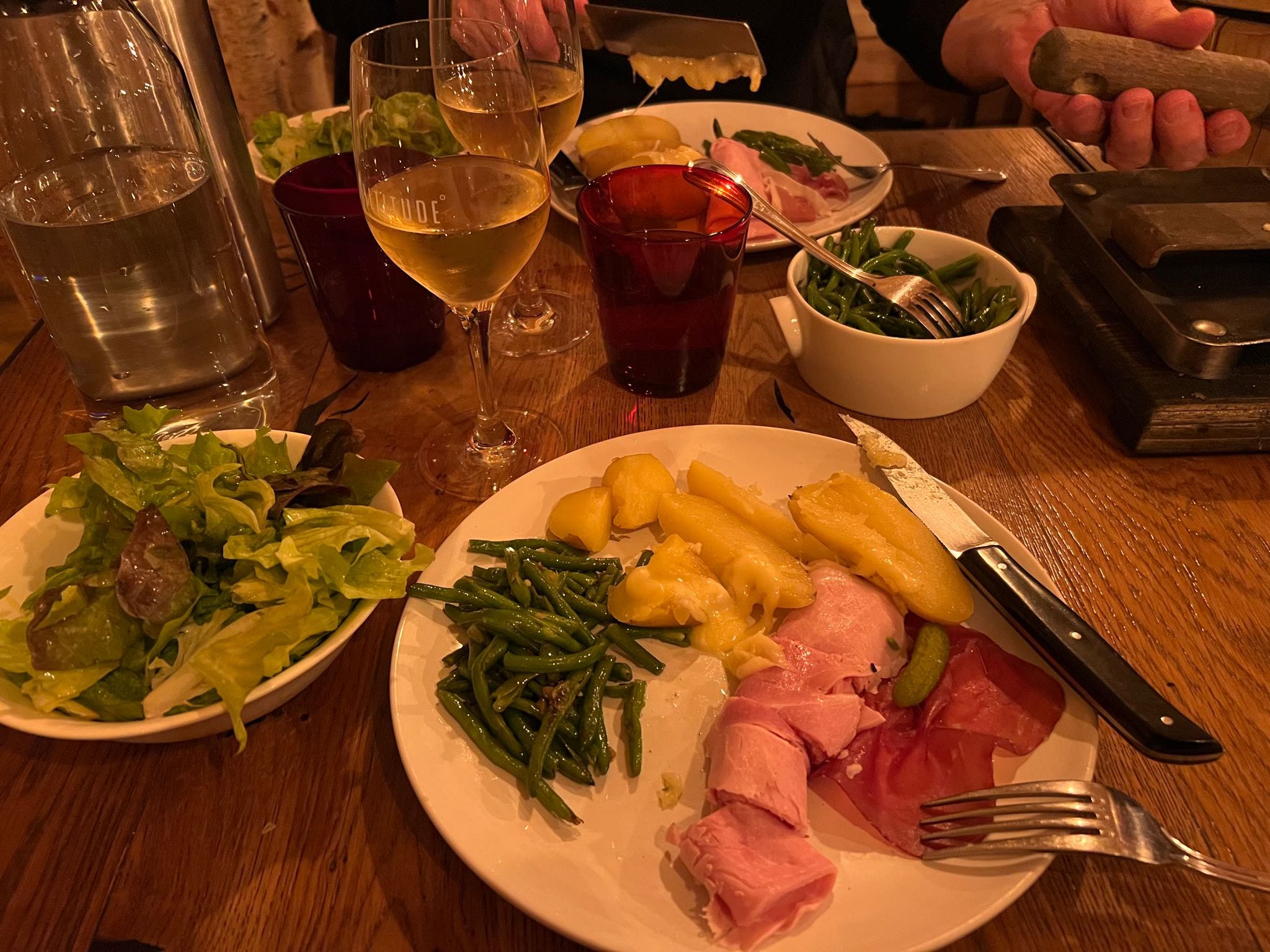
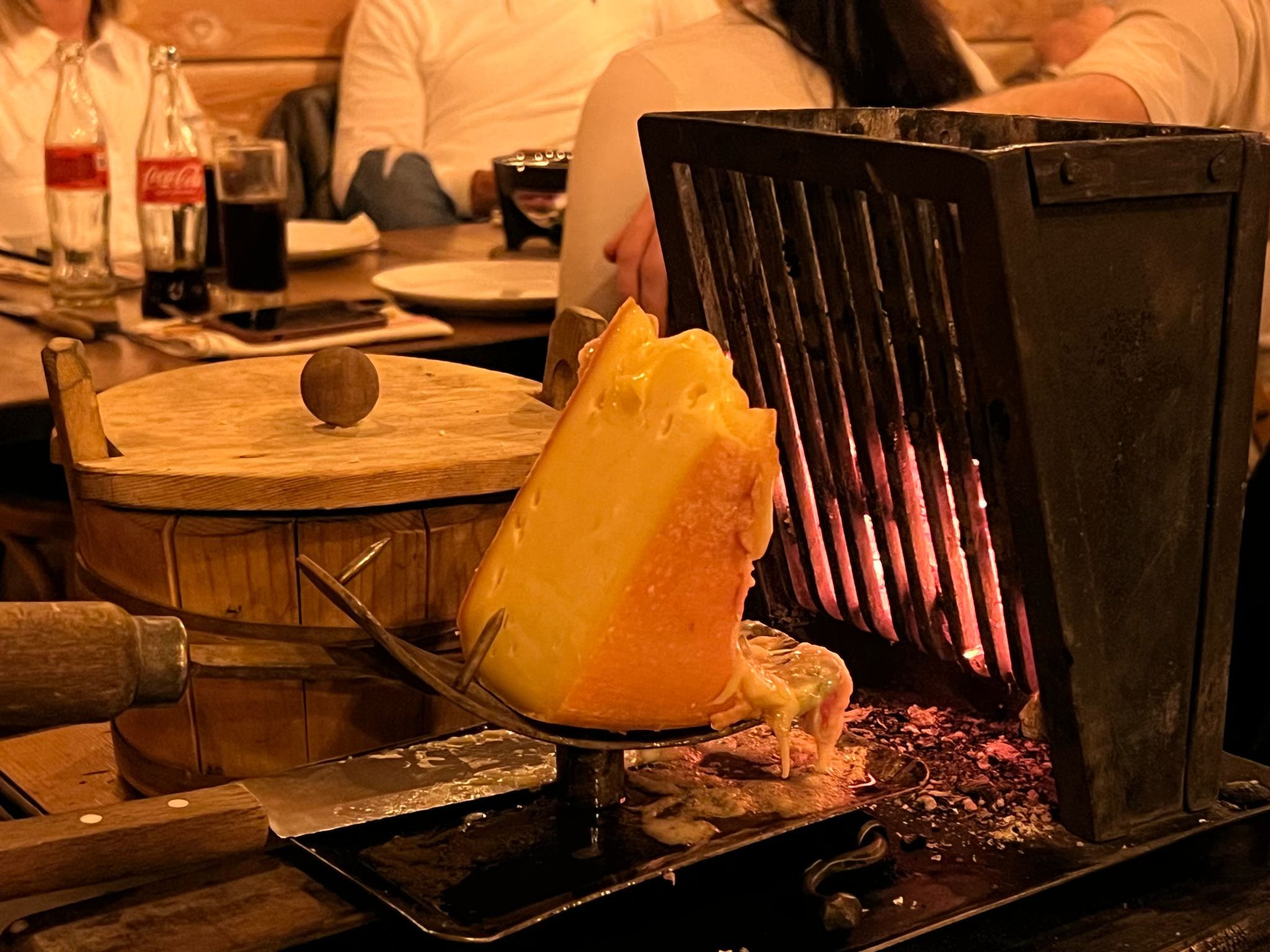
In the real spirit of winter, especially as we are but an hour from the Alps, we went for Raclette on Saturday. The restaurant l’Altitude on Rue de Crequi is the best rated of the mountain style places in Lyon and is a very pine-plank walled ski-lodge of a spot. Raclette is a cheese and the deal with the eponymous dish is that the cheese is melted to the point of bubbling yummyness and then scraped over steamed potatoes to eat with various hams and dried meats with some nods at healthiness via sides of a green salad or haricot beans. It is meant to fill a starving stomach following hours of skiing in cold weather, so it is heavy and filling. Lazing around watching Fulham thump Bournemouth followed by England remarkably beating Wales in the 6 Nations is not the most exacting form of exercise as preparation for such a repast, but we did it justice. The Savoyard food or Mountain cuisine developed around what you can keep in semi-isolated mountain valleys during winter and pre-refrigeration. Cheese, air dried hams and sausages, potatoes and pickles are served in various forms; tartiflette, which is basically a complete baked cheese filled with potatoes and added cream to make it more runny; fondue, which is either melted cheese into which you dip stuff or Raclette, which is made from various hard mountain cheeses made from the milk of cows who have been grazing on the rich summer pastures like Comte, Beaufort or Raclette itself. 

Most places have electric hot place devices to do the melting, but Altitude has charcoal fired table-top braziers that are awesome at heating the cheese together with the diners and just about look safe, in a way that you know would never be allowed in the US without a shit storm of lawsuits. By the time we had near consumed the 300g of cheese allocated per person, we were cheery-cheeked and down to t-shirts. They unsurprisingly do a good line in ice cream and sundaes to help you cool down. The ice cream was seriously good, house made and artisanal, including a Charteuse flavored one, which is a bit their thing as they have a bunch of cocktails using the green and yellow monk’s bane. To finish, I felt obligated to have a Chartreuse but chickened out and went with the 2cl rather than the 4cl option. They presented a special glass about the size of a thimble, into which a monstrous Jeroboam sized bottle of the green lightning poured by measure. I had forgotten how much of a punch it packs, and we agreed we should have a bottle at home, it’s a very Lyon thing.

Les bonnes address: 

L’Altitude

Charteuse