Gones for good: 4 the bissextile episode

Leap Year babies are defined by their birthdays in a way that trumps even astrology. There is a family in Utah who have three leap year Feb 29th-born children. They do have 7 kids in all and the second was induced, so I tend to think they might have worked out how to avoid it if that had wanted to. The French for Leap Year is bissextile which has nothing to do with gender, it is all due to the Romans. They referred to February 23 as the 6th day before the beginning of March, and the extra day inserted on February 24 was called the “second sixth” day, or “bissextile day” in a “bissextile year”. It does not roll off the tongue like Leap Year so we can be forgiven for having forgotten about its origins.

In France, they publish a newspaper every 4 years on the 29th called ‘La Bougie du Sapeur’, it’s a satirical broadsheet that has been published since 1980, so this year was edition 12. I tried to buy one on the 29th, but our local newspaper stand was closed because it was school holidays and ski-week. If you want an illustration of how serious the French take their vacations there it is, the newspaper stand closes, so the guy can have his holiday too.

Who does not get the 29th off is St Auguste. Yes, ‘le jour bissextile’ has a saint and like every other day is a Saint’s Day, so even if you are fated to be born on the 29th you still have your own patron saint; who says the Catholic Church is uncaring for its flock? St Auguste was a priest who was part of the mission to China in the 19th Century who suffered a horrible death in Guangxi province on February 29th, 1856. “He was locked into a small iron cage, which was hung at the gate of the jail. The planks he stood on were gradually removed, placing a strain in the muscles of the neck, and leading to a slow and painful death from suffocation. He had already died when he was decapitated. His head was hung from a tree by his hair. Children were said to have thrown stones at the head until Chapdelaine’s head fell to the ground and was devoured by street dogs and hogs.” The French responded by joining the British in what is unflatteringly called the Second Opium War, as in we and the French, with help from the US, went to war on China to force the Emperor and his government to let us sell opium to the people of China. We used real gun boats in our diplomacy and were successful in our aims, we also took Kowloon and added it to our Hong Kong territories and also insisted upon the legal right to proselytize Christianity, negotiated in the name of Auguste Chapeldain, who had been ‘martyred’ in doing just that. China today looks back on this period with great disdain if not shame, and Xi often mentions the Western efforts to get involved between them and Taiwan as being similarly colonial.

In Guangxi today you can enjoy a life-size diorama showing Saint Auguste kneeling before the magistrate who sentenced him to death. A six-metre bronze mural shows the cage in which he suffocated to death. A poetry contest gives prize money to those who praise “iron-willed” magistrate Zhang. So definitely not a popular figure in China is our Saint Auguste.

Lyon is back to normal today, the kids are in school and Reymond the baker is back in action. While he was off skiing, we were unfaithful in our bread breaking and went to Mado on Rue de la Thibuadiere. Mado made it into the latest edition of the foodie bible, the annual magazine “Fooding”. They do a fabulous Panettone at Christmas and their breads are hearty grained, organic beauties. However, it is their baked goods that have an opium-like hold on our taste buds. Their current offerings include a small brioche stuffed with apple sauce, a pastry-like crusted cake with preserved plums that is probably Italian in origin too called a Pasticcioto, scones, the most glorious lemon flavored brioche bun that has an almost hot-cross-bun like top crust, and a large what I can only describe badly as a large Jammy Dodger with two heart shape openings for the jam which is called Une Spectacles. Leap Year’s Day breakfast comprised of a selection of these, and we were still suffering a sugar coma about 2 hours later.

We have been watching ‘Bear’, the TV show. For those who have not yet had the pleasure, it starts unsettlingly with various Chicagoans shouting at each other in the shitty kitchen of a sandwich shop, while loud 1980s hair metal plays at a volume only just below that of the hammering dialog. It also features as a leading character, Ritchie, one of the shoutiest, and played by the actor who first came to attention as Desi, part of the Desi and Marnie sickly sweet folk duo in Lena Dunham’s ‘Girls’, as played by Ebon Moss-Bachrach. I almost stopped watching the show because Ritchie was so crushingly annoying. However, with affirmation from Holly that it was worth the perseverance I did continue to watch it, and grew to enjoy its unadulterated food porn, its exterior shots which are a love-letter to Chicago and its odd soundscape of a mix of great and grating 80s and 90s songs. Ritchie’s character arc does actually move towards a positive epiphany, and even I started to root for him at the end of the second season. The tension and pressure in delivering such high-end serious cuisine, as portrayed in the show, strikes a balance that just about tilts towards earnest craft and excellence and away from pretentious tosh, but only just.
Little Entrements with the coffee

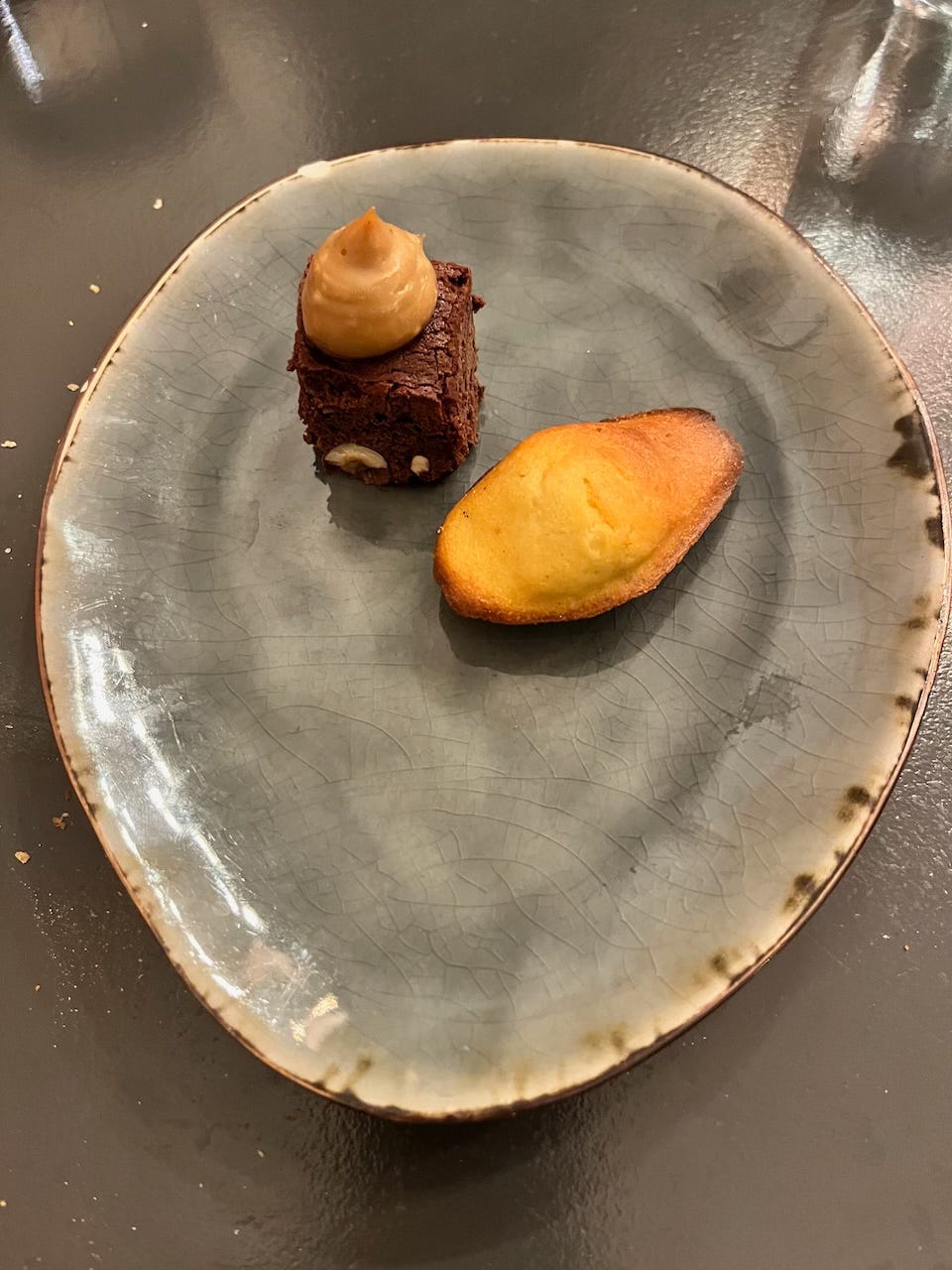
A million miles away from the restaurant experience at the 3-star place that Ritchie learns to polish forks for 3 days is Bistro B on Rue Dugesclun. A small front room downstairs with yet another Canut-style mezzanine above, holding a combined total of 30 covers decorated with a natural-wood pretend garden fence along the walls. The host/ sommelier/ cocktail maker/ waiter/ table-busser greets you in a long server’s apron with almost too intricate an arrangement of straps on the back. It is relaxed, as is he. The menu is accessed through a QR card, we get waters and a ‘pot’ of Chardonay from the Rhone Valley. They just received their Michelin Guide entry under Bib Gourmand, the great food for under €40 rating, but the food is as serious as it is affordable. I had the Duck main course, which was two ruddy steaks cut across the breast on a bed of celery purée and some assorted small select veggies and bloody delightful: “Magret de canard au vinaigre de poire, sauce gastrique, poire rôtie, pommes grenailles et mousseline de céleri”. Everything was well executed, service was good, amazing really, seeing it was one guy and a small kitchen. Two hours flew by, concluded with perfect little brownies and memorable madeleines with the coffee. 3 courses and wine for just over a hundred Euros, and we meandered our way home, happy bunnies.
Pedestrianized streets in the 3rd


Gones for good: Episode 3- Farm to table

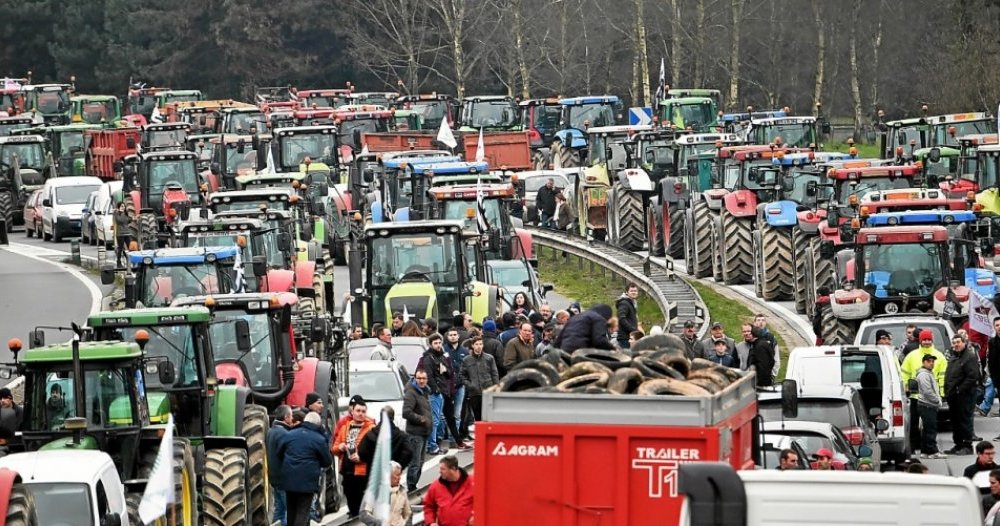
Spraying shit on the town hall has to be the best performative protest against bureaucratic bullshit ever conceived. The French farmers are in round 3 against the government of Gabriel Atal and the bright young thing PM is scrambling to defuse the situation ahead of Macron, never a popular figure in the countryside, making his cow-admiring, cheese tasting appearance at the annual Agricultural Salon in Paris this weekend. France loves a good protest and also love their farmers. The food and wine of France are at the heart of its self-image of being paradise on earth, the very essence of the good life. They parade their local produce as part of the ‘patrimoine’ and have been fierce in the protection of the various ‘pays’ and ‘produits’. There are 114 different protected types of agricultural produce under the AOP scheme in France, plus 363 registered protected wine designations. The obvious problem is that all of the protections mean nothing if the supermarkets are doing their best to drive price down and the incredible concentration of their purchasing power – the top 6 supermarkets are French owned and have revenues of €180 billion. Milk is bought at a marginal price that keeps farmer’s in penury and forced to use whatever production enhancers they can to keep alive, regardless of the long term damage to the cows. Several publicized suicides of farmers has reinforced the public support for the farmers and even with their protests blocking roads with what the Spanish are calling ‘tractorados’, as the protests spread to Spain, Czechia and Greece against what are seen as overly bureaucratic and complicated oversight and rules emanating from Brussels. 

What is putting a hair up the ass of the farmers is that these rules which are costly and frustrating do not apply elsewhere. So the target for their ire is the import of foods from outside of EU, milk from New Zealand seems a ridiculous example yet finds its way into European dairy products. French farmers did an inspired version of a trolley run this week by going into French major supermarkets, loading up in front of the cameras with products either masquerading as ‘French’ produce, or imported where the local version cannot be made for similar pricing; walking through the doors, without paying, and then donating it to the food banks that are a part of everyday life for many people in the rural farming dominant communities.

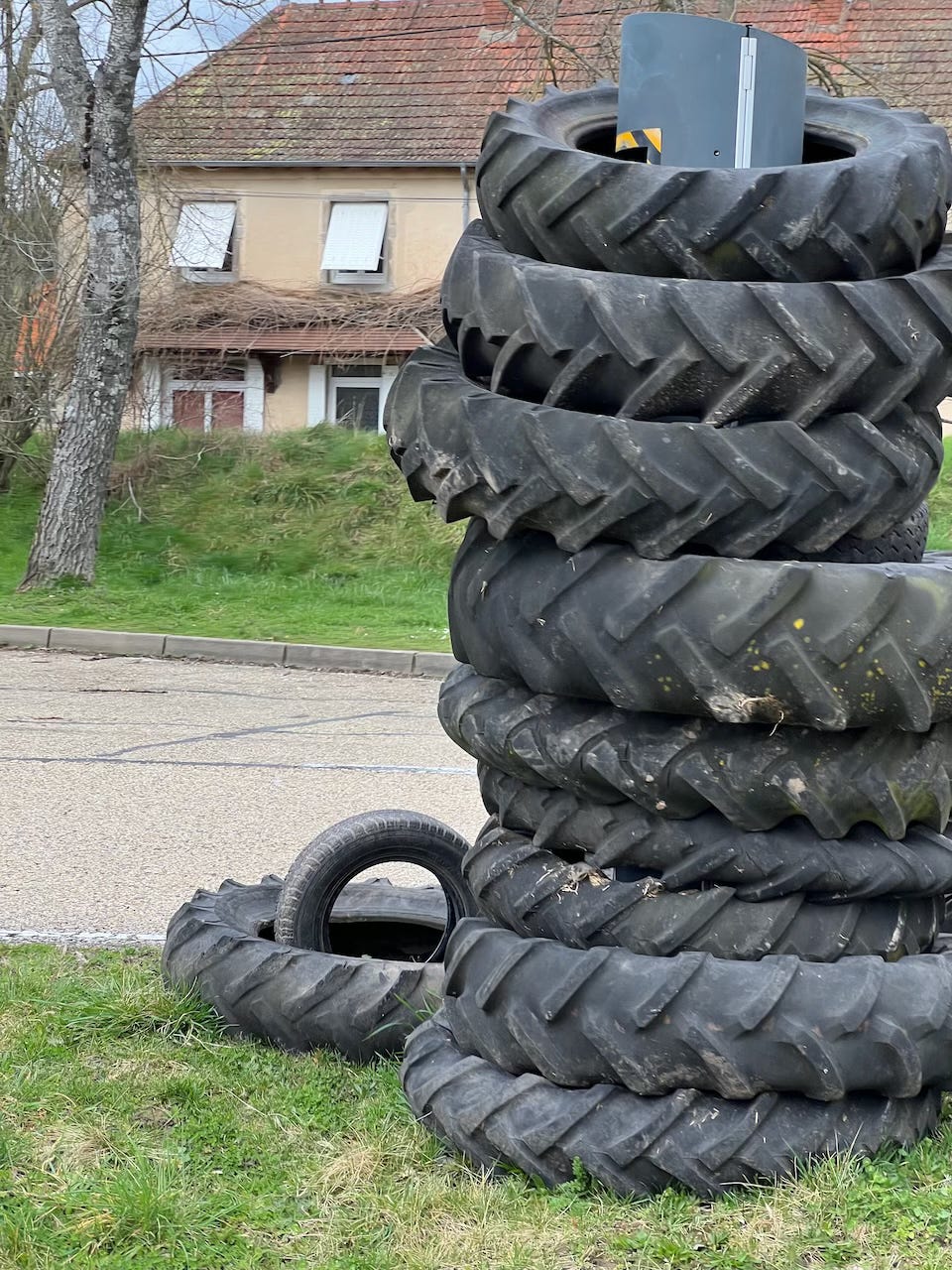
Attal and other officials were supposedly surprised by “the scale and fury of the protests” . I was impressed. We had tractors ambling along the major freeways in and out of Paris, Lyon, Bordeaux and most major cities, 3 abreast, at 5km an hour. Dumping of manure, hay bales and that staple of farm equipment, the old car tire, outside local offices of the government that are involved in any way with administering the EU’s farm policy. There is a speed camera on the way to Macon in a rural part of the department, and it often gets spray-painted but it got tired two weeks ago, and they have either not bothered to remove them or they keep them topped up. Surveys in France showed 90% plus support for the farmers, after all in principle they only want French produce as it’s the best and anything that threatens that gets an easy thumbs down.

Speed cameras looking tired

In a familiar routine now this has been going on now for 4 weeks, protests, disruption, and widespread support, Attal and other ministers urgently travel hither and nither meeting with the local Farmer’s Union guys. Every time one is interviewed on TV we get yet another example of regional dialects living on, I can barely understand them and I think the urbane Gabriel struggles too. Having survived his brush with the blue-overalled ‘Bobs’ with tractors and wellies, he dashes back to Paris and prepares another round of concessions. One early give was the repeal of the 16, yes 16, different regimes involved with preserving and controlling hedgerows. This week brought increased checks on food producers claiming their products are made in France and heightened legal action taken against those that did not conform. Attal promised there would be “product by product” checks on foods produced outside the EU containing pesticides banned across the continent to ensure they were stopped. Which is all well and good, but you cannot help but wonder why did it take 4 weeks of mass protest to get that to happen? The original protests were about the byzantine pension rules for Farmers and the pending removal of the agricultural fuel subsidiaries. Those got rolled back, but the issue is less about which little ‘give’ the government acquiesces to next but the ongoing fight underneath across the European Union.

We have an existential threat to European peace and harmony sitting in his bunker under Moscow at the end of a 30’ long table, probably at this very moment lecturing some poor lackey on the history of the Kievan Rus, or at least his own personal take on it. His Ukraine adventure cranked up energy prices to the point that inflation took off. Everyone got squeezed. Everyone was supposed to make sacrifices, but it seems the large corporations, especially the supermarkets, didn’t get that memo. While they record soaring profits, paying dividends and obscene bonuses to each other for ‘job well done’ the farmers and the ordinary person struggles with higher costs for fuel, food and rent. At the same time we have very lofty and admirable goals to right the years of ecological wrongs with rules to reduce loss of hedgerows, biodiversity, over dependence on monocultures and overuse of pesticides. However, no-one wants to price that in and so as the pithy adage goes, the shit flows downhill and the farmer is supposed to deal with the consequences, but the supermarkets can still make their profits and the ordinary person does not want to pay €0.20 more for a liter of milk or butter to keep the farmer from bankruptcy or in extremis, suicide. So yes, I guess I understand why they are spraying shit at government offices.

Lyon this week has been mild again and although the schools are off for ski week the only snow is at high elevations and the smaller, low level elevation places in the Jura and the Alps Maritime are fields of unwelcoming brown rather than glistening pristine white snow. It is the snow season so the restaurants and media are talking up the winter dishes like Choux Croute, Fondu, Tartiflette and other various holy alliances of cheese, pork and potatoes. 

Lenten Roses right on time

Saturday was St Modeste’s feast day but again no special dish in his honor. St Modeste is, it transpires, one of those fortunate chaps who was considered a generally good sort as Bishop of Trier and was rewarded with sainthood for being a best in class confessor. So he actually died in his bed in 489, no miracles, visions of the bleeding pumping heart or public beheading following several days torture for him. He got the honor as more of a local nomination process that people put forward their local martyrs and their very best confessors. After being canonized locally, all it took was some local big wig to persuade the Pope to support it, perhaps while on pilgrimage to Rome, or Avignon. Having a local saint was always good for tourism and trade with people coming to see whatever relics remained at the patron church, so the big-wig would return happy, some fiscal lubrication of the process may have been necessary, but it seemed to work for these what are called Pre-Congregational Saints. All good things come to an end, and Rome and the Pope stopped the local ‘Vote for your local Saint’ efforts in the 11th century. By that point I think they were afraid the title of Saint was being devalued as there were mushrooming cases of miracles, no shortage of martyrs and by that time there were confessors nearly everywhere. So St. Modeste is really an old style saint, and in full Lent no real feasting to be had anyway.

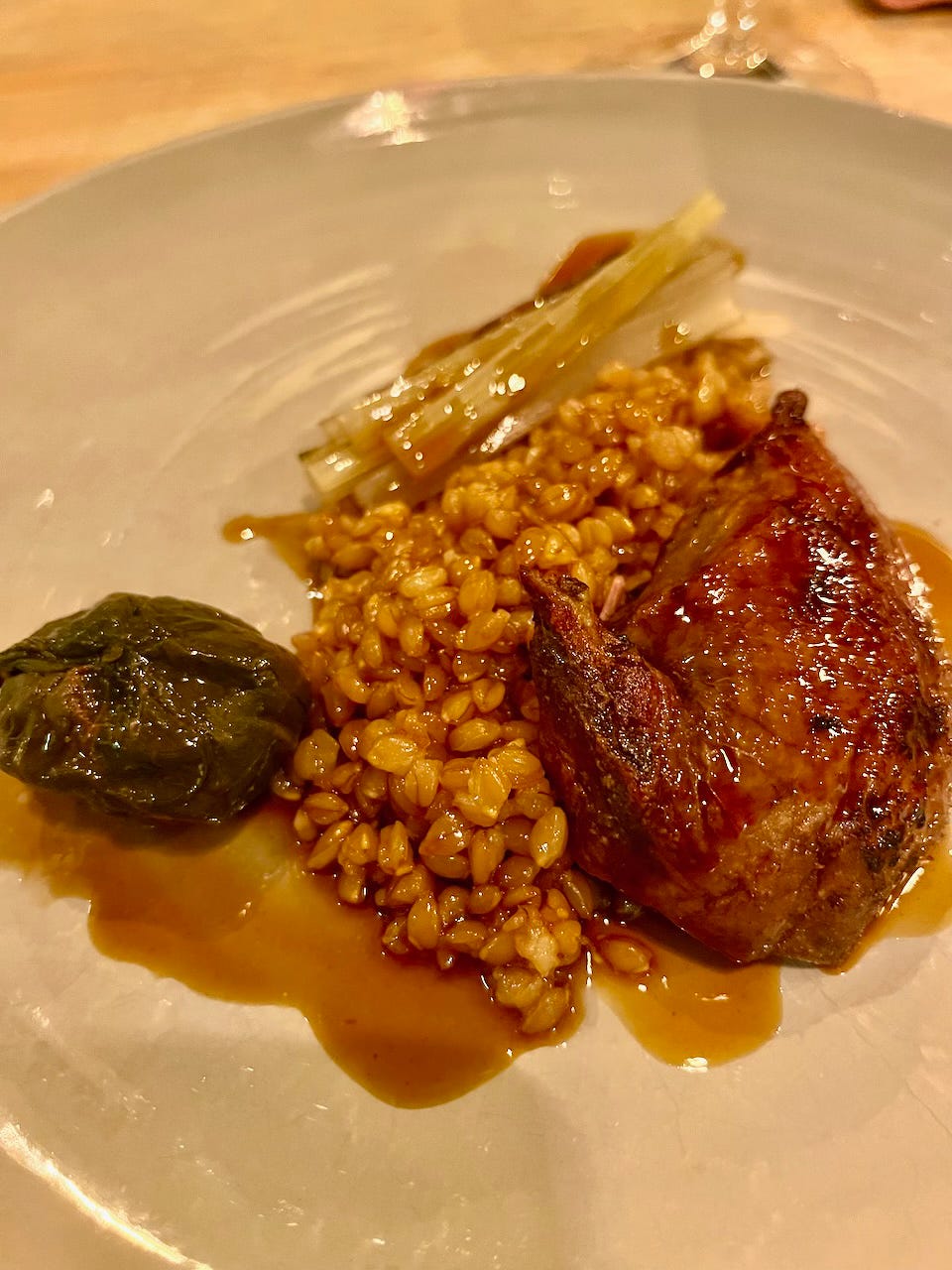
Friday night we went to “Le Cochon Qui Boit” tucked away in the narrow streets between the hillside below Croix-Rousse, ‘Les Pentes’ and the Saone. The Drinking Pig is a bright small space in a typical Lyonnais Canut-style building run by two guys who trained at Tetedoie, the expensive Mich one star up on the hill of Fourviere.  The food was very veggie led, a fabulous Jerusalem Artichoke bisque as an amuse-bouche signalled their intent. The wines are all natural as is the trend now. Natural wines all have labels that are bright-colored, and the names pun their way to taking what was traditionally very cheap wine from non-fashionable appellations into something cool and sells at 3 times the price of their traditional neighbors. The first white I tried was a Gros Plant Nantais which was crisp with a hint of the fruit from the Melon de Bourgogne grape it was partly blended from. More succesful than the Jura white that followed, a grassy yellow Chardonnay which only just made it on to the side of pleasurable. The Carignan from Languedoc was lighter than I expected but a great compliment to the Pigeonneau fermier de Bresse, petit épeautre et blettes. Filleted breast of roast pigeon, served with spelt, chard and a cabbage parcel stuffed with all the inside bits of the bird made into a deep red rich sausage. The dessert was insanely good. Describing it as butternut squash three ways does it a disservice, one caramelized round of roast squash sat in a nutty foam and was topped with a quenelle of butternut ice-cream wrapped in a stripe of chestnut puree. I always feel a bit uneasy taking pictures of plates as it is so clichéd, but here is the pigeon dish. In conclusion, this particular pig was well-fed and did his best to join in the drinking.

Gones for good: Episode 2 – Love, pain and ashes

Busy days. A late celebrated anniversary due to me being back in the Bay Area on the actual day (that was worth its own blog, but it would be like falling on a bruise, I’ve done that before, which if you didn’t read it can be found here), Shrove Tuesday and Mardi Gras, the fête de St Valentin.

France is on one hand religious, as late as 2011 over 50% of the population believed in God if asked, although it’s now down to 44% but 35 million Frenchmen and Frenchwomen self identify as Christian. On the other, it is constitutionally not religious, your Church wedding means nothing. There is no ‘And so help me God’ in courts, no invoking of His blessing when they sing the national anthem. No opening the Senate with a pithy prayer, and no place legally for any religious symbols at school. As much as people would point to the enforcement of the latter having become more a casus belli of the right and their fear of what they see as the visible signs of the march of radical Islam across the fatherland. Crucifixes around necks and yarmulke had been quietly ignored for decades, but the hijab and more recently the full body cover abaya have drawn the ire and attention. Macron is courting the center right or more pointedly not allowing the far right under Le Pen to profit from the cry for some casual cultural bullying. So religious, except when it’s mainly not.

Bugne de Lyon

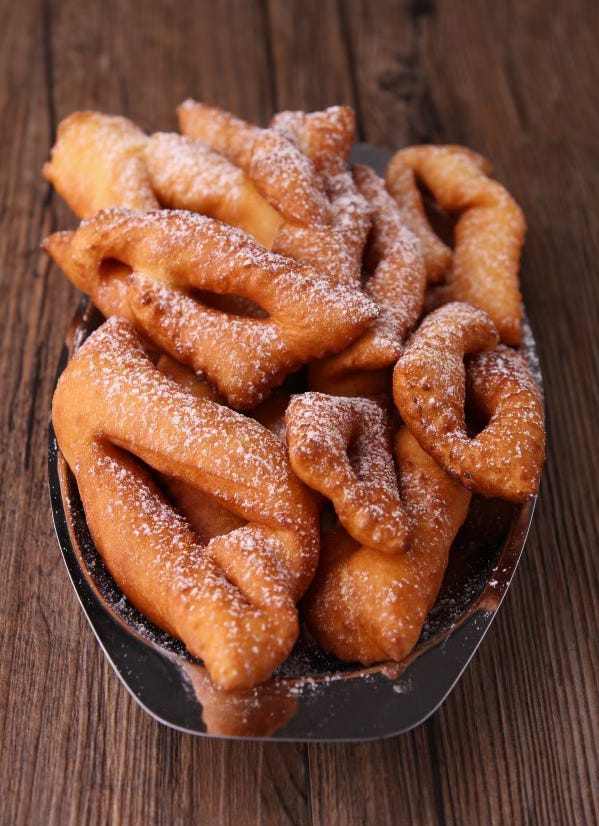
Every day in the bakers they write on a chalk board the Saint for the day. When they finish the weather forecast on France 2, they give the sunrise and sunset, phase of the moon and the Saint’s Day. Tomorrow is St Julienne for example. I am unaware if St Julienne has any particular pastry or treat but we are still technically in the season of the Bugne. This is a Lyonnaise doughnut, very light version of a doughnut and light years from a Crispy Creme or the English jam doughnut. Traditionally a Mardi Gras treat as it has ‘gras’, grease or fat; it is a small shape of dough fried in fat ahead of lent’s lean days. Dusted with sugar, it’s a sticky-fingered treat for the ‘gouter’. It is the English who are feted for their afternoon tea but ironically other than the legions of the retirees who, having strided the green and sadly now fetid land, retire to a local tea shop for tea and scones, most Brits do not have afternoon tea. Yet in France, every child returns from school between 4 and 5 to have the treat of the gouter, the local version of afternoon tea. A drink with a sweet something, bugne, chocolate bars, pain au chocolat or bread with lashings of Nutella. The adults partake with tea, sadly usually without the addition of milk and many, many bizarre herbal offerings masquerading as bringing some healthy side benefit. I am not a massive fan of bugne Lyonnaise, but neither am I a fan of doughnuts regardless of which side of the Atlantic they originate from. I do, however, really like the ‘ears’ style doughnut, called Elephant Ears or if you are from the South West ‘Bear’s Ears’. Les Oreilles d’Ours are flat layers of flaky pastry, fried of course, but flavored with orange water, fleur d’oranger. They are dangerously good, bought by the 100g and needing to be eaten within minutes to be fully appreciated.

Reymond bakes beautiful bread

The French are zealously religious about bread. Their church is the Boulangerie. We are blessed in our Burgundy town of 3,400 souls with 6 bakers, with rotating days of closure fresh bread is available 7 days a week, 6 days a week with two bread bakings, morning and afternoon. The supermarkets also sell bread, but you really must have given up on life to buy your bread there. The bakery scene is further slightly subdivided into Boulangeries, places that sell only breads, Boulangerie- Pattisseries, places that sell Bread and cakes and Patisseries that sell only cakes. There is a further odd distinction with Banettes, which are bakers who sell pre-prepared sandwiches, small individual deserts and cold drinks which serves the lunch crowd and school kids; most have some seating as its uncool in France to eat on the run. There are 35,000 boulangeries, according to the Confédération Nationale de la Boulangerie Pâtisserie Française, about the same number of communes in France. The distribution is not that straightforward as the major towns have more and the villages have lost their bakers over the years. Paris has 1360 bakeries, Lyon 286. In 1960 there were 50,000 in France but from then until around 2010 they declined steadily with many disappearing from rural villages, as the population moved into the towns and old retiring bakers were not replaced. They flat lined for a few years but since 2017 there has been a resurgence, from 2017 to 2023 the number of boulangerie-pattiseries grew by 9% as a new generation of scratch bakers has joined the profession.

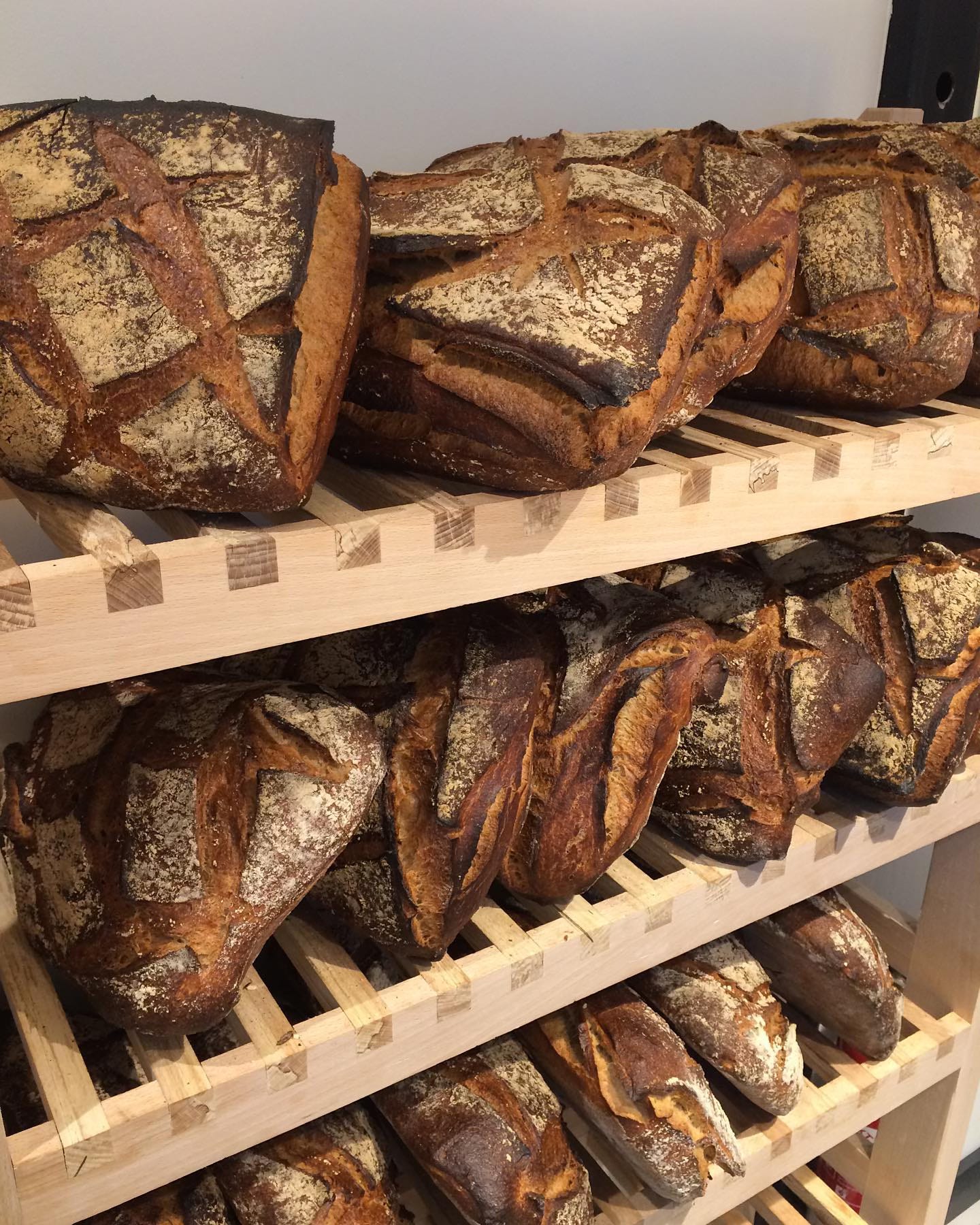
A boulangerie has to sell the basic baguette ‘traditionelle’, which is price controlled and currently €1.30 and 250 grammes. Generally avoid this and get the next one up, in Burgundy we get the Charolais which is €0.40 more expensive but sour dough rather than a commerical yeast. In France overall they bake and sell 6 billion baguettes per year, equivalent to half a baguette per person per day so yet the french like their daily bread. 82% admit to eating bread every day and an old expression to describe something as taking a painfully long time is “longue comme un jour sans pain”, as long as a day without bread. In Lyon, we have an embarrassment of riches bread wise and part of the fun exploring around where you live is working out who has the best bread, the best croissant and sorting out when your first choice is open – Reymond in our case, open only Monday to Friday and closed (congé) for August and for ‘ski week’ next week. Local knowledge like knowing who is closed when, who is open on Sunday is a result of some worthwhile exploration. At some point I will have a deep dive on Reymond as they have amazing breads and other treats. The initial frustration of moving to France from the US and not having every shop open whenever you want it soon fades as you realize that the people who work in shops and restaurants have families too, they need time off to play with their kids, they need to get a proper meal at lunchtime and if you need some more mulch for the garden remember to get it Saturday as everywhere is closed on Sundays. I like that the service is professional without ass-kissingly desperate for the tip, I like that the wait staff get benefits and vacation, I like that I am never hustled for a tip when getting a coffee or buying a sandwich. Is it frustrating that Reymond is closed for two weeks in February? Yes, but really, what the fuck? Other breads are available. The guy has kids, and he is up at 4.00am every day of the week creating some of the best bread in the world, so if the kids are off school for Ski-Week I am happy he is with them and then comes back to bake, happy and content to put his love into his dough and not put the love for the other dough above all else, like in some places we could mention.

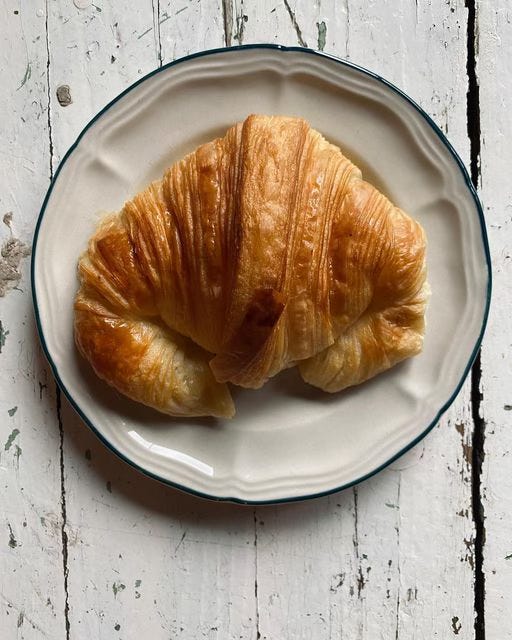
Croissants and their fellow breakfast treats like Pain au Chocolat (which for some reason my kids and I always have to pronounce in a New Jersey accent as “Panna Shock-a-latt” ) are grouped as Viennese pastries, ‘Viennoisseries’. The supposed story is that they were originally created in Vienna in the crescent shape as symbol of the victory of the Holy Roman Empire over the crescent-bannered army of the previously unstoppable Ottoman Empire on September 12th 1683. You will see Viennoisseries as the offering engraved on many Boulangerie windows and store fronts. Sometimes the baker will specify which butter they use, Reymond for example uses only butter from Charentes, French butter generally has a higher fat content than US butter which helps give that nutty mouth feel.

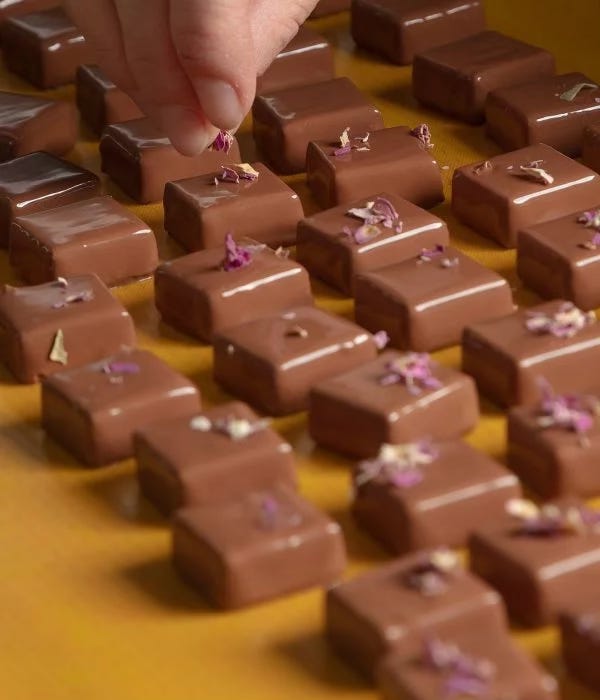
The French do not seem to get the same press as the Belgians or Swiss for their chocolates, but my experience has been that there is an insane level of quality of chocolates to be found everywhere. There are specialists that have retail outlets in all major towns, Charolles is the home of Maison Dufoux who has 6 retail outlets including one in the bustle of Presqu’isle in Lyon. The real surprise is the artisanal chocolates available in the Boulanger-patissiers who quite often make their own chocolates alongside the cakes and tarts. The French rarely visit each other empty-handed, so florists do well all year, and you understand why the baker, who has done his work by 7.00 am, spends his days baking cakes and making chocolates, which are boxed in small gift-sized presentations. Unlike in commercial chocolates you get to choose what goes in your selection, but that means there is no cheat sheet telling you what each one is, this is not your Cadbury’s or Sees Candies. It was the fête du St Valentin on Wednesday, so artisanal chocolates were getting a lot of love.

Dufoux chocolates, hand made

The dozen roses gift seems to be an imperial hangover. In France, roses are sold metrically, in 10s or 5s. Like most of the western world the French have adopted the Hallmark-enhanced saint’s day with love commercially celebrated correctly with chocolates, champagne and a choice of roses, pink, yellow, white or red. Restaurants do well, wine shops do well, and flower shops have to hire extra staff and do very well. The 14th was also Ash Wednesday, so there was an odd mix of people hustling around Garibaldi at lunchtime, some with bunches of flowers, some with a charcoal smudged cross on the foreheads, some with surprise lover’s picnics and some with all three, love and devotion was in the air.

If you need some love in your ears, start here.

Gones for good

A Lyonnaise Life – Episode 1 February

There are several words that, if not unique to the city, they are redolent of and in their repetition evoque Lyon. Canut, canaille, coquins, bouchons and gones. Gones technically is local slang for young kids but is appropriated to represent those who think of themselves as truly Lyonnais, the children of the city. We have become the adopted children of this great city, we explore with a childlike curiosity. Since we found our little part of the 3rd near Place Bir Hakeim 18 months ago we have spent more and more time here, discovering our way around, venturing further and further and developing the useful mental maps of where we find the things we need.

As someone said to me this week, Lyon fundamentally is a city of nosh, ‘une ville de bouffe’. That manifests itself in various ways. There are more restaurants with Michelin stars here than in Paris, this is where people come from around the globe to learn to cook. From the pilgrim like Bill Buford, the serious foodies, to the many Japanese who come to worship at the altar of Bocuse. France is famously great for French food, and generally sucks at all other cuisines. Lyon is the exception. Many of the global visitors, having learned their part in the brigade at one of the many cooking schools, stay for a while and present their version of their culinary tradition for a French audience. So Lyon has a ton of good Japanese restaurants, Korean, Thai, West African and even Mexican (not Tex-Mex). They are forced to tailor their offering to the local tastes, especially at lunchtime, the hot spice is turned down to 2, a basket of sliced bagette is provided and there are 3 courses, the main course has a starch and a protein. 

The 3-course meal comes in around €20 as that is the average allowance that all workers get on their ‘carte resto’, the French equivalent of the old luncheon vouchers. It’s a great example of state intervention that works in France. The worker in a large company has a canteen where free or heavily subsidized food – again 3 courses and wine is available. When I visit a large client CMA-CGM in their gorgeous tower on the waterfront in Marseilles we go for lunch in their ‘canteen’; as much as it’s served buffet style the food is serious. For everyone else who does not have access to a company restaurant they receive a restaurant card, it looks like a standard credit card and functions like one for food and drink. Couple of rules: can only be used on a work day, no Sundays, no holidays; can be used anywhere you might buy lunch from supermarkets, snack bars, fast food or restaurants. Food or booze but up to a daily limit, Mme Britton’s card is €25 a day. Just think about that with an American legal mind set: a company provided card is used to buy alcohol?! The deal with the card is the employee pays a contribution, the restaurant gives a discount and the company pays the spread. The company gets a tax deduction, the employee gets a tax-free perk, the restaurant/retail business gets business for a discount; win:win:win.

It is winter in Lyon, or what passes in our post-truth days as winter, it’s mid-February and since the Fête de Chandeleur, February 2nd the temperature has been more spring like with warm showers and temperatures in 50’s and 60’s, 8-14 C. We missed the pancakes on Chandeluer and will do likewise tomorrow on Shrove Tuesday. Not that I have anything against them, we had an old recipe that was Rachel’s grandmother’s for Finnish Pancakes, which produced crêpes as close to what I remember as my Mum’s Pancake Day pancakes, but we cannot find it. I remember my Mum gamely running a Pancake Race with other mothers at my elementary school in Bradford on Avon, I am pretty sure that is a tradition that has been consigned to the Ladybird Book version of English History and not something you would catch a French housewife doing on Chandeleur.

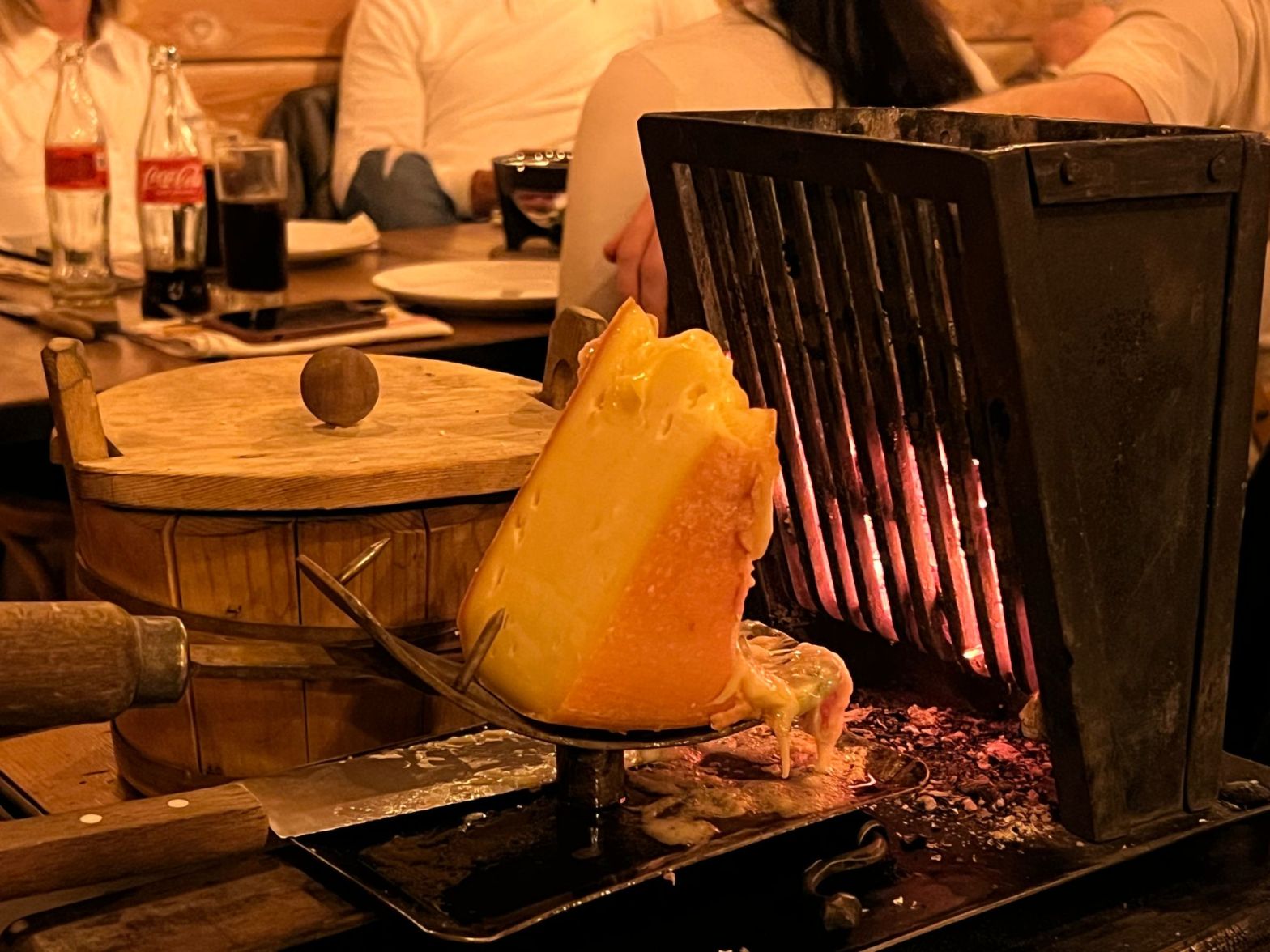
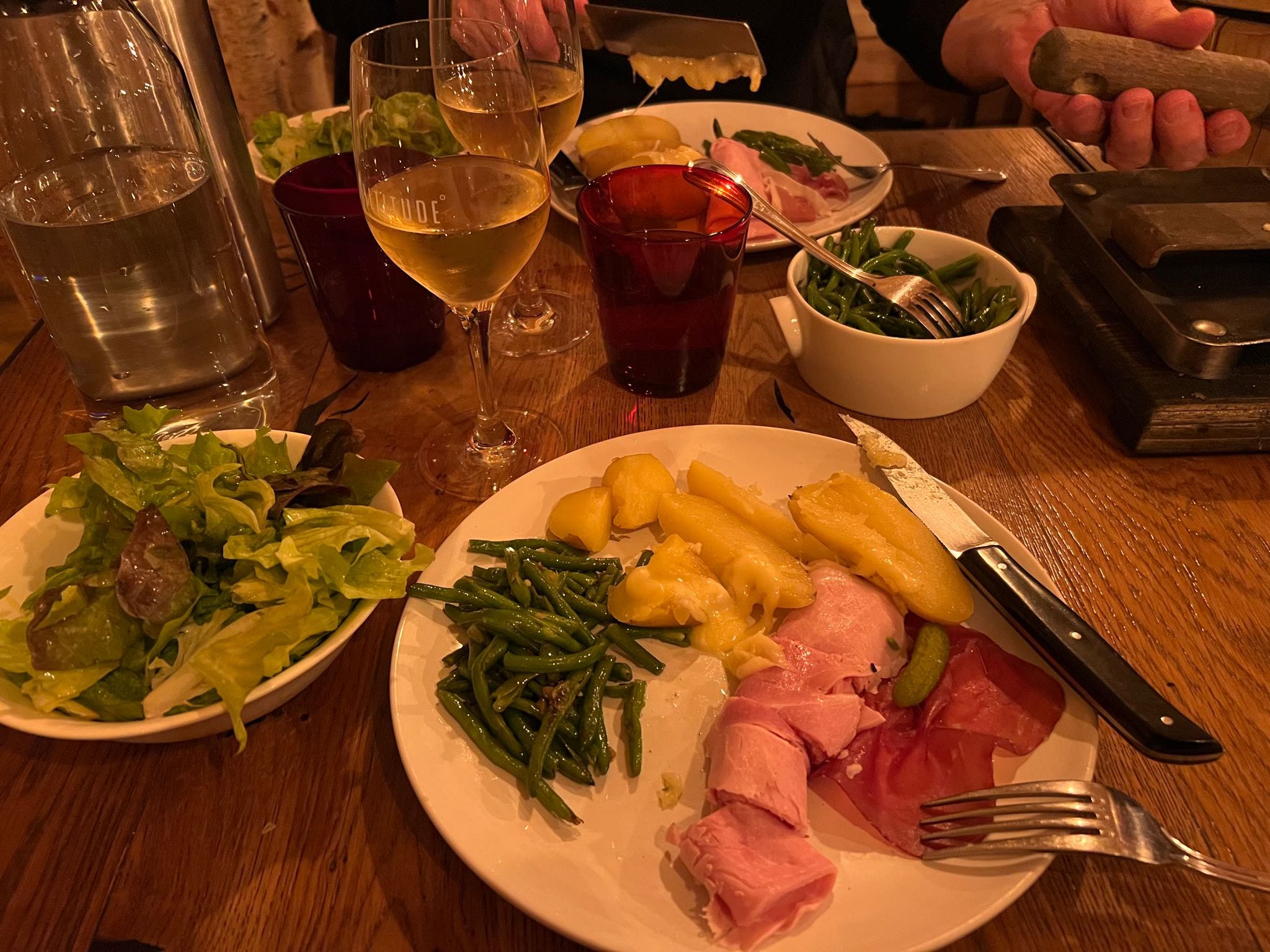
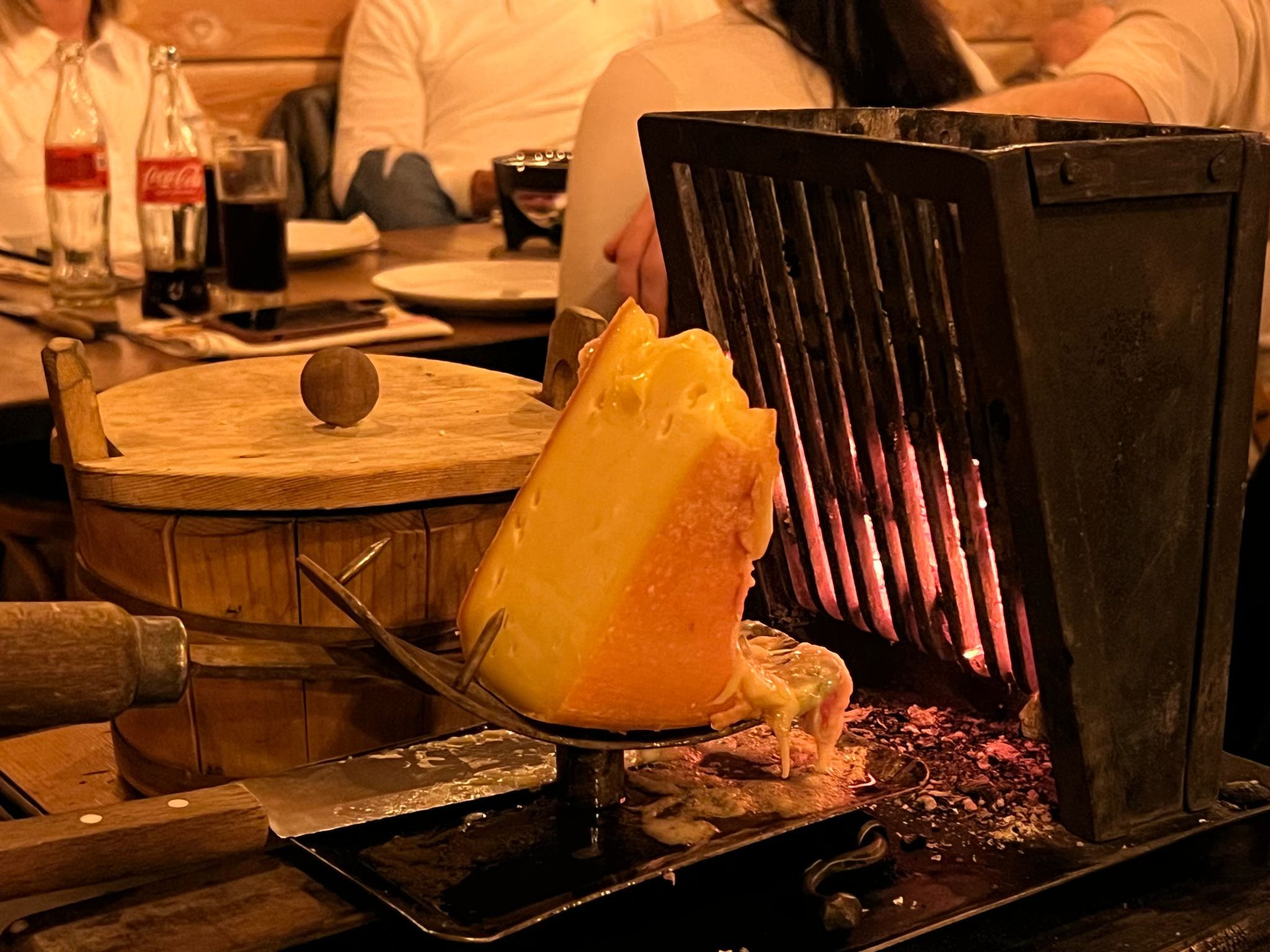
In the real spirit of winter, especially as we are but an hour from the Alps, we went for Raclette on Saturday. The restaurant l’Altitude on Rue de Crequi is the best rated of the mountain style places in Lyon and is a very pine-plank walled ski-lodge of a spot. Raclette is a cheese and the deal with the eponymous dish is that the cheese is melted to the point of bubbling yummyness and then scraped over steamed potatoes to eat with various hams and dried meats with some nods at healthiness via sides of a green salad or haricot beans. It is meant to fill a starving stomach following hours of skiing in cold weather, so it is heavy and filling. Lazing around watching Fulham thump Bournemouth followed by England remarkably beating Wales in the 6 Nations is not the most exacting form of exercise as preparation for such a repast, but we did it justice. The Savoyard food or Mountain cuisine developed around what you can keep in semi-isolated mountain valleys during winter and pre-refrigeration. Cheese, air dried hams and sausages, potatoes and pickles are served in various forms; tartiflette, which is basically a complete baked cheese filled with potatoes and added cream to make it more runny; fondue, which is either melted cheese into which you dip stuff or Raclette, which is made from various hard mountain cheeses made from the milk of cows who have been grazing on the rich summer pastures like Comte, Beaufort or Raclette itself. 

Most places have electric hot place devices to do the melting, but Altitude has charcoal fired table-top braziers that are awesome at heating the cheese together with the diners and just about look safe, in a way that you know would never be allowed in the US without a shit storm of lawsuits. By the time we had near consumed the 300g of cheese allocated per person, we were cheery-cheeked and down to t-shirts. They unsurprisingly do a good line in ice cream and sundaes to help you cool down. The ice cream was seriously good, house made and artisanal, including a Charteuse flavored one, which is a bit their thing as they have a bunch of cocktails using the green and yellow monk’s bane. To finish, I felt obligated to have a Chartreuse but chickened out and went with the 2cl rather than the 4cl option. They presented a special glass about the size of a thimble, into which a monstrous Jeroboam sized bottle of the green lightning poured by measure. I had forgotten how much of a punch it packs, and we agreed we should have a bottle at home, it’s a very Lyon thing.

Les bonnes address: 

L’Altitude

Charteuse