Gones for a Song: Now That’s What I Call Music! 21-30

Getting now to the core of this effort to think about and list out my current favorite albums from years of obsessing about music. You can probably spot by now the self-evident obsessions and repetition of styles, there are definitely some sounds that resonate more than others and I have avoided some of the big obvious IMPORTANT albums, partly as they have had the crap played out of them on the radio, soundtracks and have become mundane. No spoilers here but do not be disappointed that your favorite Zep, Beatles, Marvin Gaye, NIN or that not much Rap or modern R&B have made the list. I just did not play that much of any of them to entertain myself over the last couple of decades with the possible exception of the wooden Zeppelin stuff, like ‘Going to California’, “Over the Hills and Far Away” or ‘Tangerine’. There is a real Mix-Tape vibe to this week’s 10 though, all over the shop stylistically and release date too. So let’s get into it “One, two, three, four, tell me that you love me more, Sleepless long nights, that is what my youth was for”https://open.spotify.com/embed/playlist/6TQbkVVdhJJ0Z345UJZYbt

Number 30: Amyl and the Sniffers “Comfort To Me” 2021. Amy Taylor is a pocket sized banshee backed by some of the scuzziest guitar thrash, it is my distinct pleasure to have ever heard. It could be described as punk and has the same ridiculous amount of energy that sometimes just seems so engrossing and elevating when other punk is just noise. She has a foul mouth and most tracks have the ubiquitous E annotation, but in front of a messed up mosh pit of mouth breathers she rules supreme and takes no shit: “What the fuck’s up?” she yells. “If anyone falls down, you help them up. Don’t touch anyone. Let’s get rowdy!”. If you have to drive somewhere late at night and want to drive faster than is legal or recommended, crank this shit up.

Number 29: Underworld “Drift Series 1 Sampler” 2019. Underworld started a long, long time ago with two friends in Cardiff, I have never heard the first couple of albums which they themselves dismiss as Mark 1. The Mark 2 version saw Karl Hyde and Rick Smith start down a path of electronic music innovation not matched by many, certainly not in terms of longevity, diversity of output all of it relevant and upbeat and they are still at it. I got into them with their trio of mid 90’s bangers, “Dubnobasswithmyheadman”, “Second Toughest In the Infants”, and “Beaucoup Fish”. During Covid and confinement they decided to not let the moment pass of having space to just keep creating, so they committed to release something new every week for a year and Drift is the result. That’s a lot of music, so the Drift Series 1 Sampler is the best way into their world. As ever, a mix of slow chillout tunes amongst dance and upbeat workouts. I threw into the playlist an extra, a great thing they did with the marvelous throated friend of parakeets, Iggy Pop.

Number 28: Joni Mitchell “Shadows and Light” 1980. Joni Mitchell is one of those artists whose name gets shortened like Bruce, Elvis or Lennon and generally is known and loved for her archetypical 1970’s singer-songwriter output, an inspiration to Lana Del Ray, Taylor Swift and Prince amongst many vocal fans. I really enjoyed her forays and explorations into jazz in the late 70’s where she single handled brought Weather Report into the mainstream and Charles Mingus from a jazz footnote to be the name to drop by all wannabe ‘hepcats’. This album is a live selection of that period recorded at the Santa Monica Bowl in 1979 and features a stellar band, Pat Metheny, Lisle Mays, Michael Brecker, the ridiculously pretentious Jaco Pastorius and The Persuasions. All at the top of their game and having fun furrily singing the blues.

Number 27: The Groundhogs “Split” 1971. Tony ‘TS’ McPhee had the good taste to be a massive fan of John Lee Hooker and named his band after Hooker’s ‘Ground Hog Blues’. They provided the backing band to the great man on one of his albums and supported him on his 1964 tour of Britain. They were a power trio with bass and drums similar to Cream, jazz rhythm signatures and lead guitar taking its own path with McPhee’s blues growl singing updated blues rock rather than just rehashing the original blues classics while taking the credit – looking at you Messrs Page and Plant and their pathetic ‘traditional’ credit to avoid paying royalties to Muddy Waters or Jimmy Reed. I first got into them with “Thank Christ For The Bomb” and its odd First World War theme, The Fall covered ‘Strange Town’ which shows I was not alone. This album has the first side four parts of the Split suite, inspired by a months long panic attack and then the more standard 4 songs on side 2 which included the belting ‘Cherry Red’. I saw them on this tour and the “Who Will Save the World, The Mighty Groundhogs” tour the following year, which featured Tony’s new toy, a synthesizer.

Number 26: Paul Kantner and Jefferson Starship “Blows Against The Empire” 1968. I heard this one lazy Saturday afternoon listening to the John Peel ‘Top Gear’ radio show and started down a path of obsession with the Airplane, Grace Slick and Paul Kantner. I never got the Grateful Dead, but I absolutely got the Airplane and their side projects were at times better. The sessions for this were from a frenzied stoned summer in Wally Heider’s San Francisco studio where the Dead, Quicksilver Messenger Service and Crosby, Stills and Nash were noodling around on Crosby’s solo album “Almost Cut My Hair”. The Airplane were falling apart but this high concept science fiction space opera meets anarchic revolution (this is 1968 after all) is glorious. Lots of Pooh references, plus hijacking starships and babies. The album won a Hugo award, and I devoured from cover to cover the lyric booklet, including all the artwork by Slick and her odd annotations. Space-ship engine noises and very Robert Heinlein, they didn’t get their dates right though as the starship “ought to be ready by 1990”. Governor Reagan, as he was, also gets a nod “You unleash the dogs of a grade-B movie star Governor’s war…so drop your fuckin’ bombs, burn your demon babies, I will live again!”

Number 25: Talk Talk “Spirit of Eden” 1988. The late and sadly missed Mark Hollis was the inspiration behind all that was great about Talk Talk. They first broke through as a synth pop band doing Duran Duran style dance songs, all big floppy fringes, pastel suits with big lapels and the sleeves rolled up. The dance hits and the 12” mixes of ‘Living In Another World’ and ‘Life’s What You Make It’ are solid bangers so it was a pleasant surprise when they morphed into a thinking man’s creative act with electronics supporting rather than dominating the quiet post-rock with “Colour of Spring” in 1986. Hollis found his niche and that album and the fabulous “Spirit Of Eden” became a real inspiration to many bands including Radiohead, Kate Bush and Elbow amongst them. It’s hard to define their sound but adjectives like pastoral, peaceful, contemplative work but the sound is also glorious, this is the definitive Sunday morning album and cries out for headphones. 

Number 24: Sleeper “The It Girl” 1996. I would be lying if I didn’t admit that I had a minor crush on Louise Weiner, the gamin lead singer, who with her partner Andy Maclure had one of the most popular BritPop bands in the early to mid 90’s. Maclure had to endure being one of the infamous Sleeperblokes, a pejorative term at the time in the music press and used by musicians, to refer to any person of limited standing within a band or a drab and unremarkable individual. Maclure and the other “Sleeperblokes” themselves were reported to find it a joke, and even produced an ironic “Sleeperbloke” T-shirt to go with Wener’s “Another Female Fronted Band” T-shirt. This is the third album and is the perfect combination of ironic smart-ass lyrics and driving pop rock, like the Replacements but with a girl singing and less overall angst.

A person singing into a microphone

Description automatically generated

Number 23: Bob Marley & The Wailers “ Rastaman Vibration” 1976. One of the odd side effects of the ‘Mod’ scene in the UK in the 1960’s was the opening up of the market and popular tastes to Jamaican ska music. Named after the rhythm being ‘um ska, um ska’ we danced to ‘Long Shot Kicky Bucket’, ‘The Israelites’ and ‘Double Barrel’ so it was an easy transition to the yet slower still reggae beat in the 70’s. Punk tours were always multicultural and vocally against the casual racism of the skinheads – the biggest fans of ska ironically – so reggae became de rigeur to be played at parties alongside the latest punk or New Wave. Toots and the Maytals gave us the genre with ‘Do The Reggay’ and did well, as did Burning Spear and the homegrown Steel Pulse, but the rulers of reggae were without doubt the Wailers and the king was Bob Marley. They got cross over hits, with white guys like Clapton taking their songs and bringing them mainstream attention. The albums ‘Burnin’ in 1973 with ‘I Shot The Sheriff’ and “Natty Dread” had all the hits that came to fame on “Live” and “Babylon by Bus”. This album is more rounded, no filler or repetitive retreading. The lyrics are more confident, and his voice is now that of a global star and the studio arrangements are superb, with a large band and singers all in one stoned groove.

Number 22: Mathew E. White “K-Bay” 2021. I was late to his 2012 “Big Inner” but fell in love with its big aural landscapes, when I heard it. He is in many ways a Southern songwriter but instead of being influenced by the normal Americana tropes his background in jazz showed through. This is a man who likes wide screen production sound, lots of layers of music, choirs, piano and guitars. The follow up “Fresh Blood” in 2015 was more of the same cosmic gospel but “K-Bay” is his masterpiece, there are shades of “Pet Sounds”, “Give Me The Night” and “Gaucho”. But rather than just be a pastiche of 70-80’s AOR he has taken the smooth production and soundscape but layered over it found sounds and his ironic voice, it also rocks harder than music to cook to.

Number 21: Nick Cave and the Bad Seeds “Push The Sky Away” 2013. Nick Cave is possibly the most attractive version of growing old gracefully there is. He is insanely talented, generous of spirit, creative across several media, was the perfect romantic partner for Polly Jean and has suffered in his personal life in a way no-one would wish on their worst enemy. That he has lost not one but two sons on top of his father dying in a car accident when he was 19 and that he has managed to keep his shit together and keep producing interesting and new music is remarkable. Then in 2023 he admitted part of his ability to get through the turmoil in his private life is that he has been addicted to heroin for 20 years, addicted in a managed way but still every morning and evening addicted. The Birthday Party, Cave’s first band was on the noise side of noise-rock and make The Viagra Boys look like CSN&Y and he has always had that hard edged rock side to him, as much as the later stuff has become more melodic and a real contrast from his Grinderman dark side project. He has a great band in the Bad Seeds but as you can imagine over the 21 years of its existence it has changed, it included Barry Adamson from Magazine, Blixa Bargeld from Einstürzende Neubauten but his core collaborator is Warren Ellis; now that Mick Harvey, who was with him from Birthday Party days is gone, he just gave up in 2012 and moved back to Melbourne, drugs being one of the issues. Cave’s 2024 album “Wild God” was released to rave reviews, but I prefer the darkness of the “Skeleton Tree”, “Dig Lazarus Dig” and this marvelous “Push The Sky Away” version of Cave’s gothic life.

The Tidal playlist is here: https://tidal.com/playlist/a49d4aef-b275-4389-8d37-4dae3554044c
Gones for a Song: Now That’s What I Call Music! 31-40

Definite feeling of being in the home stretch now, which will be a relief for some of the subscribers who didn’t sign up for this and instead are expecting vignettes of daily life in France. Substack does seem to attract nerds of every artistic persuasion, and music anoraks are right up there with train spotters and the guys sitting on camping chairs on the other side of the fence at the bottom of the runway, tuned into ATC and writing down tail numbers. It seems like every day there is someone raving about an album from the 1980’s or something new they have heard. The other odd treat for us is seeing your heroes showing up and writing on Substack, 

Laura Marling

Neko Case

Stephin Merritt and 

Rickie Lee Jones – although in fairness to RLJ she is writing about films, old films and generally having a metaphorical walk down memory lane. 

Nick Hornby is also on here and although his books always share the joys of music from this side of the speaker he gets a mention purely because of the round about introduction to Steve Mason. 

I have been listening to some cool new stuff over the last few weeks and as much as I have enjoyed writing about the aural bookmarks in my life you can see by the distribution of albums from the last 15 years over my top 100 I actually spend most of my time listening to new music. I will bring back ‘Gones for a Song’ in December with a top 20 albums of 2024. Anyway in the words of young Pink, lets get into it: one, two, “Free, Four”https://open.spotify.com/embed/playlist/5GUuKta1wlx1Y0AWOm9RB5

Number 40: TV On The Radio “Dear Science” 2008. I get obsessions about certain bands, when it’s not just I like a song or an album but I devour everything I can get hold of. With TVOTR I discovered them through an EP ‘Young Liars” in 2003 which had a Pixies cover ‘Mr Grieves’ and I was hooked. I didn’t get to see them live until 2012 after the unfortunate death of the bassist Gerard Smith. They of course hailed from Brooklyn, you could tell by all the cool kids who would turn up and do guest vocal spots, Bowie, Karen O, Grizzly Bear, Peter Murphy. The music is upbeat rythym driven alt-rock but clever arrangements and interesting melody lines and harmonies made it the thinking man’s music of choice for about a 5 year period from 2006-2011. The 3 middle period albums are all superb but this one has the better overall consistent flow over “Return to Cookie Mountain” or “Nine Types of Light”. Dave Sitek’s side project “Maximum Balloon” is worth checking out if you have never heard it. There is a potential top 20 list project of ‘no hit wonder’ side projects out there.

Number 39: Gil Scott Heron “I’m New Here” 2010. The backstory to this fabulous album and the subsequent two excellent spin-offs is cool in its own right. I remember Scott-Heron as a hipster jazz-poet in the 70’s when his ‘The Revolution Will Not Be Televised’ was a staple at any cool party. He was actually a poet and damn angry, he was the first one to make a political point about cultural appropriation. Then funk came along, and he missed it, he was still tied into a loungy jazz beat and flute, which could not get you arrested in the late 70’s, let alone a record deal, so he faded from the limelight, probably because he didn’t pull any punches about the institutional racism all around him. He released a few more albums in the 80’s (“Reflections” is actually really good and worth checking out), but he bubbled around in the background as a kind of godfather of Rap character. Like many black men of the time, he got busted and locked up several times for drug possession, while white men on Wall Street got rich while in possession of the same drug. Richard Russell of the fabulous ‘Everything is Recorded’ releases and lots of production work reached out to his former US label and traveled from England to record Scot-Heron while he was out on bail in 2007 and continued over the next 3 years, helping him get some kind of artistic life back. This album was released in 2010, a mix of his ruminations looking back on his life, his grandmother and interspersed with songs. Sadly, by this time he was HIV positive and in May 2011 he passed due to complications with pneumonia. Jamie XX released a remixed version of the songs under the name “We’re New Here” which is excellent, as is the “We’re New Again” by Makaya McCraven.

Number 38: The Knife “Silent Shout” 2006. You have heard Karin Dreijer’s voice if you do not necessarily listen to The Knife, she releases material as Fever Ray, she is on Röyskopp stuff, she has sung with Björk, some of which has made it to ads and TV show episode fade outs. You will however probably never seen what she looks like unless you are a fan, and even then would probably struggle to recognize her in the street, as live she wears masks and outrageous make up, there is a definitely a persona as a singer “dancing for dollars” and as a person she sees that as a separate life. The Knife is the project with her brother Olof, they did 4 albums before they gave up in 2014. This is hard core techno beats but very Swedish with awesome melodies, you can channel some Abba if you look hard enough beneath the distortions, it is also quirky; one of their first big songs was about ‘Lasagna’. They had a couple of hits on their first two albums, but this is peak, edgy Knife, sharp and pointed.

Number 37: Savages “Adore Life” 2016. I had the classic ‘day late and dollar short’ experience with these noisy women, I was really into this the debut album and then word came they were playing ‘The Bottom of the Hill’, a tiny hole in the wall club walking distance from my apartment in SOMA in San Francisco. I thought I should get a ticket for that, but they were so obscure Anglo/French gurrrl rock, no rush. They had such a rush they got moved a week later to the Independent and sold out there within an hour. So, I never saw them. I see Jehnny Beth all the time living in France, she is the Annie Nightingale/Lauren Laverne of French rock shows on ARTE the arts channel, she is also a reasonably well-known actress and was in ‘Anatomy of a Fall’. This is arty post-punk, louder and harder guitars than Warpaint, more catchy and less whiny than Sleater Kinney. They made 2 albums but have not played since 2017 so arguably not still a band. The Beth solo album is terrible, and I have not listened to the other side projects so about time for a reunion.

Number 36: Elbow “The Take Offs and Landings of Everything” 2014. Elbow now snuggle quietly in the bosom of the average British rock fan and Guy Garvey is practically a saint. The lead singer, main songwriter, Radio 6 DJ, professional Mancunian and general great man to have a beer with, in a way that the prior holder of that office Mark E Smith never was. They have released 10 albums since starting out as Elbow in Bury in 1997, they write together and share the credits, so the money is spread out equally. The early albums are claustrophobic, I got “Asleep at the Wheel” but didn’t play it much as I found it all a bit dour, but with each album they got more adventurous in both song structure and emotional heft. “Leaders of the Free World” and “Build a Rocket Boys” are both big, beaty and bouncy, but this is my favorite. Hard to say a bad word about Mr Garvey and his friends, anyone who can write a song called “Jesus is a Rochdale Girl” is a fucking legend.

Number 35: Dry Cleaning “New Long Leg” 2021. Yet another odd British art rock band with the vocals spoken rather than sung? Yes, it is post-rock with great scrunchy guitar and big bass lines with the odd tuning every now and then, that is just on the melodic side of atonal. Floating over that is Florence Shaw’s sprechgesang tales of mundane lives, which are like being part of a conversation in a pub, they are odd and funny as fuck: “I’d like to run away with you on a plane but don’t bring those loafers”, “I’ve been thinking about eating that hot dog for hours”, “What do you think your parents feel? That nod that says, ‘I’ve seen things’”. They have released “Stumpwork” and an EP since this and have had some reasonable commercial success, playing to adoring European festival crowds. I hope they can keep it up.

A person in a cape with wings on his head

Description automatically generated

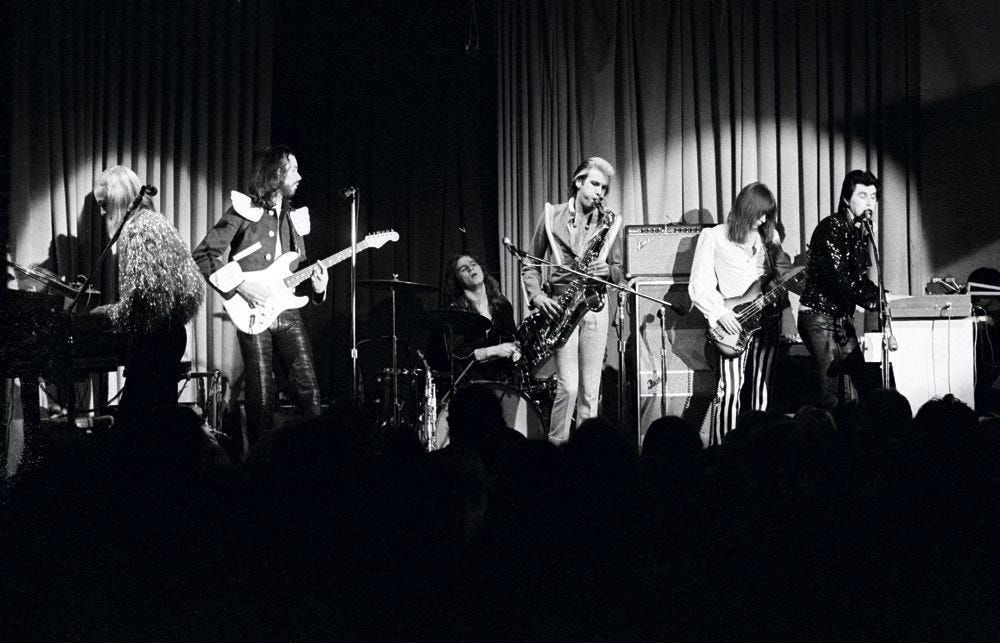
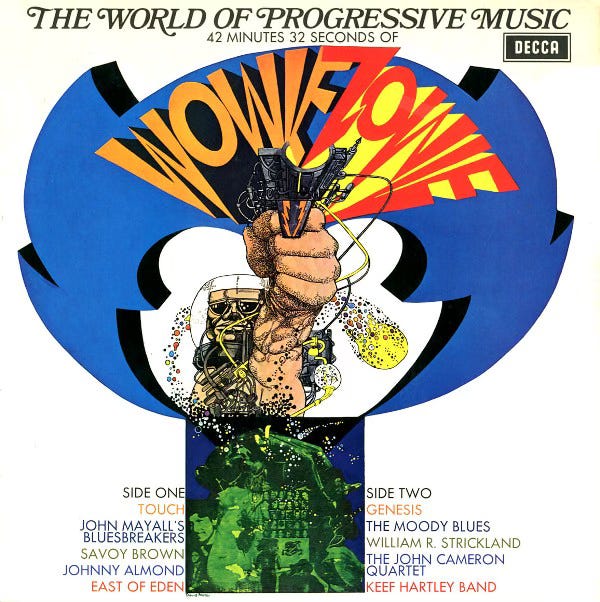
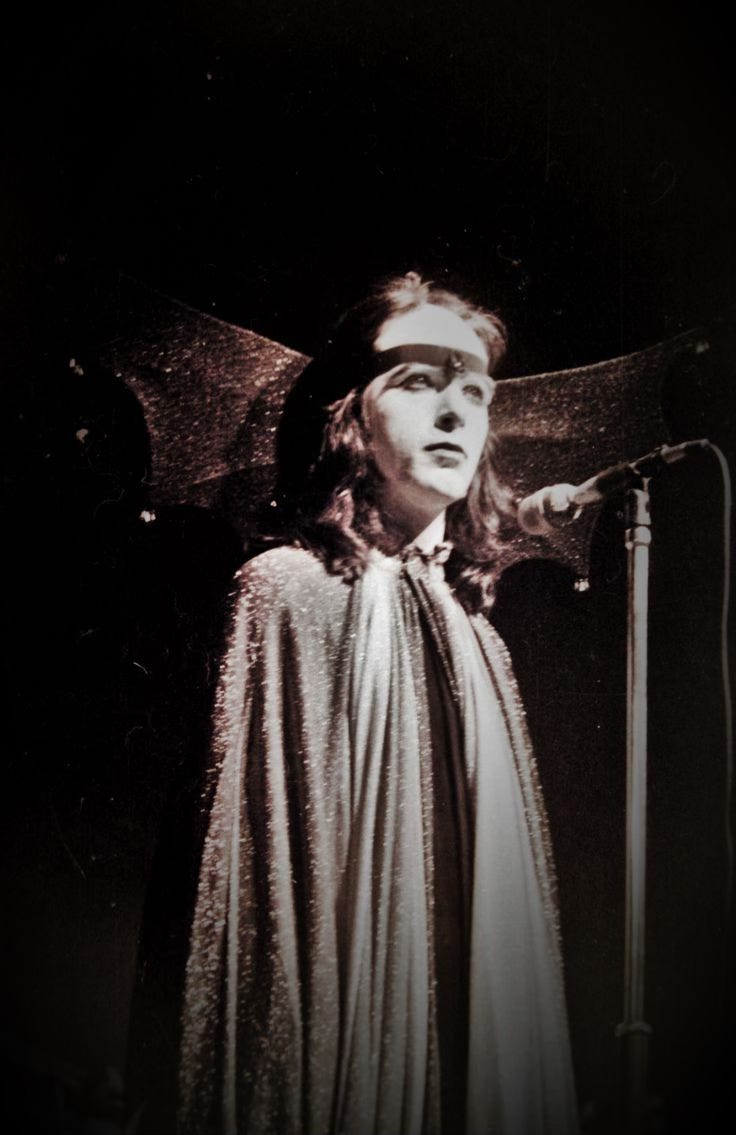
Number 34: Genesis “ The Lamb Lies Down On Broadway” 1974. Genesis were a nice bunch of public school boys who fell under the impresario Jonathan King’s spell, managed to wriggle out and added Steve Hackett on guitar and Phil Collins on drums. They were prog-rock defined, in fact I first heard their song ‘In The Beginning’ is on the “World of Progressive Music” which was the second album I ever owned. Flowery stories, lots of keyboard flourishes, nursery crimes indeed. Peter Gabriel’s voice telling the story, in this case of a Puerto Rican graffiti tagger in New York city. Gabriel had a dramatic flair and live wore odd costumes, including headdresses and makeup putting him into various characters like the ‘Watcher of the Skies’. “Selling England by The Pound” had set the scene as they got darker and less fey, but TLLDOB is their peak. But the recording of it was the end of Peter Gabriel’s involvement with the band, it was arduous, and he was absent for a lot of it due to his wife’s difficult pregnancy. They toured and performed the album in its entirety plus an encore, a decision that was not supported by the entire band considering the large amount of new material. The stage shows also involved new, more elaborate costumes worn by Gabriel, three backdrop screens that displayed 1,450 slides from eight projectors and lasers. When the reviews came in they focused on Gabriel’s theatrics and took the band’s musical performance as secondary, which pissed the others off. So, he left, and they produced a bunch of boring pop rock albums over the next 20 years while Collins became a mega star and father of Emily in Paris. Odd side note: Eno is on this album.

Number 33: The Tubes “Young and Rich” 1976. When I lived in SF The Tubes were ever present, a bit like the Quicksilver and various Dead spinoffs, well past their sell by date, playing bars and free concerts and I didn’t even bother to find out who was still in the band. In 1976 they tried to present themselves as a punk band on the back of a single “White Punks On Dope” which had been on the 1975 original Tubes album. I saw them on that tour when they were such a contrast to what the English punk scene looked like as to be laughable. They survived being ‘gobbed’ on incessantly – the quaint habit of standing in front of the stage spitting at the band. If it was good enough for the Clash or Souixie then the Tubes had to put up with it, even though they looked more like hair metal than punk. This album is so clever and fun and unlike much of what was produced in 1976 is still compelling. Its tongue is firmly in its cheek for sure with ‘Proud to be an American’ and ‘Don’t Touch Me There’ lots of ironic humor and good musicianship. They were not just vaudeville, the musicianship was consistently good, drummer Prairie Prince played for bunch of bands as a session musician and was part of Jefferson Starship, Vince Welnick ended up playing keys for the Dead.

A poster of a person

Description automatically generated

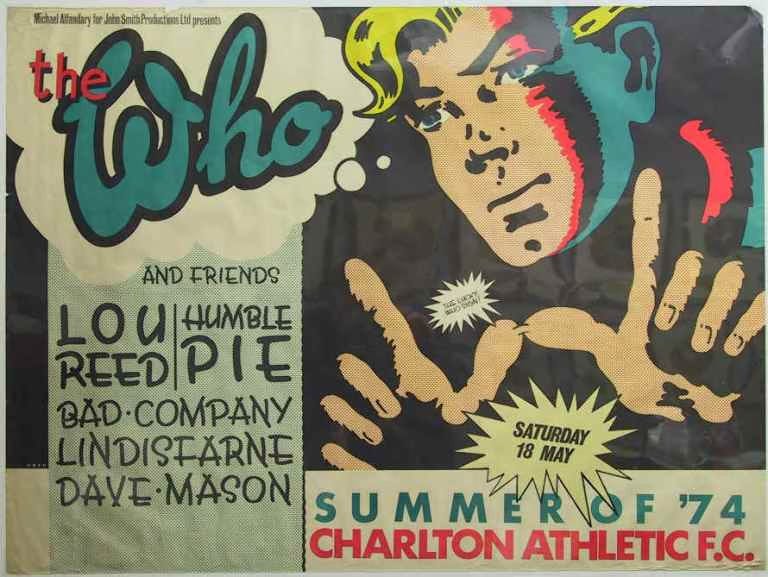
Number 32: The Who “Live at Leeds” 1971. The Who were the Mod band to the Stones being the Rockers band. The 4 piece of drums, bass, guitar and singer never changed and was pretty simple, the songs were always poppy, they started out singing Tamala Motown songs and as much as Pete Townsend wrote two ‘rock operas’ they were mainly 3 minute pop songs, verse chorus verse chorus solo verse chorus. Townsend is and was a stunning guitarist, lots of reverb and fret runs, maybe not as technically as complex as Beck or Clapton but he could rock, and this album is his guitar show piece. It includes the Tommy medley of “‘See Me, Feel Me’, as features in the Woodstock movie, the expanded version includes the precursor to Tommy “A Quick One, While He’s Away”. Both demonstrate they had superb harmonies as well as the craziest drummer to ever grace the stage, Keith Moon. The original vinyl had just 6 songs and they were the perfect hard rock. I saw them at Charlton’s The Valley in 1974 with Lou Reed and others in support and they basically mixed this set with the more upbeat Quadrophenia songs.

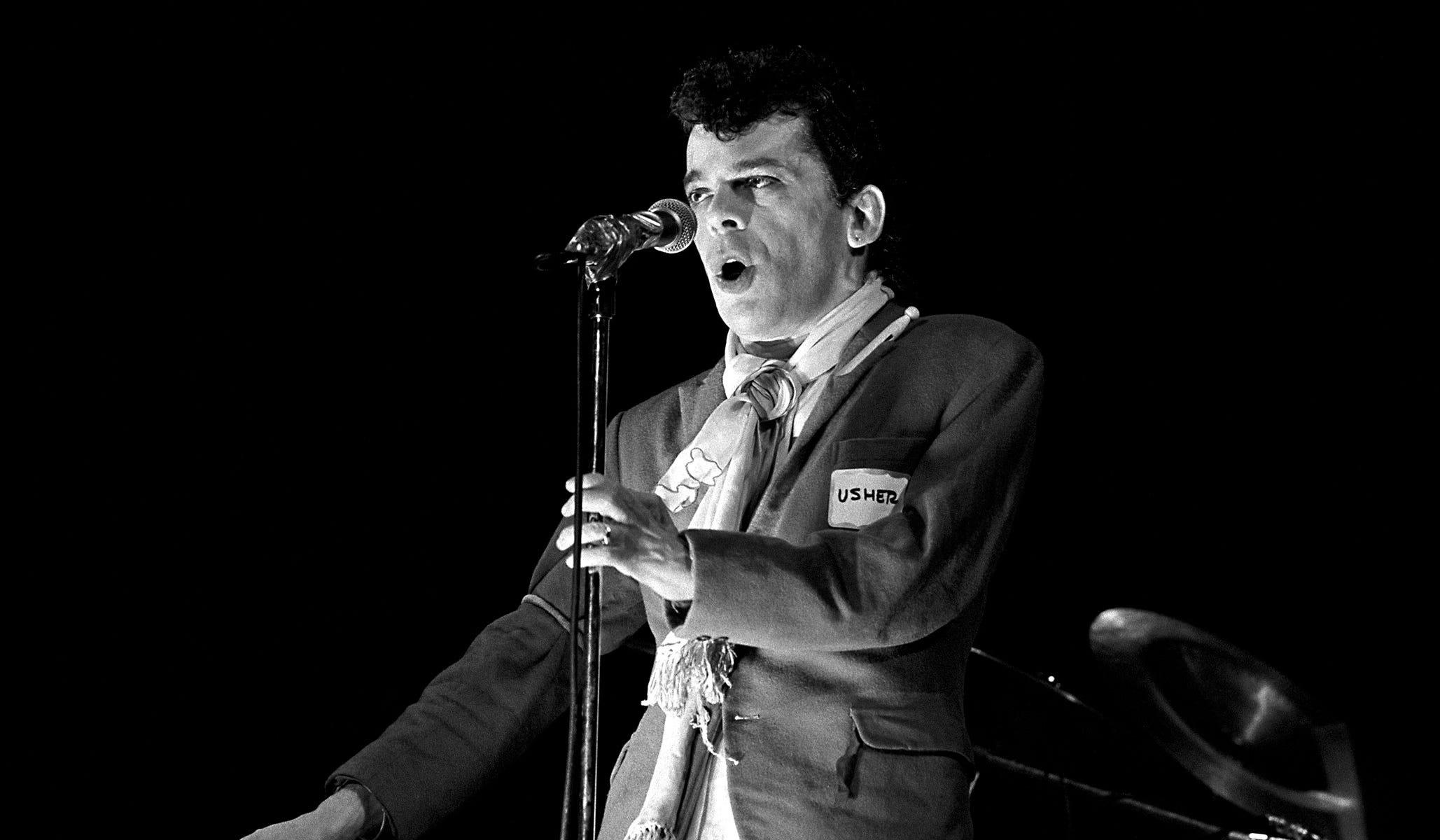
Number 31: Ian Dury “New Boots and Panties” 1976. Ian Dury was a pub rocker, his band Kilburn and the High Roads (not to be confused with Hatfield and the North) were popular in that early 70’s gap before punk, they ironically supported the Who on their Quadrophenia tour in 1973. Dury, Davey Payne and Chas Jankel came out of the last iteration to become Ian Dury and the Blockheads, although this album, which made his fame was released under his name only although Jankel co-wrote most of the songs. Dury was a multi-talented odd ball, he had been at art school with Peter Blake and had a commercial art career before the music took off. He wrote stories about the characters in the demi monde of East London and Essex where he grew up, the names were changed to ‘protect the innocent’ but Randy Mandy, Plaistow Patricia and Clever Trevor are with us to this day, in the same way that Joyce’s Dublin characters are recognizable today. He was great live, and I was lucky to see him and the Blockheads on the Stiffs tour with Costello, Wreckless Eric and Larry Wallis. I somehow befriended Kosmo Vinyl and got myself, girlfriend and a mate back to the afterparty at The Midland Hotel, which was next to St George’s Hall in Bradford, up close you really understood the degree of his disability from polio but it didn’t stop Dury who, to the strains of JJ Cale’s “Okie” as he tried to seduce the girlfriend. Another small world factette, Dury and the Blockheads toured the US for the one and only time in 1978 supporting recovering former poet, Lou Reed.

Tidal Playlist version is here.

Gones for a Song: Now That’s What I Call Music! 41-50

I went to Toronto at the weekend for a business trip, I spent most of the time in a hotel and in meetings, as you do. I did manage to do two things I do on every big city trip, explore by going for a run and hit up a couple of vinyl stores. I had not been to Toronnuh really before, technically I had once before, but we literally flew in, had 2 meetings and flew back to New York. I will talk more about my thoughts and impressions in Monday’s ‘Gones for Good’. I killed a good hour rack flicking but picked up a Stones Bootleg ‘Bright Lights, Big City’, which is an interesting footnote to my last choice “Get Your Yaya’s Out”, as it’s the original Stones with Brian Jones doing studio demos of blues songs and then 4 songs from the 1973 tour rehearsal in Montreux from mixing desk. I also got the re-release over a double album of White Stripes’ “Elephant” and “Countdown to Ecstasy”, which per my thoughts on the Dan last week features the ‘guitar’ band incarnation before Jeff ‘Skunk’ Baxter leaves. The Canadian Dollar is a friend to all visitors so I left a happy man. We are over the halfway mark, so there are some seriously great works of art ahead, as well as those albums that just get under your skin even if they never sold a ton. Let’s roll:

Number 50: Clap Your Hands Say Yeah “Only Run” 2014. Alec Ounsworth continues to this day touring as CYHSY but started the band with 3 friends in Philly in 2004. He has what could be disparagingly be called a slightly whiny voice, but so does Eric Johnson of Fruit Bats, Izaak Brock of Modest Mouse and Jordan Dreyer of La Dispute and those are all fine bands. Like them, Alec sings about the absurdity of day to day life in Modern America, like them, he gets shouty and angry at times and soft and caressing at others. The Clappers as a band were successful for a while, the kind of band that NPR’s Bob Boilen would come in his pants over, the band that Cheryl Waters would introduce them by saying their album was the best of the year. That type of accolade makes them popular but doesn’t necessarily translate into fame and fortune, so Alec still making music and taking it around is cool. I met him once and had a beer with him after a show at the Independent, nice guy. Their first album features the gloriously titled “By the Skin of my Yellow Country Teeth”, great album, as was “Some Loud Thunder”. This album, the 4th, was released after that short moment of fame had mainly passed but is to me peak Ounsworth, all big songs and a big setting, Matt Berninger kind of big, and he actually adds vocals on ‘Coming Down’. 

As WordPress does not want to embed the playlist it can be found here: https://open.spotify.com/playlist/5yvtYVRjFrLqTuxHo9heiE?si=a950e3d8e75446f2

Number 49: B-52s “The B-52s” 1979. The B-52s are almost national treasures in the way that Springteen or Madonna is and Taylor Swift will be, yet back in the late 70’s they were a dance punk band from Athens, GA. They wrote funny and ironic songs and made a fun if kitchy dance sound, they had two singers with bee-hive hair and managed to channel all that was great about life in the 1950’s without the systemic misogyny. They became bigger than life with ‘Love Shack’ from the ‘“Cosmic Thing” album, which to this day will pack any wedding dance floor, but I love their early stuff when Ricky Wilson was still alive and his strange Twilight Zone guitar sound. This contains the fabulous first single ‘Rock Lobster’ which I have on 7” vinyl and bought when it came out just on the title alone.

Number 48: Car Seat Headrest “ Twin Fantasy” 2018. Talking of whiny young men Will Barnes, aka Will Toledo is the mouth and brain behind the Headrest, he released his own stuff on Bandcamp and then when fame came knocking he released some of it again. It’s noisier than typical teenage boy bedroom rock, and it’s happily not even close to Emo. His songs have the conceit of a good education in a let’s break the 4th wall kind of knowingness. As much as he started on his own and his stuff has typical touches of the loop and double tracked vocals that is almost a trope, he actually writes big hooks in a Replacements, Swiss Family Orbison, Big Star way. This album started life as a self-penned college kid piece in 2011 but this release, sometimes shown as ‘In The Mirror’ version, is re-recorded with the full touring band. It builds on the ‘Teens of Style’ and ‘Teens of Denial’ albums with the band in 2015 and 2016, bigger, more flourishes and rocks out.

Number 47: Richard and Linda Thompson “I Want To See The Bright Lights Tonight” 1974. Richard Thompson was part of the great Fairport line up and got bored of doing straight folk so left in 1972 just as they were getting famous. He recorded his first solo album “Henry The Fly” which got panned, although it now is seen as a gem. He met on this album the singer Linda Peters who soon became his wife, muse and lead singer. They released 3 albums, this and two others before giving up on music completely and becoming Sufi Muslim in a community in the boonies. Let’s be kind and say they were on a journey and Richard is a practicing Muslim to this day, they produced 3 albums which were faith driven and not well received. They came back with “Shoot Out The Lights” just as Thompson left the pregnant Linda for a US tour promoter. It was a big hit in the US, and they toured to promote it, but the enmity between them was visible to the audience and that was the end. Thompson has produced tons of solo stuff since and is an accomplished guitarist able to play in any style. I am not a massive fan of his voice and the work as a couple is in my mind much better, this album has the glorious mix of influences with Linda’s voice and Richard’s guitar touches pulling it together.

Number 46: Radiohead “Ok Computer” 1997. I bought “Bends” while working briefly back in the UK and loved ‘Fake Plastic Trees’ and ‘Iron Lung’ and was really into their odd strung out sound as it was a contrast to the grunge that dominated mainstream rock in the US. This album if not their masterpiece is the highlight of their early years. The middle period of “Kid A” and “Amnesiac” went all a bit introspective and synth driven but they got back to writing songs with “Moon Shaped Pool” and the fabulous “In Rainbows”, which I came close to nominating. This was recorded near Bath at St Catherine’s Court, which was owned at the time by Jane Seymour, New Order also recorded “Waiting for the Siren’s Call” there. The dub reggae version of this album, “Radiodread” by the marvelous Easy Star All-Stars, shows how great the songs are on this in terms of melodies. The other interesting thing about this album even though it sounds so dense is that it was mostly recorded live which shows how much they were in-synch musically at the time.

Number 45: Roxy Music “For Your Pleasure” 1973. When they appeared on the scene as part of the Glam pop explosion Roxy were always a bit more serious, a bit more studied, a bit more elaborately coiffed than the others. They became major pop stars and Brain Ferry became a global sex symbol and as much as they drifted off into AOR pop rock in the later years the first three albums are amazing. I would argue when Brian Eno left to do his marvelous stuff elsewhere they were inevitably sliding downwards to that smooth fate. There is always a bit of lounge lizard croon to Ferry’s stylings but together with the scent of Naugahyde, whisky and cheap perfume this album creates another world in a dark club somewhere in Eastern Europe before the wall came down. “ Ta ra, ta ra” indeed.

Number 44: Yves Tumor “Heaven To A Tortured Mind” 2020. Yves Tumor channels Roxy Music as much as he channels Prince and ‘Maggot Brain’ era Funkadelic. A multi-instrumentalist, he has been making music outside the normal R&B or rap scene since 2010 but is super productive and not stuck into one groove or genre. The end result is that interesting blend of funk, guitar rock and pop, he has been quoted as saying he is inspired by Genesis P. Orridge which you can hear in the bass lines, but this is much more varied and less drony. Sean Bowie, who records as Tumor, is helped on this album by the insanely talented Diane Gordon, who also lights up Lil Yachty’s “Let’s Start Here”, and the guitarist Chris Greatti. Bowie is a name already taken in music or at least carries too much freight, so I understand the need for his/their own identity. Originally from Knoxville, TN, he has been based in Turin for a while and channelling his own inner Herman Miller has designed and made furniture as well as this fun collection.

Number 43: School of Seven Bells “Disconnect from Desire” 2010. Dream pop that follows a line back to Cocteau Twins via Slowdive and the other shoe-gaze bands, but that is very bright lit and New York rather than some gloomy northern English steel town. I liked Secret Machines which was Benjamin Curtis’ prior band and this guitar and synth dreamy pop with the twin Deheza sisters vocals was always intriguing and driven by a strong groove. They sing all the songs on the album together, rather than taking turns, and their complex vocal interplay resides at the heart of the band’s sound. The “Alpinisms” album was great but this was their peak. They had a short-lived space in the public conscience as firstly Claudia left the band, while this album was being promoted, for the ubiquitous “personal reasons” and in Feb 2013 Ben Curtis was diagnosed with a lymphoma that he succumbed to 10 months later, and then school was down and out.

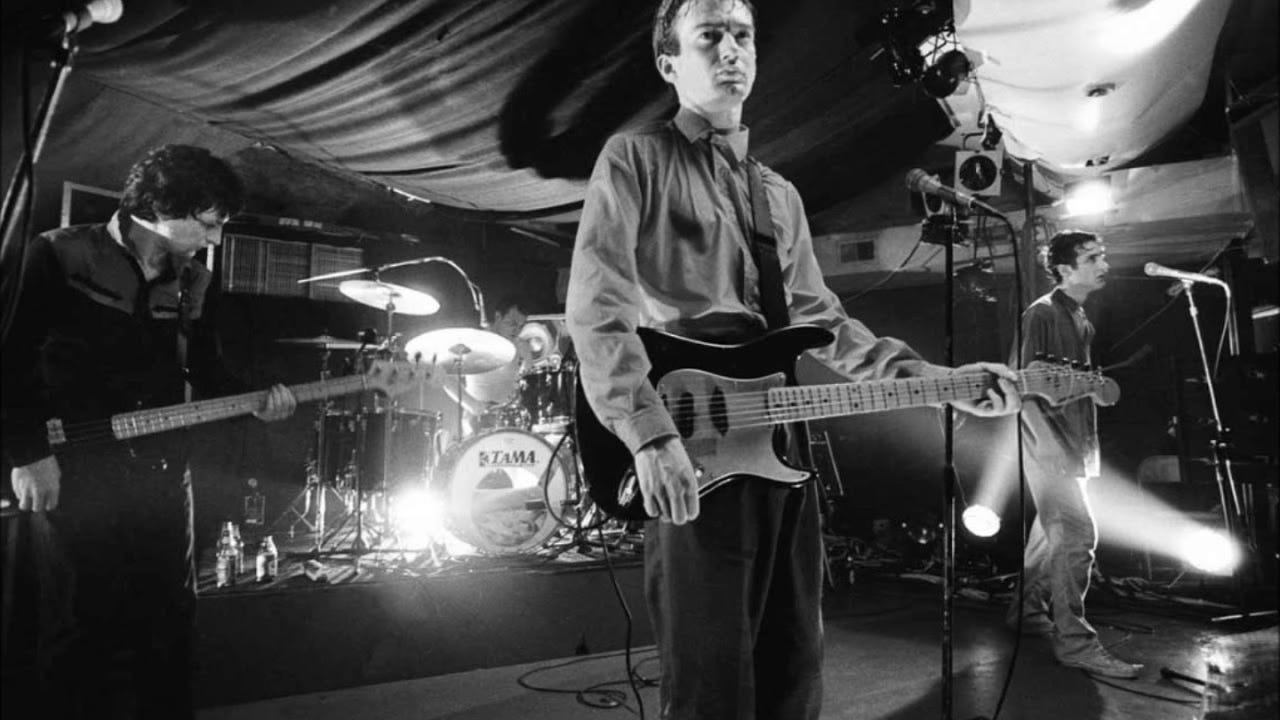
Number 42: Gang of Four “Entertainment” 1977. The sound of Leeds, 1970’s angst and cheap guitars. I saw them live a couple of times in the late 70’s while at Uni and they were unique in how they mixed the political polemic and shouty, spitting punk rock. I have the “Damaged Goods” original 7” mainly because I loved the B-side ‘Armalite Rifle’ and that was their opening shot. Over several years they evolved into an odd mix of funk and punk and saw them in the early 80’s with Sara Lee on bass when they toured with ‘“Songs of The Free”. This the first album and has their classics that still stand up today, ‘Love Like Anthrax’, ‘I Found That Essence Rare’ and the brilliant ‘At Home He’s A Tourist”. Spiky anthems and lots of feedback jerky guitar from the wonderful Andy Gill.

Number 41: T Rex “Electric Warrior” 1971. Talking of glam rock, Mark Bolan and side kick Peregrine Took ( not his real name) had been playing fey folk rock and singing about elves and maidens as Tyrannosaurus Rex but then wisely, trimmed the name, went electric and with some eyeliner, a silver sparkly velvet suit and big heels they were away. They kept some of the cosmic bullshit, but now with technically their 5th album it was much more pop with Tony Visconti producing and sprinkling his special own pixie dust over it all. One of the additions was the fabulous Flo and Eddie on backing vocals, this is the same period as the “Mother’s Live At The Fillmore” but less obscenities.

The Tidal version of the playlist is here.

Gones for a Song: Now That’s What I Call Music! 80-71

I know I am being hypocritical in trashing Spotify while using it to provide a shared playlist, but the idealist in me wants it and other platforms to just be better. How about making money without crapping all over the content providers? How about being a force for good rather than a force for enrichment and ultimately, part of the overall enshittification of the interwebs. I read about another unintended consequence of algorithmic streaming this week in the Economist, the struggle to make music festivals financially sustainable. Costs of any event are up post-Covid due to shortages of labor and wage inflation, but only the very largest, like Glastonbury, have enough demand to pass the costs on – 43% up on 2019. Even Coachella struggled this year and didn’t sell out for the first time. I used to hate listening to the radio in the US as it was all so regimented and Spotify’s algorithm has done the same to the streaming audiences, they have been all subdivided into smaller and smaller niches, isolated tribes. The effect is completely compounded by only playing songs, and no-one under the age of 40 listening to a whole album in one sitting. If the average Spotifist is listening to half their own choices and half what the shiny man in the space suit has chosen for her or him, then unsurprisingly the exposure is reduced dramatically to not just new songs but whole swathes of music, as they become off limits and not fitting into the target music as defined by the machine. If you live in the UK you have my sympathy; but you do have the joy of BBC Radio 6 Live which is like a day of programming in the spirit of John Peel. (You also have many other redeeming joys like Fulham FC, great beer, amazing cheese, Shropshire, The Ottolenghi empire, the Ebble and Nadder Valleys and Marmite.) The lack of exposure to music outside of the tribe means a struggle, even for what I lazily term Pop stars. As the Economist noted, Rita Ora struggled at the London Mighty Hoopla festival to get much of the crowd to join in on her songs, as no-one seemed to know the lyrics. At Coachella in April the crowd was unmoved by Blur’s set, “Damon Albarn, scolded them “You’ll never see us again, so you might as well fucking sing in”. Whether the problem was that Blur have not really aged that well or the crowd simply didn’t know who the arrogant prick was if he wasn’t in his Gorillaz costume I am not sure. Anyway, on to the music:

Number 80: Blondie “Blondie” 1976. I saw them on their first tour in ‘77, it’s hard to say they were not hyped but it was before the big hits took a punk band from New York to ridiculous levels of fawning and adulation. They had the incredible Clem Burke on drums who was the new wave drummer of choice for several years on the back of Blondie’s success. “Parallel Lines” had the big hits but the first album, which never really sold in the US gives you more of a sense of what a great pop band they were, matching Beatle bowl haircuts and all. The album is classic new wave, basically redoing 60’s garage rock with a bit more swagger: guitars and organ, upbeat and cheesy harmonies.

https://open.spotify.com/embed/playlist/0e3KUCpRXsrZAGNfyazmKr?utm_source=generator

Number 79: TV Girl “Who Really Cares” 2016 . TV Girl made the list primarily as they have a unique vibe and sound that somehow, they have managed to sustain, or at least the original founder Brad Petering managed to sustain after the other two founding members bailed out. I first heard their second EP “Bennie and the Jets” which is great if not actually being the song that everyone thinks it is. It is super catchy, and I was hooked and even though, by the very nature of their stuff having a unique sound, over 4 albums and an album with Jordana, they all sound similar, similarly charming and fun. They all have an odd harmony, and the lyrics are simple love and relationship stuff, and they mix some fun 60’s sound bites and samples, it has a retro pop sound for sure but cool rather than forced or kitschy. In an odd way, you can tell they are from San Diego, don’t take themselves too seriously, which is the opposite of the LA bands.

Number 78: New Order “Power, Corruption & Lies” 1983. One of the most ridiculous decisions I ever made was choosing James White and the Blacks “Off-White” to buy over Joy Division’s “Unknown Pleasures”, as recommended by the guy in the record store in Stoke in late 1979. A snappy Sax meets Punk & Disco vs. one of the most important albums of the post punk era. I finally got into New Order having missed the glory days of Joy Division and stuck with them over the years, but this album I go back to more than any other. Like everyone at the time I bought “Temptation’ and “Blue Monday’ on 12” single and they were part of the blossoming of Manchester based culture with the Fall, the Smiths and A Certain Ratio, Factory Records and Tony Wilson in his pomp. I like how their sound got fatter over time, and they have taken regular breaks when they decide they cannot stand being around other, but they come back for more, I have not loved some of the later stuff but hold ‘Get Ready’ almost as high in my esteem.

Number 77: Rilo Kily “More Adventurous” 2004. Coming out of the ashes of the Postal Service and the Elected (both of whom’s stuff has aged really badly) Rilo Kiley were Los Angeles in song at the beginning of the millennia. Jenny Lewis was a child star and can be seen in ‘Troop Beverly Hills’ and some regular TV show, Blake Sennett was also in TV so how much more LA can you be? They produced 4 albums, and the sound got tighter and less fey as they went on, the stories got darker and More Adventurous is the perfect balance of being great songs, tight arrangements having played together for 4 years by then, without being overproduced or smoothed out like the last real album “Under the Blacklight” which was their most commercially successful. This album sounds closer to Lewis’s solo stuff with that bit of country twang buried in the alt-rock meets Bacharach and David mix, the lyrics are very much a woman’s voice. Jenny and Sennett went from being lovers to bandmates and that never seems to work for long and the band went into permanent hiatus. I have enjoyed some of Lewis’ solo stuff and odd projects with new partners, but she is just too torch and twang for my taste generally.

Number 76: Pulp “Different Class” 1995. Sheffield’s own Leonard Cohen is Richard Hawley but Jarvis Cocker is the city’s Springsteen. He writes about quotidian English life in the dour northern towns where the steel mills are closing and it’s all gone a bit grey. Jarvis is funny and yet serious at the same time, he famously angrily pointed out the irony in Michael Jackson singing at the Brits Awards, surrounded by young children and pretending to be the Messiah, Cocker crashed the stage and waving his ass at the camera and derailed the whole thing. He has released great solo stuff over the last few years, but there were three great albums as Pulp, this is their classic with 4 bonafide hits as well as minor classics ‘The Bed’ and ‘Underwear’. But also check out the peak darkness of “This is Hardcore” (listen to ‘Glory Days’) and the earth friendly groove of “Trees” (‘The Night Minnie Timperley Died’ but the whole album is impressive.) He has successfully avoided becoming a national treasure and after splitting in 2002 the original members have come together occasionally over the years as Pulp since and there is some noise about them recording something new currently.

Number 75: Velvet Underground “White Light/White Heat” 1968. Arguably one of the most influential albums from one of the oddest gathering of people to be such a major influence over 60 years since they emerged strumming and drumming so hard from some basement club on the Lower East Side of New York City. When you listen to the frantic noise of the title song or anything on it and it is so unlike everything else being made at the time, there are no harmonies like CS&N, no plinky plonky Grateful Dead, the Zep/Cream blues boom is from a different planet. It’s only 6 songs and just over 40 minutes long, and the 8 minutes of ‘The Gift’ is a spooky spoken word spiel by John Cale. Side two is ‘I Heard Her Call My Name’ which is shouty and then 18 minutes of the crazed ‘Sister Ray’. The glorious noise is made by just 4 of them, as well as the export from Wales, Cale on bass and keys, the drumming is Mo Tucker and Lou Reed and Sterling Morrison on guitars. The first album featured the German model Nico, a part of Warhol’s retinue on strange ‘femme fatale’ vocals, the band was Warhol’s house band at the Factory in certain respects and he encouraged their collision of avant-garde and rock. Reed went on to his solo stuff and Cale is still making music today utilizing his deep Welsh baritone. The list of bands influenced by this lot would go for two pages.

Number 74: Madeline Kenney “Perfect Shapes” 2018. Maddy Kenney is a young artist based in Oakland, CA who over the last 7 years has produced really strong personal material that goes beyond simple singer-songwriter stuff. Her songwriting skills have grown and got better with every release. She has had help from fellow Oaklandite Toro y Moi but also having become friends with Jenn Wasner of Wye Oak and supported Flock of Dimes her last album featured her on bass on tour and she did the production for this album. There are a ton of single female artists in the alt-rock and surrounding space, but Madeline stands out through great song structures and a desire for clever arrangements over simple and poppy. She is on Substack here and has announced she is recording her 5th album now.

Number 73: Portishead “Portishead” 1997. My parents lived in Portishead, I never lived there but visited enough to appreciate the irony in a band having the name. Beth Gibbons has one of those voices that having heard it you cannot be failed to be moved, I am not a fan of the diva blasting and that is an accusation you would never level at Beth. Quiet yet indomitable, her voice dances over the most trip-hop mix of loops and instrumentation. They had a whole film-noir feel to their music and this album is probably peak Jazz club meets the Mysterons. Bristol had its moment in the sun with Massive Attack, Portishead and Blue Aeroplanes with Geoff Barrow and Beth the last people looking to be pop stars. I probably think ‘The Rip’ from “Third” is the best individual song they wrote, but everything on this album is gorgeous, it cries out to be played late at night with a glass of good whisky that you don’t really need. They technically are still a band and played in 2022, we were lucky to catch Gibbons’ solo tour this year and she sang ‘Humming’ from this album as an encore.

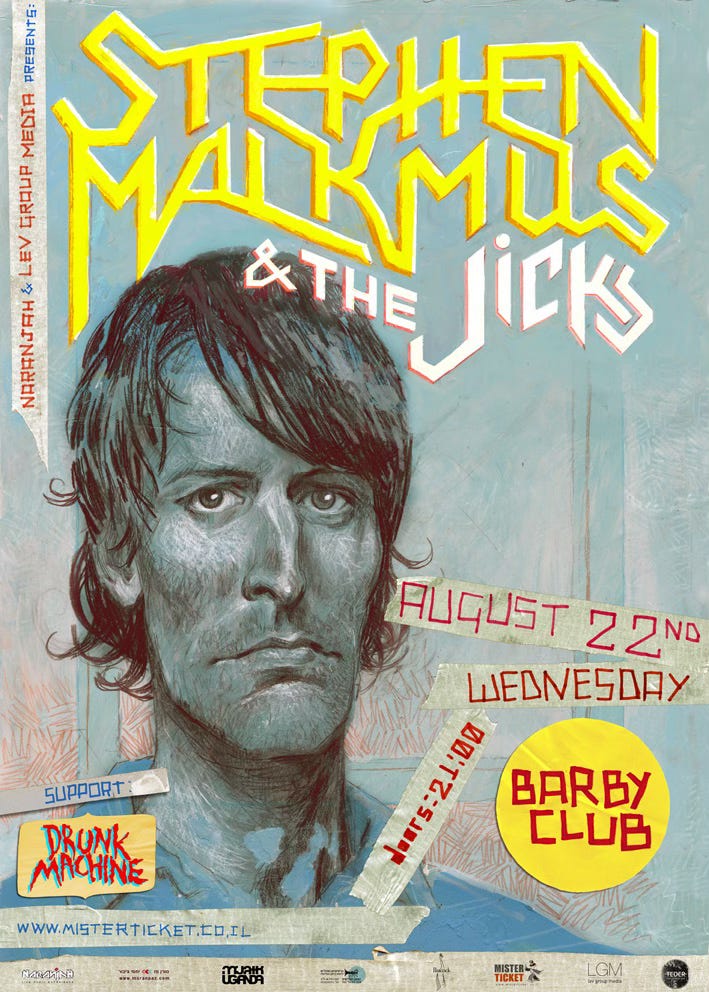
Number 72: Stephen Malkmus & The Jicks “Pig Lib” 2003. When we lived in London again 2004-2008 we had a friend of a friend who worked for Matador Records and every few weeks we would get a pile of CDs, including the fully expanded versions of “Brighten the Corners” and “Crooked Rain, Crooked Rain”. So, I had a belated but deep dive into Pavement and this was also in the pile one month and it was interesting to see Malkmus move into melody and more structured songs, yet without losing that edge. It was like the equivalent of watching Robin Williams go from crazed stream of consciousness stand-up impressions to becoming a serious comedian. He famously played the complete CAN album “Ege Bamyasu” at a festival in Berlin, which made him even more of a star in my book, spoiler alert! Malkmus is a stunningly talented guitarist and writes fun songs, still does to this day. I was lucky to be in SF 10 years later and saw him live at Slim’s, Boz Scagg’s club. 

Number 71: Sault  “11” 2020. I always had a soft spot for well produced ‘soul music’ as it was called before it split into funk, R’n’B and got completely steamrollered by rap and slipped into irrelevance, other than almost tribute versions of acts doing Vegas shows featuring a tiny share of original members, Harold Melvin and the Bluenotes, The Three Degrees, Delfonics. Prince was the last serious proponent of truly black dance music and he died alone. In London however, a candle burns brightly. The presence of truly great jazz players and the melting pot of West Africa, the Caribean and Britain has produced some prodigious talents like Kokoroko, Sampha, Ezra Colective and the daddy of them all Sault. The project helmed by Dean Cover ‘Inflo’ and usually featuring incredible vocals from Cleo Sol, Kid Sister and Chronixx is ridiculously productive, as a functioning cooperative should be. They started with two albums in 2019 “5” and ”7”, two in 2020, then a whole bunch given away in 2021 and this in 2022. They have released 11 albums since 2019, that’s Gizzard Lizard levels of output! It’s a fun upbeat, drum driven journey interspersed with spoken voice pieces usually on a theme.

Gones for good: Episode 12 – Dear Dairy

For those who may have noticed, I have a passion for cheese, a ‘Cleese in the Cheeseshop’ sketch long-list fascination with all matters to do with the fermented curd. I read somewhere that in fact they mention 43 cheeses in that sketch, and to this day I can probably recite all of them. I will assume, dear reader, that you are familiar with this staple of the Monty Python cannon, but for those who have been locked in a time vault since the 1940’s and are only now catching up, here is the original TV show version. The origin of the sketch is worth retelling. John Cleese was seasick while filming on the south coast, on the drive back to London Graham Chapman suggested he eat something to feel better; Cleese replied that he fancied a piece of cheese. Upon seeing a chemist’s (a pharmacy for those on the left bank of the Atlantic), Cleese wondered aloud whether the shop would sell cheese, to which Graham responded that if they did, it would be medicinal cheese and that he would need a prescription to buy some. Based on this insight, they decided to write a sketch based on this conceit. However, once they started writing it, they concluded asking for cheese in a chemist’s shop was too unrealistic without requiring an elaborate set up. So instead of someone attempting to buy cheese somewhere other than a cheese shop, Cleese thought that they should write a sketch about someone attempting to buy cheese in a cheese shop that had no cheese whatsoever, so they did. John did not initially find it funny. When Chapman insisted that it was funny, they presented it at a reading for the other Python members, who also thought it didn’t work, except for Michael Palin, who collapsed with laughter. So they persevered, the bouzouki players and dancing bankers were added, and the rest is history.

What has kept me from consuming too much cheese was the whole health impact around dairy produce in general. I drink skimmed milk and have for years to the point where even semi-skimmed, demi écremé or 2% milk in my tea tastes like I have added a dollop of cream. I switched to oat milk for cereal and coffee. The health concerns about dairy and specifically dairy fats became such a common understanding that they have been accepted without question and have brought forward a whole industry of vegetable alternatives and margarine catering to the avoidance of the dangers of dairy products. My first job out of college was working for the kings of trans fatty acids, Unilever. My parents under the same misguided instructions from the media and medical establishment switched from butter to some chemically enabled stabilization of mixed vegetable oils, branded and marketed as healthful, weight management enabling and smart choices: “Flora”, “I Can’t Believe It’s Not Butter” and Olivio. It now seems that the actual evidence behind the health advice that we have all been blindly following was not as robust as originally trumpeted, in fact “….sparse and few data for the effects of dairy consumption on health are available”. Au contraire, of late, there has been extensive and serious research on the long term impacts of choices in the diet, in terms of following large groups of people over long periods of time. The result of these studies have shown that not only is dairy produce not bad for the long term health outcomes but in fact the converse, consumption of dairy is actually beneficial.

In a study published in the Lancet for example, called Prospective Urban Rural Epidemiology or PURE, the researchers followed 136,000 adults from 21 countries for nine years. They found that, during the study period, those who consumed two or more servings of dairy per day were 22 percent less likely to develop cardiovascular disease and 17 percent less likely to die than those who consumed no dairy at all. Notably, those who consumed higher levels of saturated fat from dairy were not more likely to develop heart disease or die. Another one, from 16 studies involving more than 63,000 adults, found that, across an average of nine years, those who had higher levels of dairy fats in their blood were 29 percent less likely than those with lower levels to develop Type 2 diabetes. So in fact there seems to be a benefit to consuming dairy fat rather than avoiding it. As soon as I read that, I was relieved, happy that my cheese obsessions were now part of a healthy lifestyle, but I was saddened that so many people have been confused and misinformed. That they have been actively encouraged to avoid foods that now they believe are beneficial. Milk fat, it transpires, is naturally packaged in a unique structure called the milk fat globule membrane, which they now think can help bind cholesterol in the digestive tract, as well as the fermented dairy choices like yogurt and cheese containing microbes which are good for gut heath and vitamin K, which is good for the heart. The crap we were told to replace it with made a lot of people money, but trans-fats and all the other binders and fillers needed to make vegetable oil look like butter or fat-free cheese actually does and will kill you.

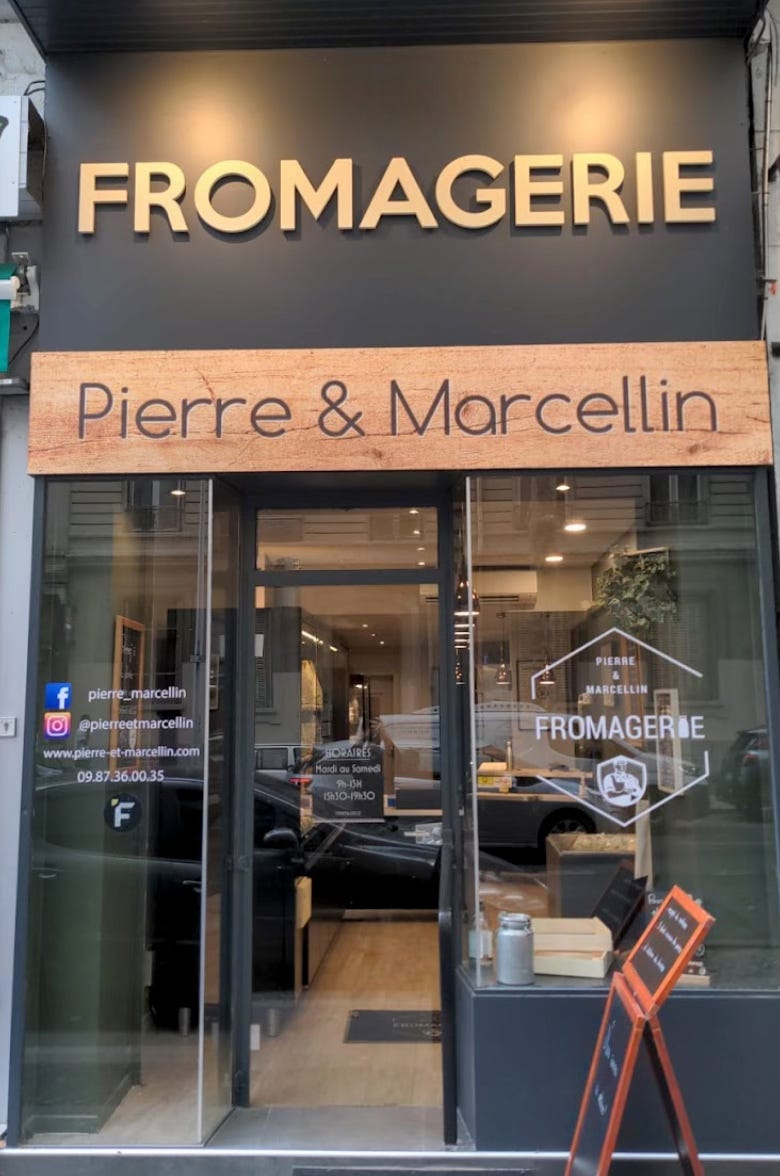
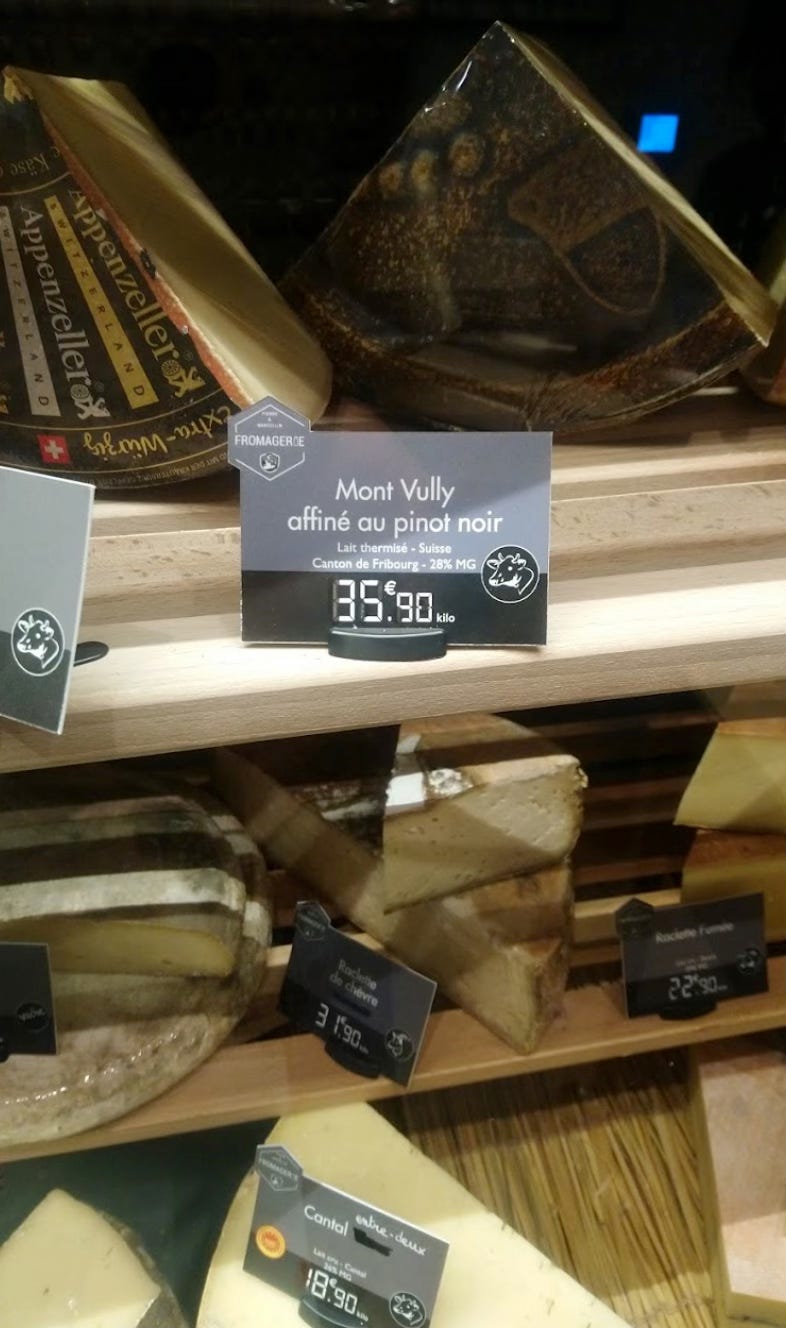
Anyway, now that is behind us, we can concentrate, as the French have always done, on good butter, yogurt, milk and cheese, together with the myriad other products that you will find in the dairy aisle here but are unknown in the US or UK: faisselles, fromage blanc, fromage frais, calin, petits Suisses. I immediately went out to our local cheese shop in Lyon, Pierre et Marcellin on Felix Faure to indulge my new-found healthy life choices, luckily it was free of bouzouki and other manifestations of the Terpsichorean muse. Some Mont Vully, Epoisse and St Timothé in hand, mission accomplished. It’s not difficult as Lyon is well served with specialist cheese shops plus most supermarkets and grocers have a reasonable selection, cut to choice, not just pre-packaged and trapped in plastic.

For my weekly saintly exploration the obvious choice was Tuesday with St George however that is a reasonably well known story, no spoilers, but he is neither English not originally had anything to do with dragon slaying. Thursday the 25th was St Marc’s day, but that is complicated as Mark the Evangelist, as he is known in the protestant lands, is firstly a major hitter, which hardly fits my desire to shine a light on some of the odd saints who are feted each day in our local bakers. Most people will have heard of him, he is the Chelsea of saints, popular with the wrong type, a bit gauche and like the mess that is the boys from Walham Green, he has some dirty laundry in his meteoric rise to the big leagues. No Russian oligarch or bumbling American hedge fund yokels, rather that is it commonly acknowledged that he didn’t actually write his eponymous gospel. Not only that, but it seems that the majority of his popular life story details are actually filched from another Mark, the interestingly dubbed “Cousin of Barabas” or John Mark. Maybe this is the origin story of the expression “to be wide of the mark”?

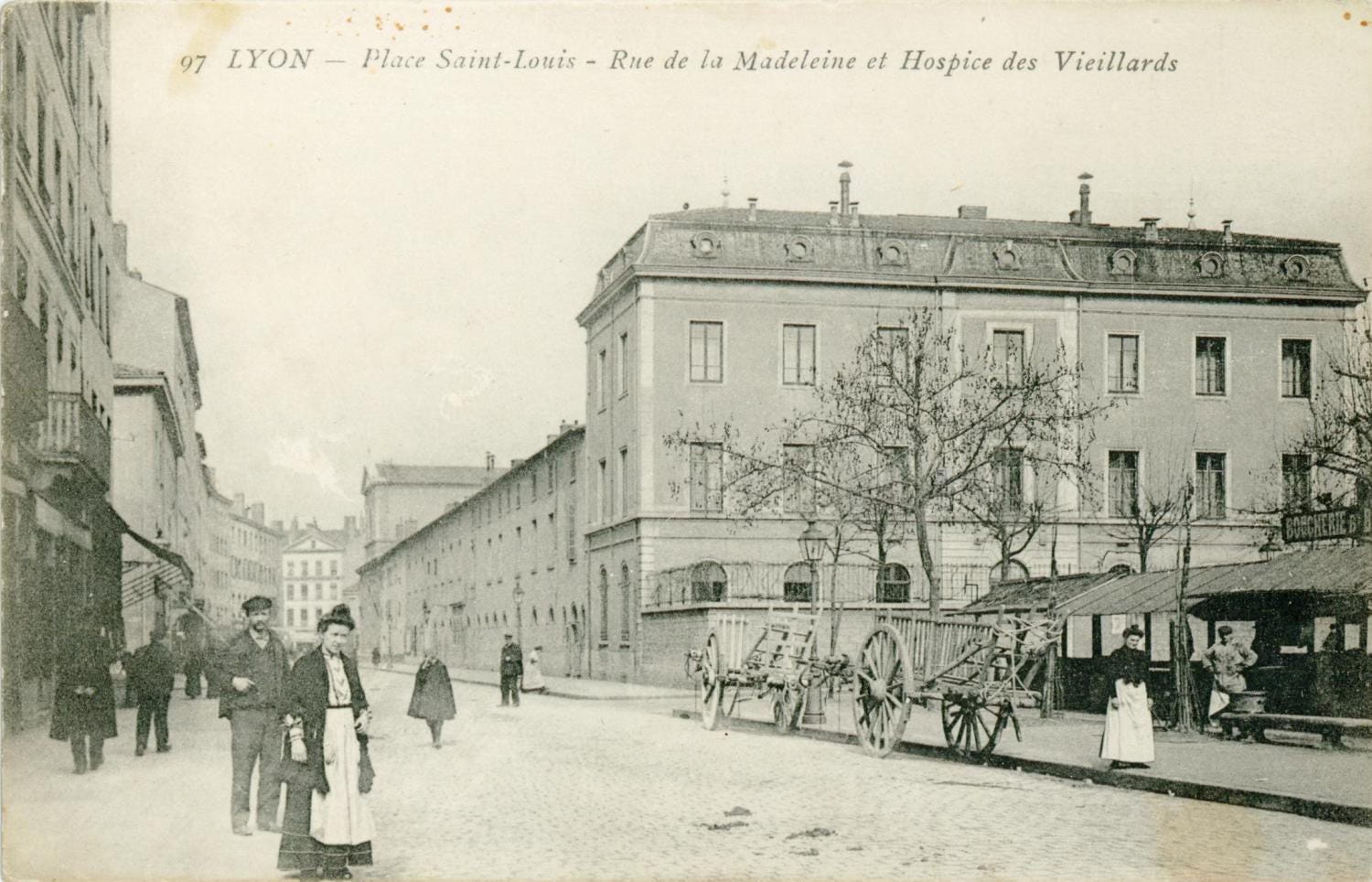
We braved the torrential rains that have engulfed most of Northern Europe to go to the farmer’s market at Place St Louis in the 7th arrondissement of Lyon. It is the typical market with a majority of stalls selling fruit and vegetables, some are actual farmers, some are more classic green-grocers who buy their produce at the wholesale market. Some are specialists, there is for example one guy who sells predominantly Italian citrus; Sicilian lemons, blood oranges (which are confusingly sold in France by their varietal name more often than not, so you will see Moro, Maltaise or Sanguinello) and occasionally in season bergamots. The fish stall is excellent and the two brothers who run it always have a smile, even in today’s monsoon, often they check with me what the English word for the variety of fish that I am buying. We had an odd exchange due to the confusion over Monkfish, which they misheard as Monkeyfish so I was desperately explaining that is what was not a poisson de singe, but indeed a poisson des moines. There is an awesome poultry butcher, they farm about 50 minutes outside of Lyon and draw the crowds by having a rotisserie with glistening, golden, fat-dripping chickens rotating and scenting the air. The other end of the stall is the greatest variety of poultry cuts, roasts, legs, thighs, sausages, patés imaginable, and of course eggs. The delight that is a paupiette, is one of their specialities. A small parcel of joy encased in a boned, flattened leg of chicken, guinea fowl or turkey; the middle will be chopped meat and flavoring – mushrooms, peppers, herbs and the French chile of choice, piment d’espelette. There is a cake and bread stall who also sell great pies and tarts, all baked in their wood burning oven so that their crust has that flaky crispness that is tough to get from a traditional electric or gas oven. There is a good cheese stall with an excellent separate section just to contain their selection of goat cheeses and a butcher’s van with more traditional sausages, offal and cold cuts. In summer there are seasonal vendors with honey, baked goods, re-caning of wicker furniture and that staple of French markets, the guys selling mattresses. Luckily, as it is mainly locals rather than tourists we miss the rip-offs like the Pyrenees cheese guys, proffering free tastes and selling their large wheels of Brebis at the very reasonable price of €45 a kilo, which you can get from the supermarket for half the price. If someone is giving food away there is usually a compensatory mechanism, beware men bearing sun dried tomato hummus samples!

Gones for good: Episode 11 Disquaires, drugs and discoveries

Lyon made an unscheduled and unflattering appearance on France 2 a few weeks ago. France 2’s news programming is the most watched, like BBC’s or NBC’s nightly news, it is more generally watched than other populist or entertainment-focused options. They have a serious approach to the news, slightly undercut by the female news anchors still tottering around in 5-inch heels; they may be occasionally allowed to be in jeans to show they are not overly buttoned up, but the jeans are ferociously tailored, and the heels are sharp. The men always and without exception appear in blue suits, white shirts and often with blue ties. The royal blue suit, a fashion item not seen in the anglophone world since the 80’s, regularly makes an appearance. Lyon’s appearance was on a 45-minute special ‘exposé’ featuring an undercover examination of the urban drug trafficking in one of Lyon’s suburbs, the Tonkin public housing complex in Villeurbanne. The hidden cameras were concealed among the efforts of a group of citizens who formed a collective effort called Tonkin-Paix-able, looking to ensure a peaceful Tonkin. The group rock up regularly in the middle of the major drug exchange with white t-shirts, rubber gloves and trash bags and ostensibly remove the detritus of the marketplace, ironically less used needles and more fast food packaging and beer cans thrown down by the dealers as they sit, hoodied and bored, on make-shift cardboard seats on the steps of the large public building opposite the tram stop. The collective tries to engage with the dealers to keep things as civilized as possible for the neighbourhood.

The story is common across France, not just the large banlieues that ring the major cities. Banlieue means suburb in a strictly etymological sense, but in France it is more synonymous with what Americans refer to as ‘the projects’. Public housing is a key part of the French social contract. The majority of French people rent rather than own houses and long term rental contracts, ample legal protections for tenants and local government rent controls mean it’s a simple long term choice for many working class people in the large towns and cities. Much of the rental housing is state owned, usually by the local council, some are private or charity but most is truly public housing. Through a natural process of selection recent immigrants get concentrated into the less well positioned cités, as in the movie images of ‘les banlieues’ in Marseilles or the Paris suburbs, isolated for many years without access to good public transport. In these areas, poverty and lack of opportunity follow declining standards in the schools and those who can do, move away, further concentrating the young poorly educated boys, not really men, into a process of boredom and finally relief through working for drug trading gangs. Selling ‘stups’ as in ‘stupifiants’, is a way and for many the only way for kids to make a living, other than riding scooters and bikes delivering food to the richer areas. The biggest trade is in weed or hash, with coke and crack some way behind. It’s a cash business and profits flow upwards, so at the sharp end the kids are not covered in gold chains, nor driving Mercedes SUVs in some wannabe rap video lifestyle. They all wear the same drab outfit, black Adidas jog pants, black Nike ‘baskets’, black zip hoodie, black baseball-cap and the one sign of affected affluence, a faux Gucci man-bag strapped across the chest.

France still gets shocked when the turf wars escalate into deadly violence, and even a single death will usually make the nightly news. Macron, in one of his studied efforts to deprive the far right of its rallying points, recently dropped into one of the major banlieues of Marseilles, La Castellane. On camera, he told residents that his newly announced campaign will “try to destroy the networks and the traffickers.” Macron said 82 people have already been detained, with 60 of them remanded in custody for further questioning. “Drug trafficking is a growing scourge” and “the situation is very difficult” in Marseille and other cities, he said, adding France was in the throes of a “battle” against the dealers. One of the ‘difficulties’ is that if the dealers are under 16, and most are, they cannot usually be arrested. The other glaring problem is the obvious demand for weed and an almost blind denial of the simplest thing to do would be to regulate the sale and take the clandestine market public. The wine lobby is dead set against legalizing weed as it watches Gen Z drink more IPA than vin de table. The French are happy to regulate the crap out of tobacco and vapes, but not marijuana. Go in a tabac today, and you are confronted by pack after pack of cigarettes with no visible branding and statutory stipulated 2.3rds of the packaging displaying pictures of cancers and post-mortem lungs. There was a story this week, continuing the theme of the “national effort” to save the tabacs. With some 23,300 shops across France, 41 percent of which are located in towns with fewer than 3,500 inhabitants, tabacs are an important part of French life, even for non-smokers. We regularly get parcels delivered to our local tabac as it’s often the free or cheaper option. This week’s new effort was paying the expanding no-touch automatic freeway toll charging. Last Fall, it was them selling ammunition for hunters. Why not allow them to sell weed? Solve all the small town angst and big city crime in one joint.

Saturday was the saint’s day of independent record stores, Disquaire Day or Record Store Day. Fuelled by special one off releases or collector’s items in the making, April 20th is a celebration of small and large record shops and Lyon is blessed with lots of them, most within walking distance spread around the narrow streets at the foot of les Pentes de Croix Rousse, a short walk from the Hotel De Ville. We made our way through the weekly pro-Palestine rally and the now regularly red stained fountains symbolizing the daily death in Gaza to my favorite, Sofa Records. They have an insane collection of West African and Hi-Life music and always something intriguing playing. They have good rock and pop stocks as well, and the shelves are well organized and easy to browse. Maybe it is completely unlikely that I would find a real gem of a discovery as those are now only found in charity shops, but it’s still a pleasurable way to while away some time. There was an interesting article in last Friday’s Grauniad about record collecting, ahead of RSD. In the UK even the charity shops have worked out that a quick look on Discogs will turn a €4 bargain into a €25 special display.

I didn’t need a Rumours picture disk or a “réédition splatter” of Sabbath’s ‘Paranoid’, so my shopping was less focused on the ‘special RSD releases’. I found the following treats: 

“Lets Make Up and Be Friends” – The Bonzo Dog Band’s last album before Stanshall’s death (but featuring the first appearance of Sir Henry Rawlinson).

“TANGK” – Idles – independent record store version, new album from the best men in dresses.

“Desolation Boulevard” – The Sweet. The vainglorious effort by the Ballroom Blitzers to shake off their Glam-Pop reputation with a hard rock record.

“Flock” – Jane Weaver – a bargain pink vinyl version of her 2021 album which features vibes and who can resist a good vibraphone sound.

“Actual Life” – fred again – The first of the ‘Life’ trilogy, silver vinyl.

“Pretty Hate Machine” – Nine Inch Nails. A gift for Rachel, who is currently inspired by Reznor and tough to find on vinyl.

“Live Montreal 1971” – Frank Zappa. A semi-official bootleg from a radio broadcast. Its the ‘vaudeville’ band with Flo and Eddie on vocals, so all Fillmore 71 favorites plus one of the songs from the eponymous Phlorescent Leach and Eddie album from 72, which I have never seen on any official release.

If you would like to sample these treats, listen here.

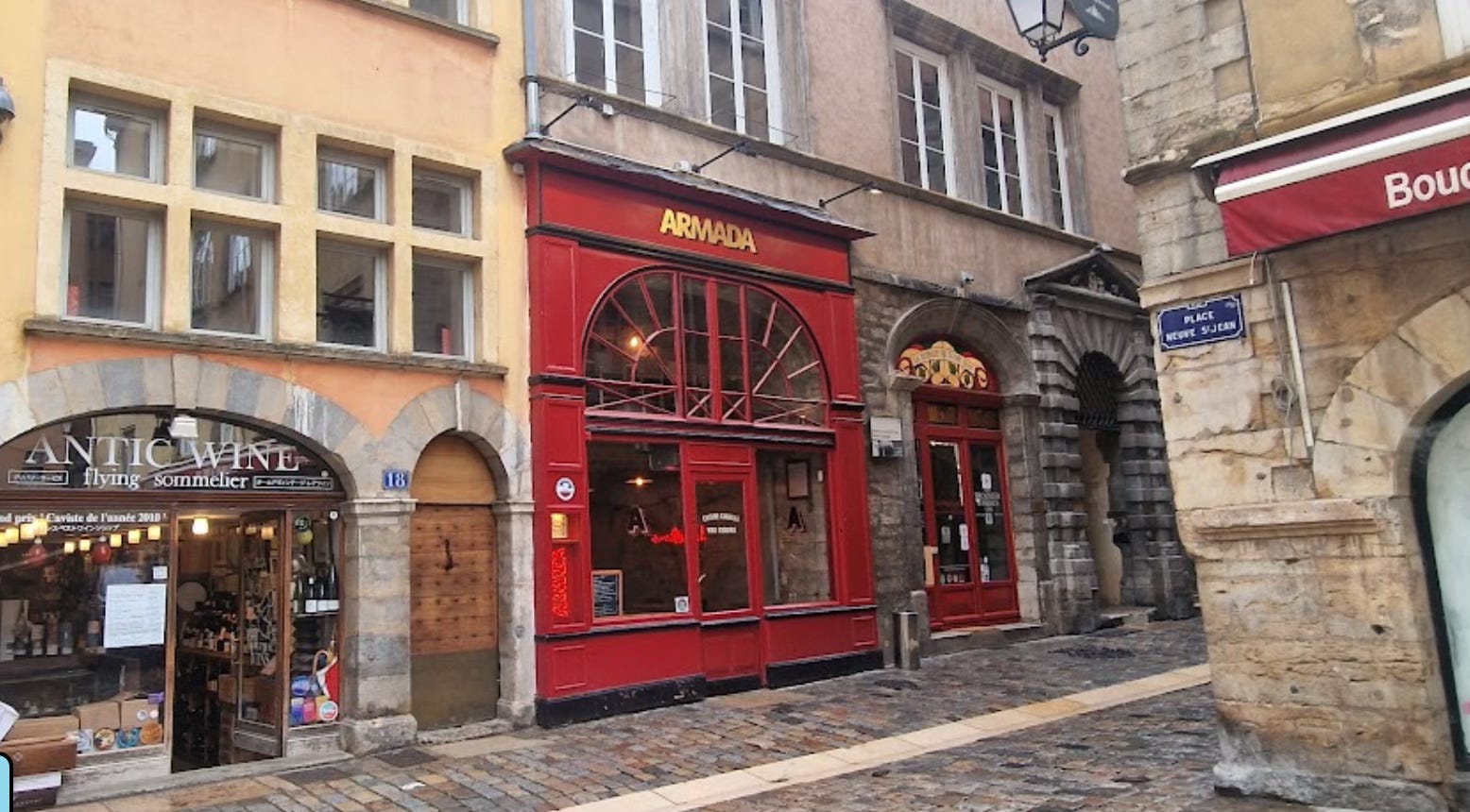
After a week in the mountains living on cheese and ham, it was good to get back to proper nosh. Friday night we went back to Armada on Rue de Boeuf in the old town. The first time we went there was by coincidence when they publicly made Le Fooding Guide, so it was interesting to see how they had adapted to their new fame in the intervening couple of months. They are still super friendly and faithful to the original vision of fun food. A modest space, sharing plates but not twee, tiny portions that you end up ordering 3–4 dishes a head. All very very good, the veggie driven starters were spring encapsulated, which was welcome after the winter of Tuesday and Wednesday in the shadow of Mont Blanc. Next door is Antic Wine, so they occasionally have specials from the neighboring cellar, and we had an amazing 2013 Montlouis followed by a 2011 St Amour. Some Loire whites are known to age and Chenin is a good grape to do that but a 13-year-old Cru Beaujolais is not common outside of Morgon, so we were blown away how good this was. The best dish of the evening was a lamb spring festival on a server, lamb from the Ardeche 3 ways, the fatty belly end grilled, the main rump chop served ruddy and the sweet breads done quickly on the griddle. All served over peas, pea pods and asparagus. The chef proudly delivered the two deserts and happy to chat about what made them special to him and ultimately to us. Among a ton of tourist traps, the modern Francis Drake would be happy to stumble into this Armada.

If you would prefer to receive this via Substack stroll over here: https://open.substack.com/pub/anecdotesandantidotes/p/gones-for-good-465?r=tnn6j&utm_campaign=post&utm_medium=web

Gones for good: Episode 10 – Fishheads and tales

Salmon is great to eat, but less impressive as a color for pants. You can farm salmon in large lakes, lochs and open sea-pens, so from the perspective of sustainability you would think it would get a hefty thumbs up. Especially as we are supposed to eat oily fish, reduce meat consumption and support a sustainable protein source with no methane emissions. In the US, partly thanks to the ubiquity of farmed salmon in sushi, the annual consumption per head is over 3 pounds of salmon. That sounds a tiny amount from a European perspective, but you have to remember vast swathes of the US eat zero fish, ever. European per capita consumption of just farmed fish production was 6.7 kilos in 2021, the last year data was available. Farmed salmon divides opinion sharply, in fact in some quarters it is demonized. When I lived in California I could choose to only eat wild salmon and its depth of flavor and color is like night and day, but in France we get one choice of Salmon, farmed. There are by contrast a plethora of options of other fish even in supermarkets and my fish guy on the market (a long-suffering PSG fan), has 2-3 whole different types of fish, 6-8 filleted fish plus shellfish of various hue, seafood preparations like quenelles, fish moussaka and preserved fish like herrings, smoked salmon and kippers. But salmon he does not sell, as he cannot compete with supermarkets and their farmed Norwegian salmon. The concern with the farmed salmon, particularly that emanating from Norway, Scotland and Chile, is that it’s raised in poor conditions of health and hygiene for the fish. The fish meal used to feed them together with insufficient water filtration means that the farms cause real destruction around them and have effectively killed off the wild varieties of salmon that gave the original reputation to those fish origins. There are efforts to identify those sources that do play by the rules, but it’s not always that easy on markets or where wet fish is sold to identify whether you are buying good or evil salmon. Being marked as Organic is also a false friend, as that can refer to the food on which they are raised rather than the overall farming regime.

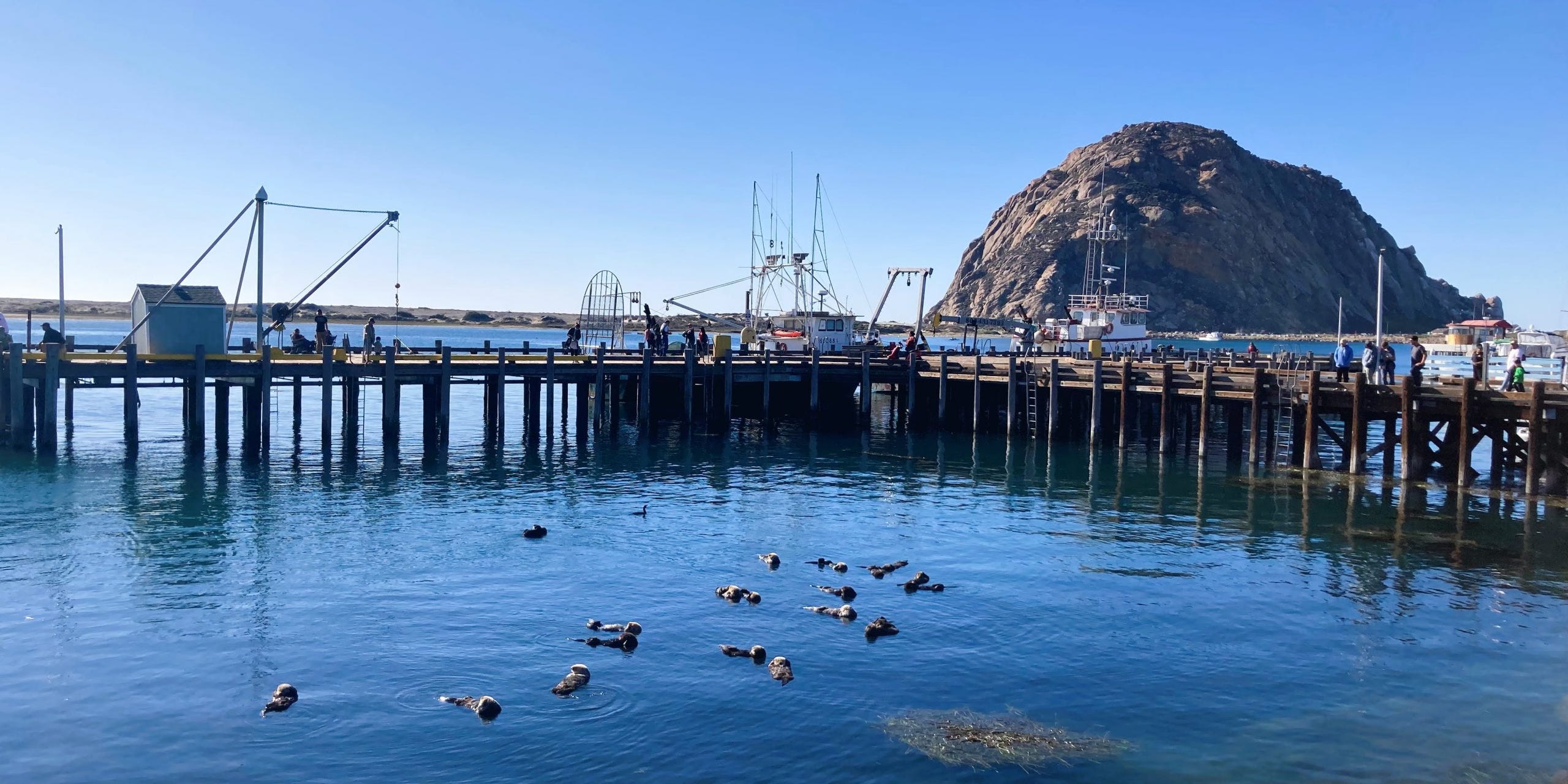
I once went wild salmon fishing off Morro Bay on the Central Coast of California. A friend won a prize at a private school fund-raiser that his kid went to. Another parent was a salmon fisherman, so he, and a plus one, got to go out on his commercial fishing boat. I was roped into being the plus one and at 6.00 am one Saturday morning was picked up to go and fish. My friend forced down me some disgusting anti-seasickness med with coffee, despite my protestations that as a semi-experienced sailor, it didn’t bother me. Off we sailed on a small fishing boat on a pretty flat, sunny morning sea while the Dramamine fucked with me. I felt like death for the first 45 minutes as we headed out to sea, finally the mate cooked us a fried breakfast – part of the prize thank god – and finally the nausea disappeared. We were using sonar to find the shoal of King Salmon the captain was in search of. This was definitely not Ahab and the beast, this was technology provided mastery of our domain. The visual clues were dolphins and seabirds, the dolphins smash into the shoal, which for safety swim in giant spherical shapes. The dolphin impact stuns and breaks off the salmon swimming on the perimeter of the ball, and they float up, stunned, to be gobbled up by the dolphins or the diving seabirds. The ball shape shows up clearly on the sonar, and we let out the fishing lines. Again, no romance here, just large hooks with shiny reflective aluminum lures on lines 800 yards long get trailed off the back of the boat as we slowly drift over the battered ball below us. We haul the lines back in and every 6-8 feet there is a large king salmon flailing on a hook, some of these are immense, the size of small sheep, 30-40 pounds in weight. Friend and I help with the hauling-in of the lines but the Mate and the skipper do the execution work, the gift to the school ensures we don’t have to bludgeon our way to our prize. An hour or so later we putt-putted back into Morro Bay, the catch nicely snuggled in the chiller hold covered in ice. We were each given one cleaned King Salmon as our bounty-come souvenir of our morning’s adventure on the high sea.

I am, as the regular reader will have spotted, quite fascinated by the daily saint’s days that the baker’s shop writes on the chalk board each day. So last Tuesday the 9th of April was in honor of St Gaultier. He should be the patron saint of reluctant labors, like my salmon fishing, and is in fact I was delighted to discover invoked in case of work related stress. He is also patron saint of Vintners, which is a good cause. St Gaultier was a professor of philosophy and rhetoric which was so exciting he became a Benedictine monk near Meaux, of mustard fame. He was appointed by the king, Philip 1st, abbot of a new foundation at Pontoise. The discipline at this new Abbey was lax, and he ran away several times to avoid the responsibility of making it less lax. He gave up completely and went to Cluny, which is actually not far from us at Charolles and was at the time the biggest and richest abbey in Eastern France. They sent him back to Pontoise. He tried to escape to Tourraine and hid himself on an island in the Loire, before yet again being led back to the abbey. He also escaped to an oratory near Tours before being recognized by a fellow pilgrim, who grassed him up. 

After being forced to return yet again to Pontoise, this time he decided to go to Rome to appeal directly to Pope Gregory and gave him his written resignation. Gregory instead ordered him to resume his responsibilities as abbot and never leave again. Accepting his fate, he campaigned against the abuses and corruptions of his fellow Benedictines, and was beaten and imprisoned for his troubles, which may have been why he was not so keen on the job in the first place. He resumed his work after being released and died in 1099.

St Gaultier or St Walter as he is known in English, was buried in the abbey at Pontoise, the place he had strived so hard to avoid. He was canonized by Hugh, Archbishop of Rouen in 1153, and was the last saint in Western Europe to have been canonized by an authority other than the pope. He did finally escape Pontoise, as they managed to lose his body during the Revolution.

I have escaped the city life of Lyon this week by taking a late break to ski with Dan in the Val D’Iseres, staying with a friend in Tignes 1800. It’s typical spring skiing so today we had sun, sleet, snow and rain. It is by coincidence the last week of the Easter school break for Paris so the resorts, although not full as it is late, are awash in Parisians. Some are gloriously old school in terms of spring skiing means one thing and one thing only, working on your tan. There are great examples of people at each bar and restaurant with pine yellow tans, working hard to get them to the full dark oak tan that some of the older French ski-instructors sport. It was a sunny day yesterday and there were folks laying out in deck chairs at 10.30 in the morning at 2500 meters above sea level. If I hadn’t watched him play badly against Villa later that day, I would not have been surprised to spot Ben White of Arsenal fame laying out there too. He is a young man who seems to have taken upon himself the curation of a serious tan all winter and with his odd goatee, looks more and more like a pantomime Captain Hook, grease paint and all. 

We are this week in the former land of Savoy, Italy is just over the mountain to our East, and so much cheese, ham and pasta is consumed. They have basically exhausted any way of cooking cheese, ham and potatoes and all combinations are sold for lunch and dinner. Tartiflette, raclette, baked whole Mont D’or and Rebluchon. Pasta with cheese, pasta with ham and cheese, pasta with cheese, ham and potatoes dominate the menus. The good news is that the local wines from Savoie are good accompaniments and great value, we had a Chignin Bergeron last night which was a bright pretty white without being floral. If you are spring skiing, you oscillate between being cold, wind swept and needing staunch hearty food and being hot and sun burned and wanting salads and bottles of rosé at lunch. Happily, the quality of food at French ski resorts puts to shame the rarefied efforts, at what is basically fast food, that masquerades as $45 lunches at any US ski resort. We are surrounded by valleys that in summer provide pasture for cows that deliver the milk for the Beaufort, the Abondance, the Raclette and the various Tomme de Savoies that enrich the local dishes. The other local drink owes much to St Gaultier’s fellow Benedictines, Chartreuse. In both Green and Yellow forms, the bottles are behind every bar, in every restaurant, in every shop. Here in the Alps they also have local Jenepé liqueurs which compete taste wise with Chartreuse and both the original and the local versions turn up in ice-cream and deserts. Lyon celebrates its affinity to Chartreuse like San Francisco does to Fernet, but for some reason our local wine shop on Felix Faure cannot seem to secure regular supplies. I am going to have a Chartreuse with a coffee one morning this week, just because it seems to be the done thing, and maybe I bring a bottle home.

Gones for Good: Episode 9 – Cheese coursing

April the first passed with several striving consumer brands demonstrating their hip edginess by self-knowingly winking at the April Fool’s tradition with hot dog flavor soda drinks, stoner-speak decoding apps and Korean BBQ scented deodorant sticks. It does not really translate in France, as their tradition for April 1st is a unique and esoteric take on pranking someone by attaching to their back a paper cut-out of a fish. So the worst that can happen to you is that you are the Poisson d’Avril for a period of time until you work out why everyone is sniggering and yes, it’s you, you have a paper fish stuck to you! 

The origin of this odd little tradition is that until the 16th century the new year was celebrated at different times, in different regions of France; the first day of spring in some places, Easter in other, 1st of April in others. Charles the IX decided to standardize the calendar, and the new year officially started in 1564 on January 1st. The word didn’t get distributed that well in pre-industrial days, but when the King’s Messengers finally spread the word, there were still some folks celebrating the turn of the year in April and giving the traditional gifts of fish – partially tied to the ending of Lent. The sophisticated and well-informed took the piss out of the rural rubes by giving them pretend fish gifts. So if you end up the butt of the office joke and everyone is sniggering behind your back as you discover a paper fish sellotaped to your designer hoodie, then blame King Charles.

What the French do take seriously is the overall quality of life, more as something to debate about rather than boast about. As much as arriviste foreigners we look at France and revel in its positive contrast with the tattered putrefying carcass of our homeland that once was England, or the political dumpster fire of a gerontocracy in thrall of big business that the US has sunk to, the French always find something to complain about. This week, the French woman’s magazine ‘Femme Actuelle’ published its list of top 50 places to live in France as a woman. They used data from the Ministries of the Interior and Health but also from numerous agencies known intimately to the French but who remain to me just one of many confusing collections of initials, including INSEE and CAF. They evaluated the quality of life for women through the comparisons of factors such as health, access to housing, public transport, security, juvenile delinquency and even pollution. For each, they gathered the most relevant indicators, but Femme Actuelle admitted that this was not always easy. The data had to be available, reliable and comparable for all the competing cities. As an example, they could find no reliable publicly available measures of the share of green spaces or pedestrian zones available in a municipality, although, under certain conditions, women favor them. They finally selected twenty-one indicators, to which a weighting coefficient was applied, according to the importance the magazine attached to them, focused around 4 key axis to derive the final ranking: the provision of specific care, security, the living environment and the action of the municipal authorities. Lyon was happy to receive the fourth place in the ranking behind Strasbourg, Rennes and Bordeaux. Paris was 7th and in last place Perpignan, just behind monied Antibes in 49th. Lyon takes the green space and pedestrianization super seriously, so might probably have scored higher if that was one of the measurable common factors.

The French also take cheese seriously. As part of Charolles’ inaugural Gourmet Festival, “Les Rendez-vous Gourmands” there was an event hosted by our local L’atelier des fromages, the cheese workshop, which being out of Lyon for the week we took advantage of. This was in contrast to Maître Doucet, who hosted 3 four-handed dinners at his Michelin starred Maison Doucet, each one featuring a guest pair of hands from another 1 or 2-star chef. Those little beanfeasts were €250 a head, each one; so I would be intrigued to find out how many locals ponied up for more than one of these. Doucet is a relentless self-promoter, appearing on the French equivalent of Good Morning America, cooking Charolais beef during the recent Agricultural Foire in Paris. That was the one that Macron spent an unprecedented 14 hours at, to prove his ‘man of the people’ standing. I am sure Doucet has a well-heeled fan base who made the journey up from Lyon or down from Paris for the rendez-vous. He was there as the event was kicked off on the Wednesday morning, which coincided with the weekly market, so the town was bustling, even in the incessant rain. They had drinks and folk music and the local folk culture society, Les Gâs du Tsarollais turned out in their peasant costumes of yore, which for some reason seem to include fur coats.

He is a good chap, our cheese guy, literally as his name is Bonhomme. He provided an “Atelier Brasero Autour Du Fromage” of 5 courses with drinks included for €30 a head. The rain and wind fortuitously decided to bugger off that Thursday morning, and so we had a warm spring evening around the Brasero, tucked away in the alley between the cheese shop and Place Baudinot. The Brasero for the unitiated, (myself included before the evening) is a large circular wood-fired grill with cast iron cooking surfaces above and surrounding the vented fire box.

We were welcomed to start the evening with a selection of cheese appetizers with a local Blonde beer. Each of the cheeses was given a formal introduction by Pierre Bonhomme, all examples were Fromage Fermier, which is a subtle but critical distinction. This means it is made on a farm and not in a large dairy, it brings a link directly from the animals raised to provide the milk, the land they graze on and the hands that work the cheese. We had a winter’s milk Beaufort, a fruity Comté (16 month old), a local Charolles AOP goat cheese and a mild sheep’s milk blue cheese.

The Brasero kicked into action and we had local beef grilled then bathed in an oil-based dressing of garlic, wild thyme and local honey. It was served with a slice of another Charolles goat-cheese and drizzled with honey and served with a White organic St Veran, which is the closest quality white wine to us. Pierre explained that Charolles as a AOP, appelation d’origine protégée, has one of the highest proportion of fermier producers, with each hustling to make the little towers of cheese, supposedly inspired by the Tour De Charles le Temeraire; it takes 3 liters of milk to make 1 Kg of cheese.

This was followed by a take on the traditional raclette, with a chilli infused raclette cheese, heated to bubbling hot served on bread with generous options of charcuterie to accompany it. This was served with a Fleurie.

For the traditional cheese course, we then had two contrasting but stand-out strong cheeses. There was a lively discussion about which are the ‘strongest’ tasting cheeses and Montgomery Cheddar, which he sells, got an honorable mention alongside Maroilles and Munster. He served Epoisses, which was made originally by a religious order but has been made in Burgundy for over 500 years, its orange rind a result of the regular brushing with Marc de Bourgogne, an eau de vie. There remains only one fermier producer still producing it today. This was accompanied by another strongly flavored rich cow’s milk cheese, Chaource, from 2 hours north-east of us on the way to Champagne. This was another farmer produced and refined cheese, Fermier AOP. We washed this glorious pairing down with Hautes Cotes De Beaune and had a serving of whole grain Dijon mustard on the side. 

On the subject of strong cheese, we then had a tasting of Pierre’s ‘Fromage Fort’. This is a typical poor man’s food that takes leftovers and recreates something new. Generally it’s the odd pieces and leftovers of cheese that remain, shredded finely and mixed with cream or yoghurt, some alcohol (white wine or marc) and some also mix in leek or other vegetable stock. The beaten, smoothed version of a cream cheese is then eaten on toast. It’s an acquired taste and depends ultimately on the recipe as it is very sharp, pungent and acidic. Pierre makes one with only goats milk cheese or only cows milk cheese, never with sheep and never with blue cheese. If you like those acidic Danish blue cheeses, you will like Fromage Fort. I think you could also use it to revive olden wooden furniture or polish tarnished jewelry, not a great fan; although Dan, who was with me, loved it.

We finished the cheese exploration with Salers on whisky-flamed toast and the same Irish single malt whisky on the side. By this time most of the social awkwardness in throwing 16 people together had melted around the now-cooling brasero, so we had a rambling discussion on salted butter, whisky and whiskey, Brexit and walked away full, satisfied and happy into the dark evening streets, no fish stuck on our backs.

Gones for good: Episode 7 – Bread Heads

There was a recent article in the storied business journal, the Harvard Business Review, on the tactical genius of the French Boulanger. Through a study of the bakers in Lyon, the three learned professors “analyzed the location strategies of 177 bakeries within the city of Lyon, from the beginning of 1998 to the end of 2017”. They were surprised that Traditionalist bakeries (in the food capital of France) had survived. Bread making in France is a relatively simple business and is regulated in part. The ‘baguette traditionnelle’ specifically by law, can contain only flour, water, salt, and yeast. By their name, the Traditionalists don’t use a variety of “time- and cost-saving practices (such as the use of mixes and frozen dough), which are more or less invisible to consumers”. My emphasis in bold. What does not appear once in the research paper is the word or even the concept of taste. I could be snarky and make the case that as 2 of the three researchers are Dutch and the third Swiss that we should not be surprised. But really? The authors of the article were shocked, that despite these disadvantages, the Traditionalists have maintained a strong majority share of the French bread market despite modernist competitors using the cheaper efficient production tricks. They came to the mystifying conclusion that there was a logic defying trick by the Traditionalists, who instead of shunning being next to or nearby a modernist bakery, actually more often than not, set up right under their modernist competitors noses. So you make something you love making, in a time honored traditional way using natural ingredients and as sure as shit, tastes better than the bland cheaper option, and you are in business in a country that loves bread, in a city that worships at the altar of nourriture every day. Unsurprisingly, you are successful. In other news, wine is wet.

Other bread loving nations include the English and the Irish. Ireland has one of the highest natural incidences of celiac disease, yet you will not find a lot of gluten-free options. It seems the Irish have made a conscious decision that if they are to suffer, it will not be for a lack of bread. Nor for a lack of Guinness, although I was surprised to see the UK drinks more of the foamy browny-black stuff than its country of origin, closely behind Ireland is Nigeria. In a hot, sticky, equatorial humid climate the last thing I would be craving is Guinness, but that’s why I am not running a global drinks business like Diageo. Where you will not find cans of Guinness for sale publicly is the Kingdom of Saudi Arabia. The Kingdom is dry and has been since 1952 when King Abdulaziz banned it after one of his sons got drunk at a diplomatic function and killed the British Consul with his sword.

This Thursday, continuing our own swordless tradition, we celebrated the saint’s day of Sainte Clemence. Yet another German widow of nobility who when her hubbie, Menginard I, Count of Sponhiem (a minor kingdom yet again in the Holy Roman Empire) went toes up, goes into a convent, does some good work and then mysteriously ends up beatified. If you are born on this day, the French refer to you as a Clementine, which could be confusing if you became so ridiculously successful in business to the point you are dubbed a mandarin.

Good weather, good times

Wednesday through this weekend was the “Le Temps Est Bon” (Good Weather) food festival which, although it’s the third week of March, was prophetic in its timing. It was 22 yesterday, and everyone is behaving like it’s spring. We went to one of the events, a dinner with the Mich 1 starred chef Vivien Durand from Lormont, near Bordeaux was invited to take over the kitchen by Florian Remont of the Bistrot du Potager, which is in the 7th, the Gerland area. Remont’s place is known for his South Western Pays-Basque style cuisine, so it was obviously a meeting of the minds. In a small world coincidence, we drove so many times across the Pont d’Aquitaine to and from Bordeaux airport to the cottage in Duras. On the headland to the south of the bridge’s entrance was a ruined château that in its day, i.e. before they built a 6 lane suspension bridge at the bottom of the garden, it must have had great views over the Garronne estuary. For all those years it was a graffitied husk of its former greatness, but in the latter few years of our journeys it was being refurbished, and it just so happens that Durand’s Black Prince restaurant is situated in the château’s former stable block.

The menu was a 5 course tour de force. Brussels, young and fried whole like a flower with a syrupy dressing of shitaki mushrooms kicked it off. Followed by sea-bass carpaccio, then a glorious sous-vide prepared monkfish dish. I think sous-vide is generally preposterous, but this was ‘melt in the mouth’ so I get it was worth the faff.

You are kidding me

The main event was kid goat from the Basque Country, spit roasted and served in an unctuous sauce with girolles and perfect roast potato. It was then followed with a selection of spring veggies – roast baby leeks and roast white asparagus on a bed of fried kale and spinach with pea-shoots garnish. It would have pleased Popeye and my Olive Oyl thought it the best dish of the night. Dessert was a bit of a mess with some crispy chocolatey sticks that were nearly inedible, on top of hazelnut cream and a bread flavored sorbet that just didn’t work together. Otherwise, pretty great food in quite a cool space.

The other oddity of the night was the total fail on the music. As well as the French do food, they do music as badly sometimes. We dined with a soundtrack of electronic disco at a volume that was just annoying enough that you noticed it, yet too low so all you really heard was the tinny repetitive beat. The music that if played loud while the young bucks were doing prep in the open kitchen would have been fine, but not dining music, never, ever. In the loos downstairs they seemed to have replaced the ceiling speakers with former earpiece speakers from old telephones so the tinny beat was something otherworldly, laughable even. It’s a shame as the French can do dance music – Justice, Daft Punk, Cassius, Laurent Garnier but this was just crap. This is what good French dance music sounds like.

Gones for good – Episode 6 blossoms amongst the beef

Green, yellow and pink. The colors of the Charolais countryside are ‘other side of the rainbow’ technicolor contrasts after the cement and tarmac gray of Lyon in March. The green is so lush and bright that it has a hyperreal quality as the sun courses across crisp, clean blue skies and appears to welcome us back to the country. We welcomed visitors from Brooklyn who had spent some fun but rainy days in Paris, before the TGV delivered them into the underappreciated former industrial belly of Burgundy at Le Creusot. We had plans for an indulgent culinary tour of our part of France, a bit of a blow out, a ‘bonne bouffe’. 

Les vaches Charolaises

As we headed south into the Charolais the weather smiled on us, and we were greeted on either side by the white cows of the local breed, nuzzling their way through the pasture in their small hedge rowed fields. As you get further south into the more hilly and higher elevations of the Brionnais, its sister breeding ground of the Charolais beef cattle, the fields are edged by dry stone walls that are familiar to anyone from rural England. The fields are small to allow simple rotation, avoiding over grazing, the walls provide shelter from the wind in winter. They are too small and uneven to be used for arable crops at scale, so we are spared the pesticide induced monocultures of the north of France. We benefit instead from lots of butterflies, bugs and crawling things and all the birds and small animals that feed on them, and the larger birds of prey and larger animals that feed on them in turn. The forested parts are full of large wild boar and to a lesser extent deer, which keep the local hunters busy every winter weekend and provide a steady supply of ‘saucisson de sanglier’, dried wild boar sausage, to the local shops. They -reintroduced wolves to the Morvan, a forested mountainous plateau 45 kilometers to the north of us, Romanian wild wolves. Much to the annoyance of the local sheep farmers, the wolves will do their wolf-thing regardless of man-designated borders and fancy lamb in their diet from time to time. The protests of the farmers are smoothed away with cash payments for lost livestock at market pricing, quietly and quickly, like a wolf in the night the problem comes, and the problem goes away.

Our grand bouffe took place on March 14th which was the feast day of St Mathilda. Unlike many of the saints who followed a path of denial and simple life, our Mathilda was a Saxon Queen and was used to feasts and wine. She was the first of what are referred to as the Ottonian Queens, she gave birth to the first King Otto, who then had more descendants all named Otto. Her lad Otto is ‘important’ as he restored the Holy Roman Empire. Charolles ended up being an island of the Holy Roman Empire, part of the Dukes of Burgundy’s lands and the seat of Charles Le Temeraire. Charles’ father Philip the Good was the most powerful of the Dukes of Burgundy and responsible for the creation of the united low countries of what is today Holland and Belgium. His troops captured Joan of Arc at Compiegne, and he handed her over to the English, who with the help of Burgundian judges burnt her for heresy. Phil was a bit of a player, he married three times and had three legitimate sons, all from his third marriage; only one, Charles the Bold, reached adulthood. Philip had 24 documented mistresses and fathered at least 18 illegitimate children, who are bluntly called things like “Anthony, bastard of Burgundy, Count of la Roche” or “Philip, bastard of Burgundy, Bishop of Utrecht”. Anyway, Mathilda was a good wife herself and gave birth to two other boys and 2 girls, as well as Otto. When her hubbie, Henry of Saxony, shuffled off from his mortal coil, she used her not insignificant wealth to set up convents. Not a great number, just 3 and they tended to be finishing schools for the daughters of powerful families, so once again hardly a path to beatitude through pain and suffering. It seems it was easier to become sainted in 968, when Mathilda died, than later, or they tightened up the rules to make it a more exclusive club.

The daffodils are out, as is the forsythia, bright shards of yellow catching the eye as you walk the lanes. We have a grand old magnolia tree in the garden, and it was just breaking into its pinkness when our visitors were here, but today it’s barbie-ing out. In two days it completely opened up, partly as those two days were warm and bright in a way that they should not be, in mid-March. 

As it mentally to me was still winter, we planned the local delicacy, Boeuf Bourguinon. It’s an easy dish to cook in advance, so I would not be faffing around while we were all chatting and enjoying drinks. In such a beef area you simply ask the butcher for ‘Bourguignon’, he then asks how many people and whether you want it ‘gelatinous’ or not? That would not translate well into English, as we have terrible memories of gristly meat, especially from school dinners. I asked for ‘half-and-half’, M. Jardin, the butcher, then cut the chunks off the piece of beef in the right size. If the beef is well browned, and you cook it in the wine for a long slow time, the gelatin dissolves completely to help make the liquor with the onions and mushrooms gloriously unctuous. I had the luxury of cooking it slowly most of the day, then letting it sit for a couple of hours before rewarming to serve. It was to be served with a simple Baker’s Potatoes, ‘Pomme de Terre Boulangère’, another easy comfort food dish that cooks quietly while you do more fun things, like snacking on foie gras on brioche and a glass of 2012 Monbazillac. I did manage to get distracted enough making the starter that I burned the first few slices of brioche in the toaster, even at a setting of 1 it has so much butter in it that it needs a constant eye and attention, not one of my strong suits, especially if talking. I was all for scraping off the burnt bits with a knife, but that was universally rejected as too English, 1960’s post-rationing thinking. 

Eating salad as a starter rather than an accompaniment or later palate cleanser is a very American habit, but in my defense the local Mich 1* place is now serving ‘Salade Hivernale’ as an Entré, so if it’s good enough for Maitre Frederic Doucet, it’s good enough for me. The pears and walnuts are at the end of their season, but they nuzzled companionably with the mid-winter mâche (or Lamb’s Lettuce, as it’s known in England, although I have never seen it in the US on either coast), pea shoots and a local hard goat cheese, Pyramide d’Argolay. I am a massive fan of Alsace Gewurtztraminer wines, when they are dry and balanced they are the perfect accompaniment to this green mix of flavors and textures, the hint of sweetness within the dry backbone of the wine stands up to the Banyuls vinegar in the dressing. We had a cheering 2019 Wolfberger Gewürztraminer Hatschbourg. It’s not particularly expensive or a ‘grand vin’, Wolfberger is the local cooperative wine making organization for the picture-postcard village of Eguisheim in the Alsace, just outside Colmar. We visited in 2022 and picked up half a case of this Gewurtz and a full case of covid while we were there. 

We washed the beef down with Givry Premier Cru. That is the closest, most serious Burgundy to us. I bought this from the winery of J.P. Berthenet, a friendly family winery tucked away on the hillside of the village of Montagny. You could drink his Montagny as an easy-going weekend burgundy, but his Givry is great and has a bit more elegance. This was a 2018, it had a bit of bottle age but was still relatively fruit forward, perfect for the richness of the Bourguinon. We also had a 2020 Clos de la Servoisine, Givry 1e Cru from Deliance Freres, less mature and tighter, but it helped keep the conversation flowing through to the cheese course. We had some local Charolais ‘mi-fraiche’ goat cheese, a local Palet de Vache, a serious Maroilles from Lille that had the fridge stinking for a week and a big hit with the crowd, Shropshire Blue.

The meal ended with a pear tart from the local bakery Boulangerie L’Éclair-cie. Like many of the bakers in town, his bread is very good if uninspiring in its selection, but that is down to local tastes. Where he does stand out is his pie crust, that crunchy butter texture comes from a really hot oven and great technique. We had a smashing time, as you can probably guess.

As can be expected, we had a slow, lazy start to the next day and blew out the cobwebs with a walk along the former disused rail line to the local Fours à Chaux, what look like a castle for gnomes but are actually lime kilns. The little white calves of the Charolais which we hoped to find foraging in the fields either side were absent, probably rotated off somewhere else, so the promised close up photo ops were not delivered, but perhaps after indulging in beef the previous evening that was a welcome mental degree of dissociation.

Four à Chaux - Lime Kilns